Georgia S5L3.c
The Standard
- S5L3
- Obtain, evaluate, and communicate information to compare and contrast the parts of plant and animal cells.
Construct an explanation that differentiates between the structure of plant and animal cells.
Georgia Standards of Excellence for Science · Obtain, evaluate, and communicate information to compare and contrast the parts of plant and animal cells.
Teacher's field guide
What This Standard Means
What Students Need to Do
- Students identify structures shared by plant and animal cells, including the cell membrane, cytoplasm, and nucleus. They explain that plant cells also have a cell wall, chloroplasts, and usually one large central vacuole.
What Mastery Looks Like
- A student can label plant and animal cell diagrams and sort their structures correctly. The student can use specific cell parts as evidence when identifying an unknown cell.
Common Misconceptions
- Students may confuse the cell wall with the cell membrane or place chloroplasts in animal cells. They may also think every plant cell contains visible chloroplasts or that cell shape alone proves the cell type.
How to Assess It
- Show one plant cell diagram and one animal cell diagram without labels. Ask students to identify each cell and cite two structures that support each choice.
Lesson moves
Ways to Teach It
Build side-by-side cell models with clay, adding a rigid cardboard wall and green beads only to the plant cell.
Write: “How can cell parts help you identify an unknown cell as plant or animal?” Use three named structures as evidence.
Sort organelle cards onto plant, animal, or both mats, then defend each placement with a partner.
Compare microscope photos of onion skin and cheek cells, then explain which structural clues identify each sample.
Free download
Printable S5L3.c Worksheet
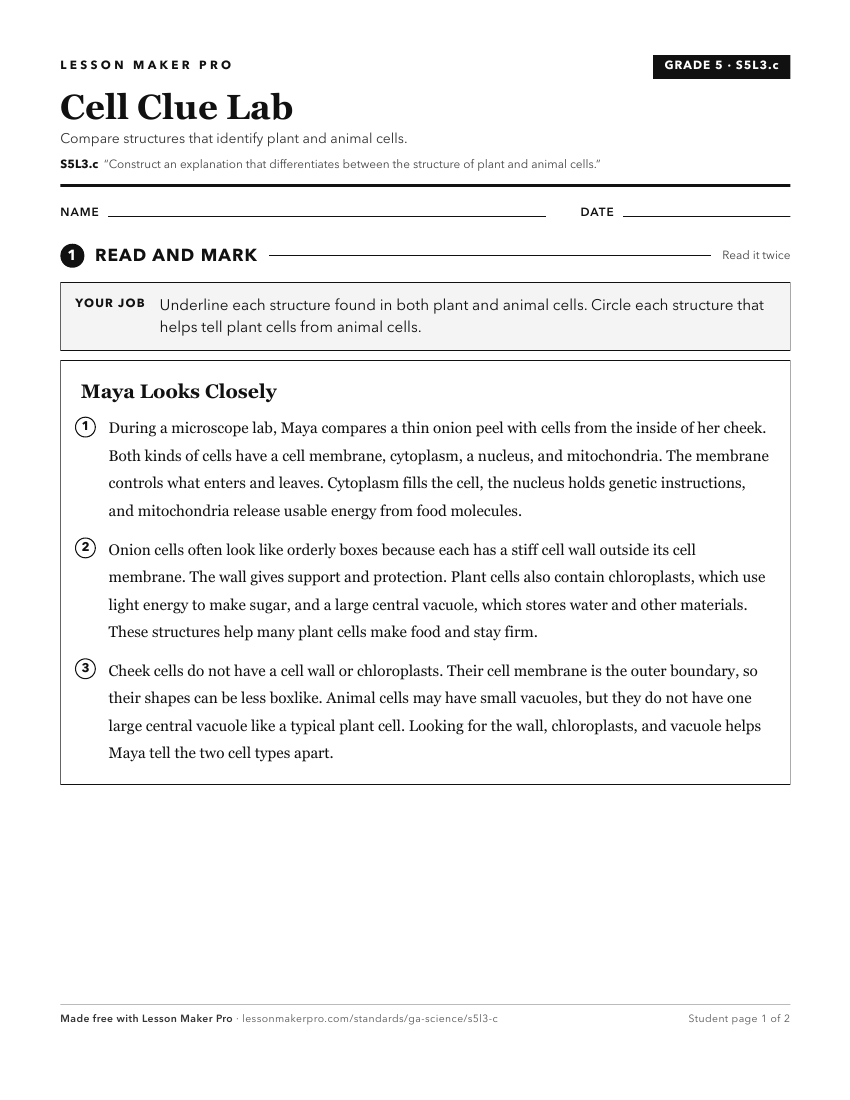
A ready-to-print activity worksheet aligned to S5L3.c, with an answer key for the teacher on its own page. No account needed.
PDF, US Letter, prints cleanly in black and white.
Download the worksheetKeep exploring
Related Standards
- S5L3
Obtain, evaluate, and communicate information to compare and contrast the parts of plant and animal cells.
- S7L2.a
Develop a model and construct an explanation of how cell structures (specifically the nucleus, cytoplasm, cell membrane, cell wall, chloroplasts, lysosome, and ...
- S5L3.b
Develop a model to identify and label parts of a plant cell (membrane, wall, cytoplasm, nucleus, chloroplasts) and of an animal cell (membrane, cytoplasm, and n...
- SKL1.a
Construct an explanation based on observations to recognize the differences between organisms and non-living objects.
Turn this exact standard into a lesson
Grade, subject, topic, and the complete standard are prefilled. Create one free, no account needed.
Also for this standard:Make a WorksheetMake a QuizMake a Sub Lesson