Georgia SKL1.a
The Standard
- SKL1
- Obtain, evaluate, and communicate information about how organisms (alive and not alive) and non-living objects are grouped.
Construct an explanation based on observations to recognize the differences between organisms and non-living objects.
Georgia Standards of Excellence for Science · Obtain, evaluate, and communicate information about how organisms (alive and not alive) and non-living objects are grouped.
Teacher's field guide
What This Standard Means
What Students Need to Do
- Students examine plants, animals, and everyday objects. They decide whether each is alive now, was once alive, or was never alive, then explain the choice with an observation.
What Mastery Looks Like
- A student correctly sorts examples such as a bean plant, fallen leaf, and plastic button. The student gives evidence, such as the plant grows, the leaf came from a plant, and the button never grew.
Common Misconceptions
- Students may think only things that move are alive, so they misclassify plants. They may call a toy robot alive because it moves, or fire alive because it grows. They may also treat a seed or dormant plant as nonliving.
How to Assess It
- Show pictures of a potted plant, fallen leaf, and plastic block. Have students circle what is alive now, box what was once alive, and explain one choice using because.
Lesson moves
Ways to Teach It
Set out a potted plant, rock, plastic spoon, and fallen leaf; students observe with hand lenses and place each on a sorting mat.
Post the prompt, “What evidence shows a plant is alive even though it does not walk?” and have students draw and label two clues.
Show picture cards; students move to Alive Now, Once Alive, or Never Alive corners and give one reason.
Walk the playground and photograph one organism and one nonliving object, then make a class chart of the evidence students noticed.
Free download
Printable SKL1.a Worksheet
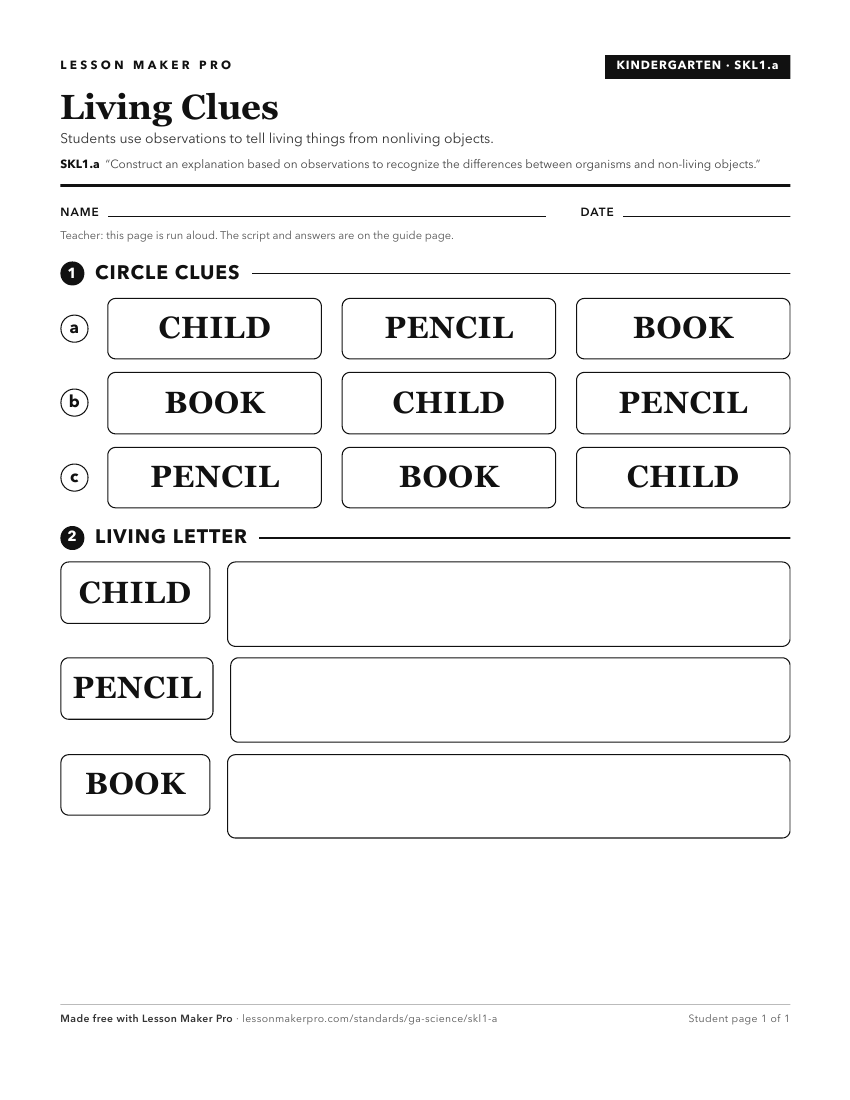
A ready-to-print activity worksheet aligned to SKL1.a, with an answer key for the teacher on its own page. No account needed.
PDF, US Letter, prints cleanly in black and white.
Download the worksheetKeep exploring
Related Standards
- S3L1.c
Use evidence to construct an explanation of why some organisms can thrive in one habitat and not in another.
- S1P1.a
Use observations to construct an explanation of how light is required to make objects visible.
- S7L4.a
Construct an explanation for the patterns of interactions observed in different ecosystems in terms of the relationships among and between organisms and abiotic...
- SKL1
Obtain, evaluate, and communicate information about how organisms (alive and not alive) and non-living objects are grouped.
Turn this exact standard into a lesson
Grade, subject, topic, and the complete standard are prefilled. Create one free, no account needed.
Also for this standard:Make a WorksheetMake a QuizMake a Sub Lesson