Georgia S5L3
Georgia Standard (Element Cluster)
Obtain, evaluate, and communicate information to compare and contrast the parts of plant and animal cells.
Georgia Standards of Excellence for Science
Cluster contents
Elements in This Standard
S5L3 is a Georgia science standard. These are the elements under it.
- S5L3.a
Gather evidence by utilizing technology tools to support a claim that plants and animals are comprised of cells too small to be seen without magnification.
- S5L3.b
Develop a model to identify and label parts of a plant cell (membrane, wall, cytoplasm, nucleus, chloroplasts) and of an animal cell (membrane, cytoplasm, and n...
- S5L3.c
Construct an explanation that differentiates between the structure of plant and animal cells.
Teacher's field guide
What This Cluster Means
What Students Need to Do
- Students gather information from cell diagrams, microscope images, models, and short texts. They identify major cell parts and compare which parts plant and animal cells share. They communicate similarities and differences using labels, tables, or written explanations.
What Mastery Looks Like
- A student can correctly label the nucleus, cytoplasm, cell membrane, cell wall, chloroplasts, and vacuole. They can explain which structures are shared and which are typical of plant cells. They support comparisons with evidence from a diagram, image, or text.
Common Misconceptions
- Students may place the cell membrane only in animal cells or confuse it with the plant cell wall. They may label vacuoles as plant-only, assume every plant cell has chloroplasts, or use shape alone to identify a cell.
How to Assess It
- Give students one plant cell diagram and one animal cell diagram. Ask them to label six parts, list one similarity and two differences, and cite one visible feature as evidence.
Lesson moves
Ways to Teach It
Build side-by-side plant and animal cell models with clay, then label each part and connect shared structures with matching strings.
Write a paragraph responding to the claim, “Plant and animal cells have mostly different parts,” using two pieces of evidence.
Sort organelle cards onto plant, animal, or both mats, then justify each placement to a partner.
Examine microscope images of onion skin and cheek cells, then identify evidence that each sample is plant or animal tissue.
Free download
Printable S5L3 Worksheet
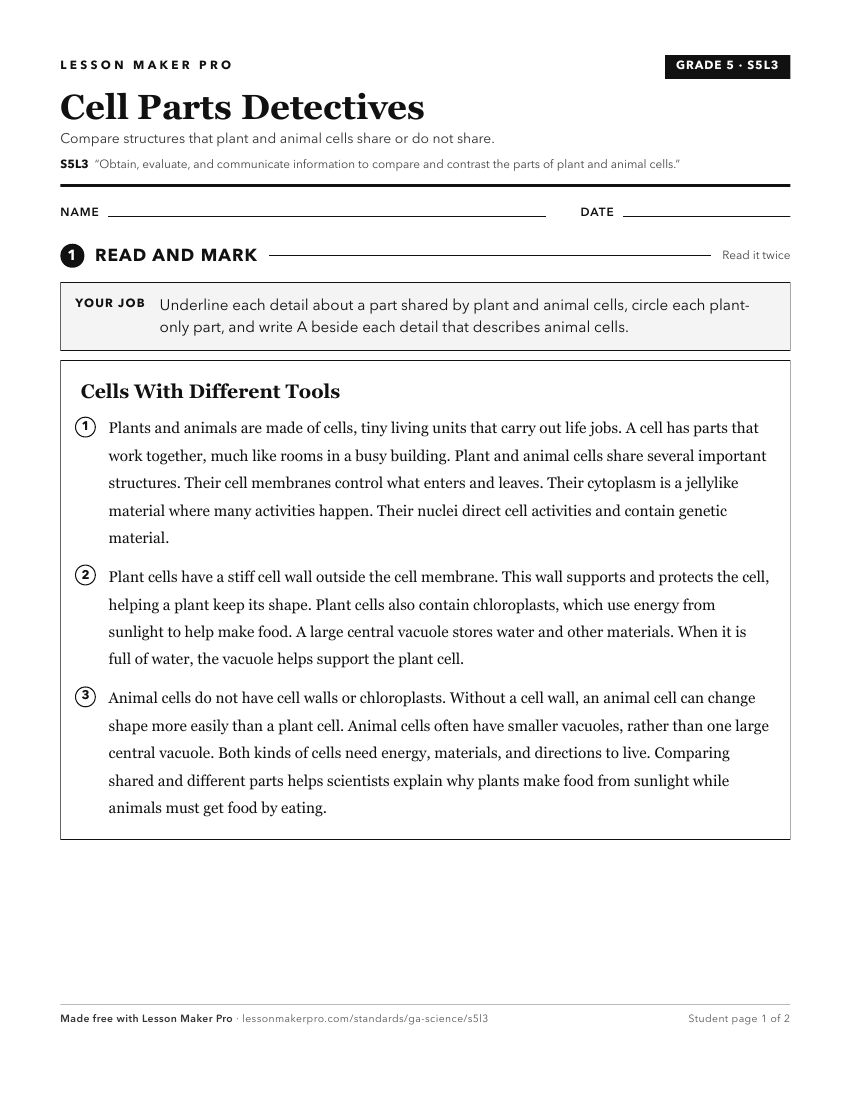
A ready-to-print activity worksheet aligned to S5L3, with an answer key for the teacher on its own page. No account needed.
PDF, US Letter, prints cleanly in black and white.
Download the worksheetKeep exploring
Related Standards
- S7L2
Obtain, evaluate, and communicate information to describe how cell structures, cells, tissues, organs, and organ systems interact to maintain the basic needs of...
- SKL2
Obtain, evaluate, and communicate information to compare the similarities and differences in groups of organisms.
- S1L1
Obtain, evaluate, and communicate information about the basic needs of plants and animals.
Turn this cluster into a lesson
Grade, subject, topic, and the complete cluster are prefilled. Create one free, no account needed.
Also for this cluster:Make a WorksheetMake a QuizMake a Sub Lesson