Georgia S5L3.a
The Standard
- S5L3
- Obtain, evaluate, and communicate information to compare and contrast the parts of plant and animal cells.
Gather evidence by utilizing technology tools to support a claim that plants and animals are comprised of cells too small to be seen without magnification.
Georgia Standards of Excellence for Science · Obtain, evaluate, and communicate information to compare and contrast the parts of plant and animal cells.
Teacher's field guide
What This Standard Means
What Students Need to Do
- Students use digital microscopes, zoomable images, or videos to examine plant and animal samples. They record visible cell patterns and use that evidence to make and support a claim.
What Mastery Looks Like
- Students identify repeated cell structures in magnified plant and animal samples. They cite specific image details and explain why magnification is needed to observe individual cells.
Common Misconceptions
- Students may think magnified cells are shown at their actual size or that only small organisms have cells. They may also treat a labeled diagram as direct evidence from a specimen.
How to Assess It
- Show digital micrographs of onion tissue and cheek tissue. Ask students to write one claim, cite one detail from each image, and explain why magnification was needed.
Lesson moves
Ways to Teach It
Use a digital microscope to view prepared onion and cheek-cell slides, then capture and label evidence of cell boundaries.
Write a claim explaining how two magnified images show that both a leaf and an animal organ contain cells.
Play an evidence sort, matching digital micrographs, observations, and claims about plant and animal samples.
Examine a digital skin biopsy image and explain how doctors use magnified cells to study body tissue.
Free download
Printable S5L3.a Worksheet
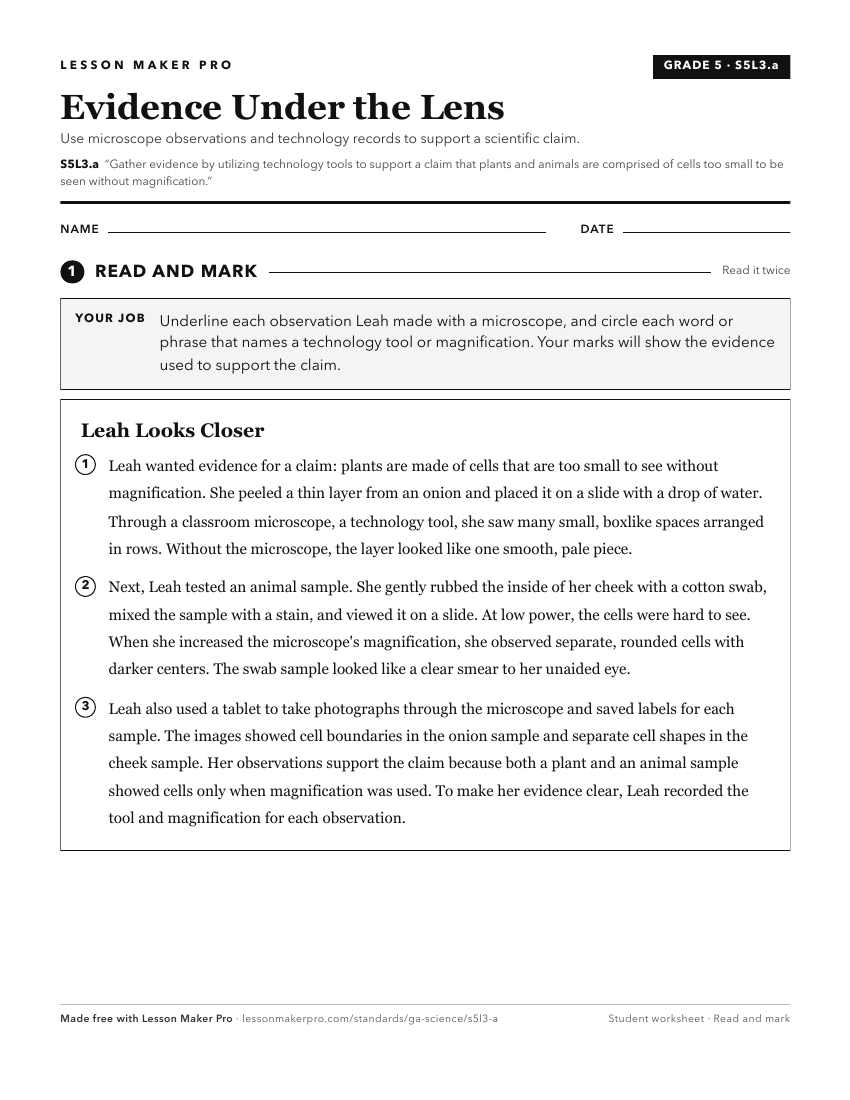
A ready-to-print activity worksheet aligned to S5L3.a, with an answer key for the teacher on its own page. No account needed.
PDF, US Letter, prints cleanly in black and white.
Download the worksheetKeep exploring
Related Standards
- S5L3
Obtain, evaluate, and communicate information to compare and contrast the parts of plant and animal cells.
- SKL2.b
Construct an argument supported by evidence for how plants can be grouped according to their features.
- S5L4.a
Construct an argument using scientific evidence to support a claim that some microorganisms are beneficial.
- S5L4.b
Construct an argument using scientific evidence to support a claim that some microorganisms are harmful.
Turn this exact standard into a lesson
Grade, subject, topic, and the complete standard are prefilled. Create one free, no account needed.
Also for this standard:Make a WorksheetMake a QuizMake a Sub Lesson