Georgia S5L4.b
The Standard
- S5L4
- Obtain, evaluate, and communicate information about how microorganisms benefit or harm larger organisms.
Construct an argument using scientific evidence to support a claim that some microorganisms are harmful.
Georgia Standards of Excellence for Science · Obtain, evaluate, and communicate information about how microorganisms benefit or harm larger organisms.
Teacher's field guide
What This Standard Means
What Students Need to Do
- Students make a clear claim that a specific microorganism can harm a larger organism. They choose scientific evidence and explain how it supports the claim.
What Mastery Looks Like
- Students identify relevant facts, such as infection rates, symptoms, or tissue damage. They connect those facts to a claim without saying that all microorganisms are harmful.
Common Misconceptions
- Students may assume every microorganism causes disease or use the word germ as proof of harm. They may list symptoms without explaining how the evidence supports their claim.
How to Assess It
- Exit ticket: “In a study, 18 of 20 people who ate Salmonella-contaminated food became ill, while none in another group became ill. Explain what this shows.”
Lesson moves
Ways to Teach It
Sort symptom, microscope, and transmission cards for three microorganisms, then assemble a claim-evidence-reasoning chart showing how one harms its host.
Write: Which evidence best supports the claim that Salmonella is harmful, and why is that evidence stronger than an opinion?
Play Evidence Match by pairing microorganism cards with verified effects, then reject distractor cards that show no harm.
Read a food recall notice and identify the microorganism, the reported harm, and the action families should take.
Free download
Printable S5L4.b Worksheet
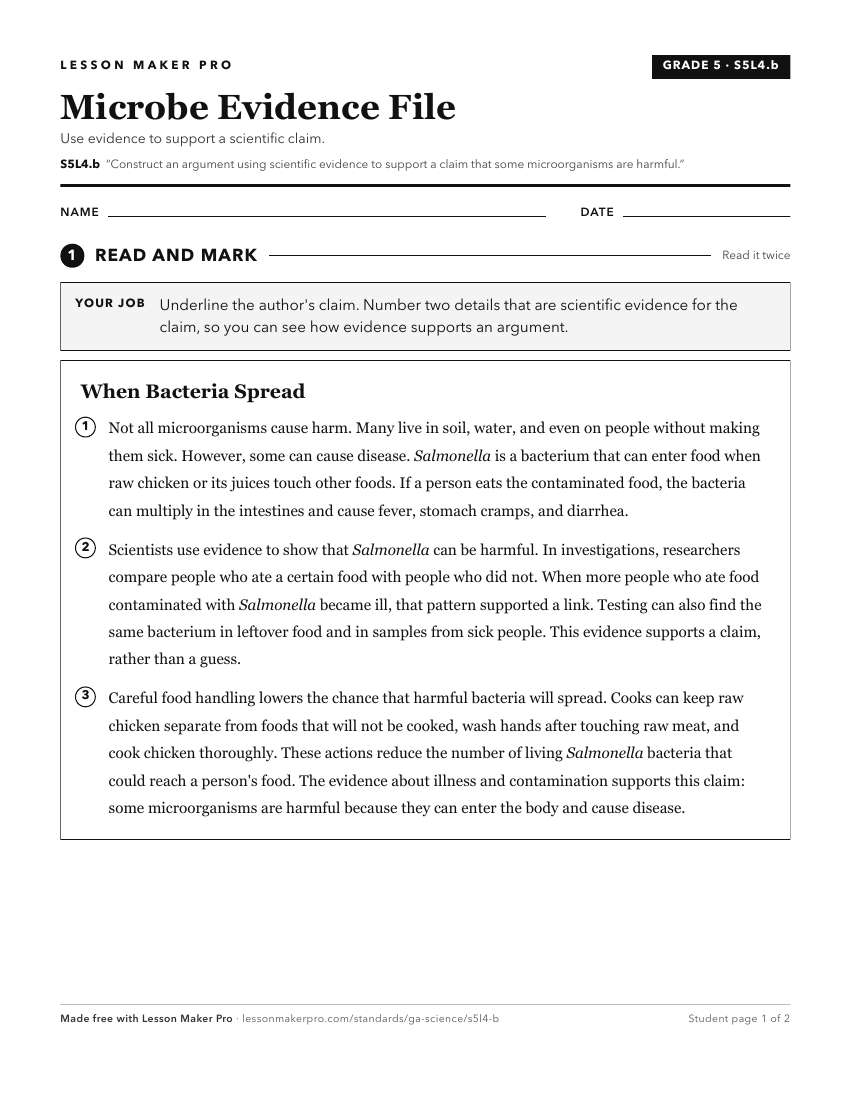
A ready-to-print activity worksheet aligned to S5L4.b, with an answer key for the teacher on its own page. No account needed.
PDF, US Letter, prints cleanly in black and white.
Download the worksheetKeep exploring
Related Standards
- S5L4
Obtain, evaluate, and communicate information about how microorganisms benefit or harm larger organisms.
- S5L4.a
Construct an argument using scientific evidence to support a claim that some microorganisms are beneficial.
- S5E1.a
Construct an argument supported by scientific evidence to identify surface features (examples could include deltas, sand dunes, mountains, volcanoes) as being c...
- S3E2.a
Construct an argument from observations of fossils (authentic or reproductions) to communicate how they serve as evidence of past organisms and the environments...
Turn this exact standard into a lesson
Grade, subject, topic, and the complete standard are prefilled. Create one free, no account needed.
Also for this standard:Make a WorksheetMake a QuizMake a Sub Lesson