Georgia S5L4
Georgia Standard (Element Cluster)
Obtain, evaluate, and communicate information about how microorganisms benefit or harm larger organisms.
Georgia Standards of Excellence for Science
Cluster contents
Elements in This Standard
S5L4 is a Georgia science standard. These are the elements under it.
Teacher's field guide
What This Cluster Means
What Students Need to Do
- Students gather information from texts, images, or videos about microorganisms affecting plants, animals, and people. They judge the evidence and explain whether each effect is helpful or harmful.
What Mastery Looks Like
- Students can describe benefits such as digestion, decomposition, and food production, as well as harms such as disease and food spoilage. They support each claim with accurate evidence from a source.
Common Misconceptions
- Students may think all microorganisms are harmful or that every microorganism causes disease. They may also confuse microorganisms with tiny insects or assume antibiotics kill viruses.
How to Assess It
- Give students a short source card about one microorganism. Ask them to identify its effect, label it helpful or harmful, and cite one supporting detail.
Lesson moves
Ways to Teach It
Mix yeast with warm water and sugar, observe bubbles, and record evidence that a microorganism can help make bread rise.
Write a claim explaining why calling every microorganism a germ is inaccurate, using two examples as evidence.
Sort microorganism cards into helpful, harmful, or both, then challenge a partner to justify one disputed card.
Examine yogurt labels and food spoilage photos, then explain how microorganisms can affect foods in different ways.
Free download
Printable S5L4 Worksheet
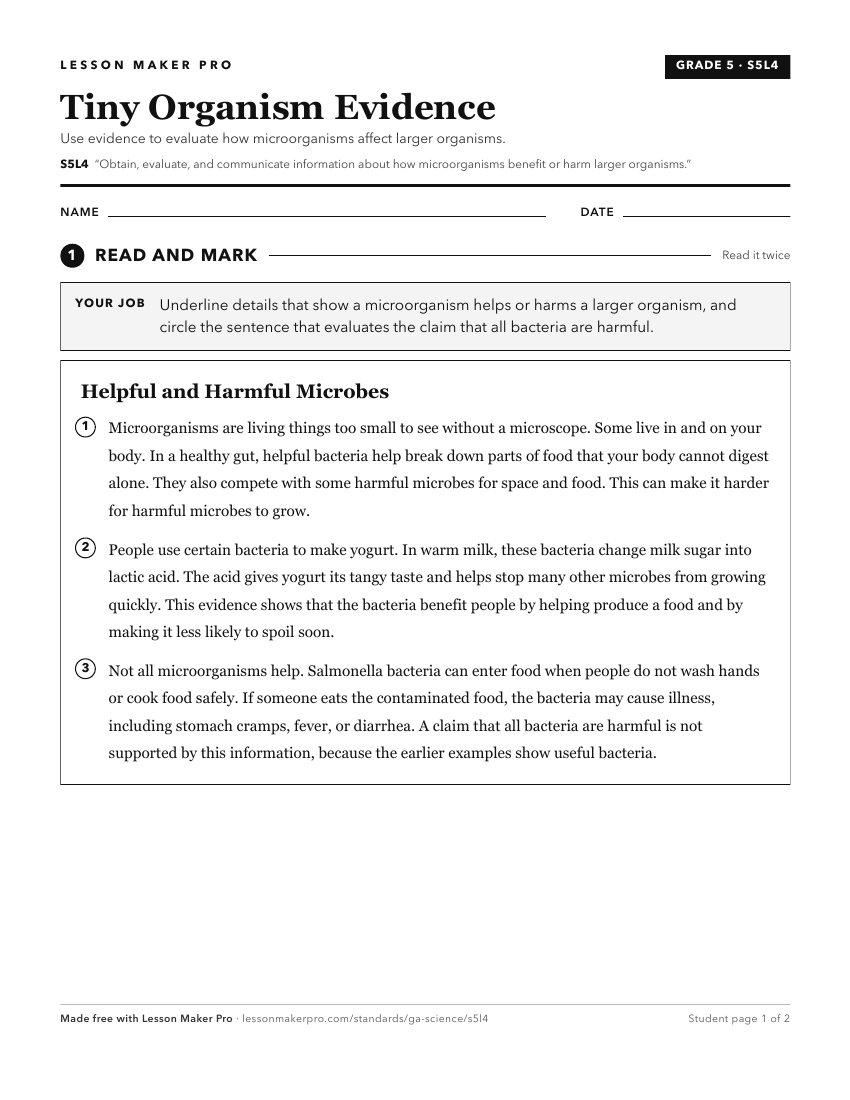
A ready-to-print activity worksheet aligned to S5L4, with an answer key for the teacher on its own page. No account needed.
PDF, US Letter, prints cleanly in black and white.
Download the worksheetKeep exploring
Related Standards
- S7L4
Obtain, evaluate, and communicate information to examine the interdependence of organisms with one another and their environments.
- S7L1
Obtain, evaluate, and communicate information to investigate the diversity of living organisms and how they can be compared scientifically.
- S2L1
Obtain, evaluate, and communicate information about the life cycles of different living organisms.
- S1L1
Obtain, evaluate, and communicate information about the basic needs of plants and animals.
Turn this cluster into a lesson
Grade, subject, topic, and the complete cluster are prefilled. Create one free, no account needed.
Also for this cluster:Make a WorksheetMake a QuizMake a Sub Lesson