Georgia S7L4
Georgia Standard (Element Cluster)
Obtain, evaluate, and communicate information to examine the interdependence of organisms with one another and their environments.
Georgia Standards of Excellence for Science
Cluster contents
Elements in This Standard
S7L4 is a Georgia science standard. These are the elements under it.
- S7L4.a
Construct an explanation for the patterns of interactions observed in different ecosystems in terms of the relationships among and between organisms and abiotic...
- S7L4.b
Develop a model to describe the cycling of matter and the flow of energy among biotic and abiotic components of an ecosystem.
- S7L4.c
Analyze and interpret data to provide evidence for how resource availability, disease, climate, and human activity affect individual organisms, populations, com...
- S7L4.d
Ask questions to gather and synthesize information from multiple sources to differentiate between Earth's major terrestrial biomes (i.e., tropical rain forest, ...
Teacher's field guide
What This Cluster Means
What Students Need to Do
- Students use food webs, population data, and ecosystem models to explain how living things depend on other organisms and nonliving resources. They trace energy and matter, then predict how a change in one part of an ecosystem affects the rest. They support explanations with evidence from data and reliable sources.
What Mastery Looks Like
- A student can build or read a food web, identify biotic and abiotic factors, and explain direct and indirect effects of a change. The student uses data to justify predictions about population shifts, competition, symbiosis, or ecosystem disruption.
Common Misconceptions
- Students often think food web arrows point toward what is eaten, rather than toward the organism receiving energy. They may assume ecosystems stay balanced, all relationships benefit both organisms, or one population change affects only its direct food source.
How to Assess It
- Give students a food web with grass, grasshoppers, mice, snakes, and hawks. Ask, "A drought cuts the grass population in half. Predict two population changes and explain each using the food web."
Lesson moves
Ways to Teach It
Give groups organism cards and yarn to build a food web, then remove one species and trace three effects through the web.
Ask students to write: "Does a tick benefit, harm, or leave its host unchanged, and how do you know?"
Play a food web relay where teams match scenario cards, such as drought or invasive species, to likely population changes.
Use local stream or schoolyard observations to identify one resource limit and predict how it affects two nearby species.
Free download
Printable S7L4 Worksheet
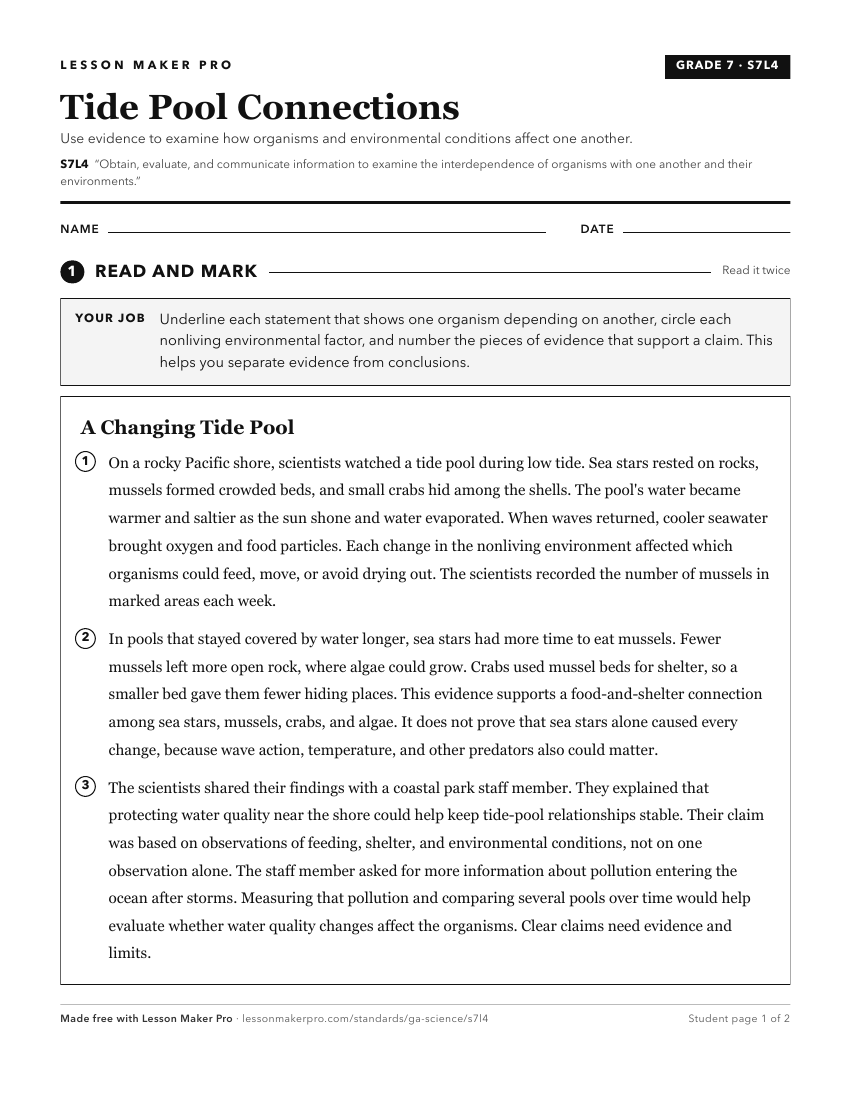
A ready-to-print activity worksheet aligned to S7L4, with an answer key for the teacher on its own page. No account needed.
PDF, US Letter, prints cleanly in black and white.
Download the worksheetKeep exploring
Related Standards
- S4L1
Obtain, evaluate, and communicate information about the roles of organisms and the flow of energy within an ecosystem.
- S7L1
Obtain, evaluate, and communicate information to investigate the diversity of living organisms and how they can be compared scientifically.
- S2L1
Obtain, evaluate, and communicate information about the life cycles of different living organisms.
- S1L1
Obtain, evaluate, and communicate information about the basic needs of plants and animals.
Turn this cluster into a lesson
Grade, subject, topic, and the complete cluster are prefilled. Create one free, no account needed.
Also for this cluster:Make a WorksheetMake a QuizMake a Sub Lesson