Georgia S7L4.d
The Standard
- S7L4
- Obtain, evaluate, and communicate information to examine the interdependence of organisms with one another and their environments.
Ask questions to gather and synthesize information from multiple sources to differentiate between Earth's major terrestrial biomes (i.e., tropical rain forest, savanna, temperate forest, desert, grassland, taiga, and tundra) and aquatic ecosystems (i.e., freshwater, estuaries, and marine).
Georgia Standards of Excellence for Science · Obtain, evaluate, and communicate information to examine the interdependence of organisms with one another and their environments.
Teacher's field guide
What This Standard Means
What Students Need to Do
- Students ask focused questions about climate, water conditions, plants, and animals. They gather evidence from several sources and use it to compare terrestrial biomes and aquatic ecosystems.
What Mastery Looks Like
- Students correctly identify ecosystems from climate graphs, maps, images, and species descriptions. They explain key differences using evidence from at least two sources.
Common Misconceptions
- Students may confuse weather with climate or assume all forests and grasslands have similar conditions. They may also treat estuaries as freshwater and overlook salinity as a defining factor.
How to Assess It
- Give students a climograph and species card for two unnamed ecosystems. Ask them to identify each ecosystem, cite evidence from both sources, and write one follow-up question.
Lesson moves
Ways to Teach It
Place climate, plant, animal, and water cards at stations; teams match each set to an ecosystem and defend each match.
Write: Which two ecosystems seem most alike, and what evidence from two sources best separates them?
Play Ecosystem Guess Who, students ask yes or no questions about rainfall, temperature, salinity, and organisms until they identify the hidden ecosystem.
Compare local stream data with an estuary data sheet, then explain how salinity changes which organisms can live there.
Free download
Printable S7L4.d Worksheet
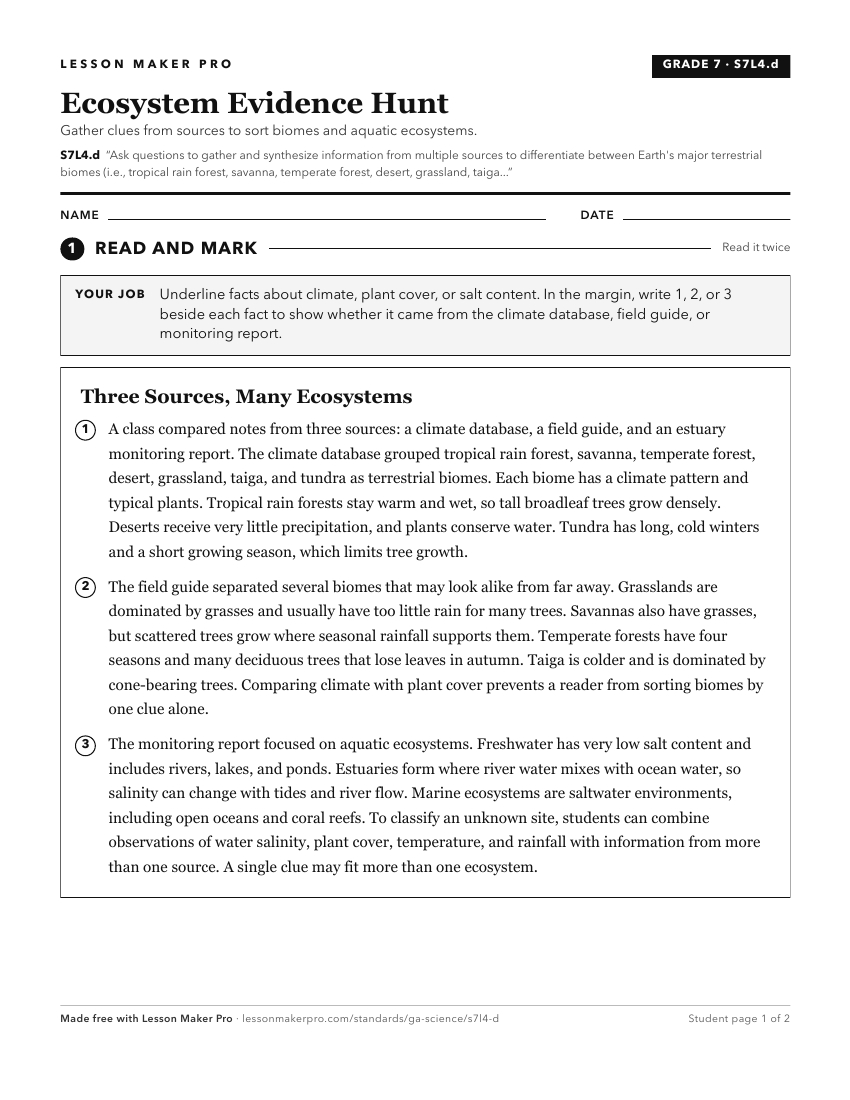
A ready-to-print activity worksheet aligned to S7L4.d, with an answer key for the teacher on its own page. No account needed.
PDF, US Letter, prints cleanly in black and white.
Download the worksheetKeep exploring
Related Standards
- SKE2.a
Ask questions to identify and describe earth materials—soil, rocks, water, and air.
- S3L1.a
Ask questions to differentiate between plants, animals, and habitats found within Georgia's geographic regions.
- S3L2.a
Ask questions to collect information and create records of sources and effects of pollution on the plants and animals.
- S6E3.a
Ask questions to determine where water is located on Earth's surface (oceans, rivers, lakes, swamps, groundwater, aquifers, and ice) and communicate the relativ...
Turn this exact standard into a lesson
Grade, subject, topic, and the complete standard are prefilled. Create one free, no account needed.
Also for this standard:Make a WorksheetMake a QuizMake a Sub Lesson