Georgia S6E3.a
The Standard
- S6E3
- Obtain, evaluate, and communicate information to recognize the significant role of water in Earth processes.
Ask questions to determine where water is located on Earth's surface (oceans, rivers, lakes, swamps, groundwater, aquifers, and ice) and communicate the relative proportion of water at each location.
Georgia Standards of Excellence for Science · Obtain, evaluate, and communicate information to recognize the significant role of water in Earth processes.
Teacher's field guide
What This Standard Means
What Students Need to Do
- Students ask answerable questions about Earth’s water, then use maps, graphs, and data tables to find answers. They compare major water stores and present the pattern in a labeled model or chart.
What Mastery Looks Like
- Students can explain that oceans hold about 97 percent of Earth’s water. They show that most freshwater is frozen or underground, while lakes, rivers, and swamps hold a tiny share. They also connect groundwater with aquifers.
Common Misconceptions
- Students often think most freshwater is found in lakes and rivers. Some picture groundwater as underground lakes rather than water filling spaces in soil and rock. They may count aquifers and groundwater separately or mix up percentages of all water and freshwater.
How to Assess It
- Exit ticket: Of all water, 97% is ocean water and 3% is freshwater. Ask students to write one answerable question, then draw a labeled model showing that most freshwater is in ice and aquifers.
Lesson moves
Ways to Teach It
Use graduated cylinders and droppers to divide 1,000 milliliters among oceans, ice, groundwater in aquifers, lakes, rivers, and swamps using provided percentages.
Prompt: Why can freshwater shortages occur when Earth has so much water? Require two numbers and three storage locations in each response.
Give pairs reservoir cards and percentage cards; students race to match them, order them, then correct one another using a reference graph.
Use the local water utility website to trace the school’s tap water from reservoir or aquifer to treatment plant and classroom.
Free download
Printable S6E3.a Worksheet
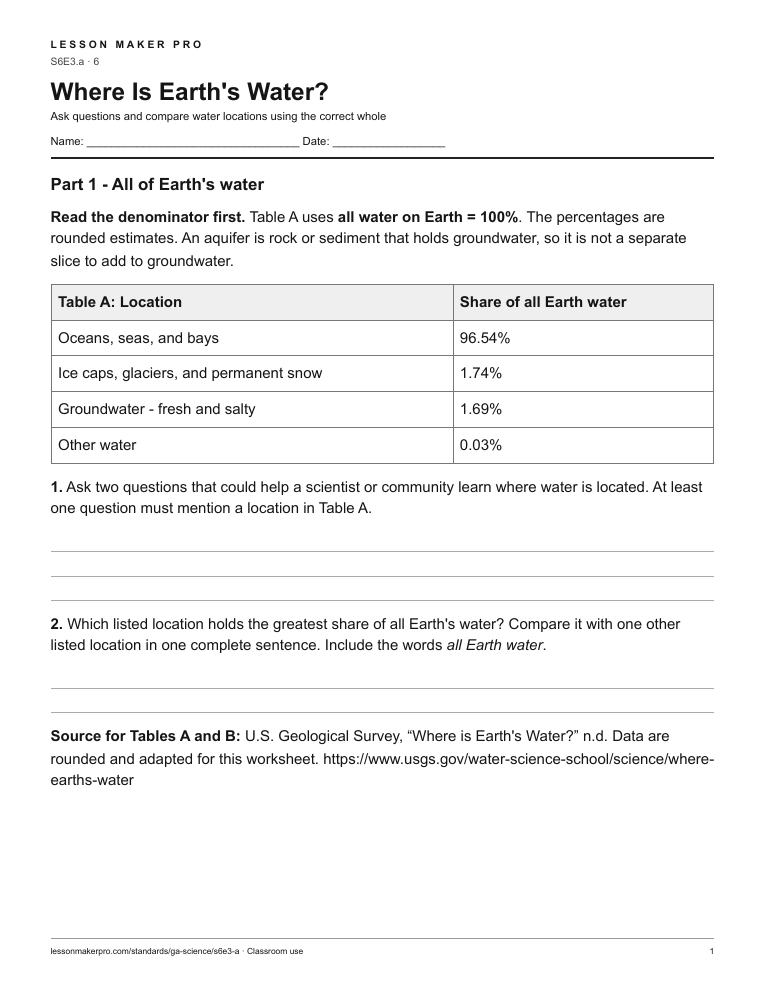
A ready-to-print activity worksheet aligned to S6E3.a, with an answer key for the teacher on its own page. No account needed.
PDF, US Letter, prints cleanly in black and white.
Download the worksheetKeep exploring
Related Standards
- SKE2.a
Ask questions to identify and describe earth materials—soil, rocks, water, and air.
- S7L4.d
Ask questions to gather and synthesize information from multiple sources to differentiate between Earth's major terrestrial biomes (i.e., tropical rain forest, ...
- S6E3.c
Ask questions to identify and communicate, using graphs and maps, the composition, location, and subsurface topography of the world's oceans.
- S6E3
Obtain, evaluate, and communicate information to recognize the significant role of water in Earth processes.
Turn this exact standard into a lesson
Grade, subject, topic, and the complete standard are prefilled. Create one free, no account needed.
Also for this standard:Make a WorksheetMake a QuizMake a Sub Lesson