Georgia S7L1
Georgia Standard (Element Cluster)
Obtain, evaluate, and communicate information to investigate the diversity of living organisms and how they can be compared scientifically.
Georgia Standards of Excellence for Science
Cluster contents
Elements in This Standard
S7L1 is a Georgia science standard. These are the elements under it.
Teacher's field guide
What This Cluster Means
What Students Need to Do
- Students gather information about organisms and compare traits such as cell type, number of cells, body structures, and how energy is obtained. They use evidence to classify organisms and explain their choices.
What Mastery Looks Like
- Students can sort unfamiliar organisms into reasonable groups using several traits, not appearance alone. They can use a classification key and defend each choice with evidence.
Common Misconceptions
- Students may group organisms only by size, habitat, or visible features. They may call fungi plants, assume all microorganisms are bacteria, or think classification groups never change.
How to Assess It
- Give students four organism profiles. Ask them to group the organisms, name the traits they used, and explain one choice with evidence.
Lesson moves
Ways to Teach It
Sort organism cards by cell type, number of cells, and energy source, then write a rule that describes each group.
Write a claim answering, “Should a mushroom be grouped with plants?” and support it with three traits.
Run a dichotomous key relay where teams identify pictured organisms and record each choice in the key.
Compare grocery items such as mushrooms, yogurt cultures, seaweed, and yeast, then identify the organism group connected to each product.
Free download
Printable S7L1 Worksheet
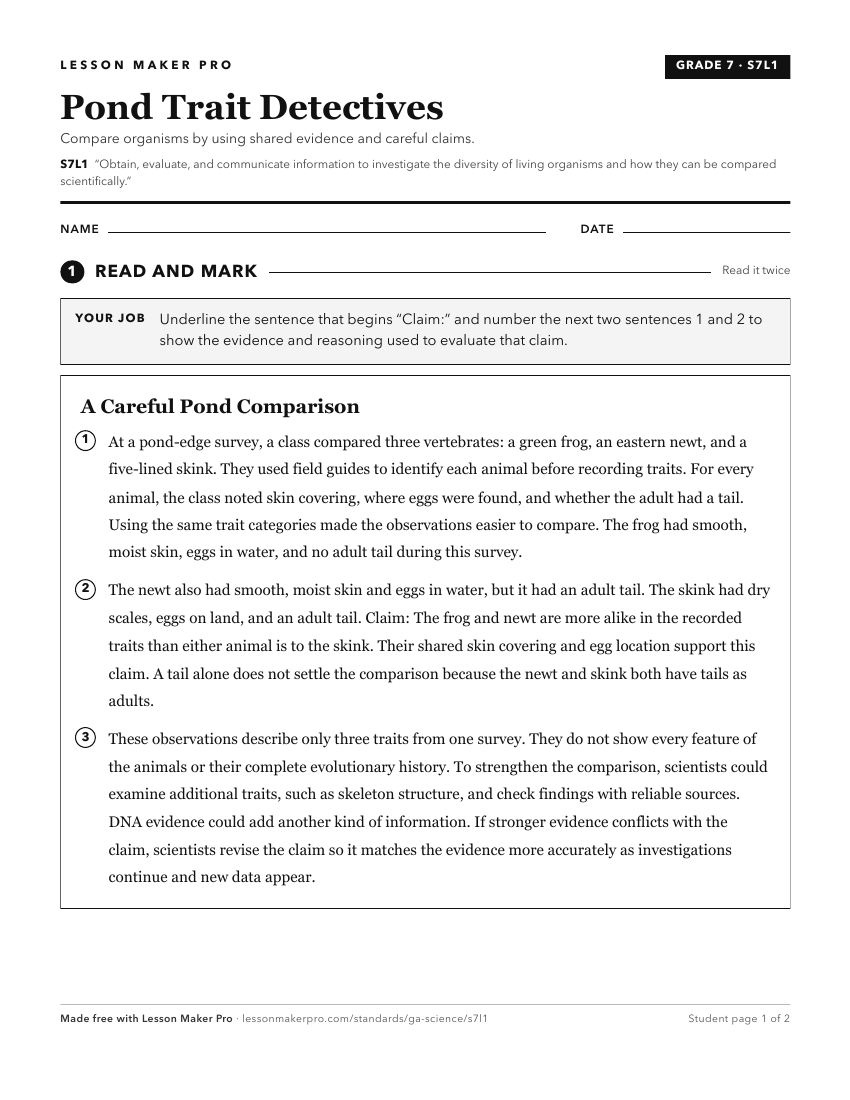
A ready-to-print activity worksheet aligned to S7L1, with an answer key for the teacher on its own page. No account needed.
PDF, US Letter, prints cleanly in black and white.
Download the worksheetKeep exploring
Related Standards
- S7L4
Obtain, evaluate, and communicate information to examine the interdependence of organisms with one another and their environments.
- SKL2
Obtain, evaluate, and communicate information to compare the similarities and differences in groups of organisms.
- S2L1
Obtain, evaluate, and communicate information about the life cycles of different living organisms.
- SKL1
Obtain, evaluate, and communicate information about how organisms (alive and not alive) and non-living objects are grouped.
Turn this cluster into a lesson
Grade, subject, topic, and the complete cluster are prefilled. Create one free, no account needed.
Also for this cluster:Make a WorksheetMake a QuizMake a Sub Lesson