Georgia S8P1.f
The Standard
- S8P1
- Obtain, evaluate, and communicate information about the structure and properties of matter.
Construct an explanation based on evidence to describe conservation of matter in a chemical reaction including the resulting differences between products and reactants.
Georgia Standards of Excellence for Science · Obtain, evaluate, and communicate information about the structure and properties of matter.
Teacher's field guide
What This Standard Means
What Students Need to Do
- Students compare reactants and products using mass data, observations, and particle models. They explain that atoms rearrange into new substances while the total amount of matter remains unchanged.
What Mastery Looks Like
- Students can account for each type and number of atom before and after a reaction. They describe new product properties and support conservation claims with measurements or particle diagrams.
Common Misconceptions
- Students may think matter disappears when a gas escapes or appears when a solid forms. They may also think unchanged mass means the products have the same properties as the reactants.
How to Assess It
- Exit ticket: Two colorless solutions with a total mass of 125 g react in a sealed flask and form a yellow solid. Predict the final mass, then explain what changed and what stayed the same.
Lesson moves
Ways to Teach It
React baking soda and vinegar in a sealed zip bag, measure mass before and after, then explain the result.
Show reactant and product particle diagrams, then ask, "What changed, what stayed the same, and what evidence supports your claim?"
Run an atom-accounting relay where teams match reactant and product cards, count each element, and reject reactions that lose atoms.
Compare a nail's mass before and after rusting, then explain why oxygen from the air makes the rusted nail heavier.
Free download
Printable S8P1.f Worksheet
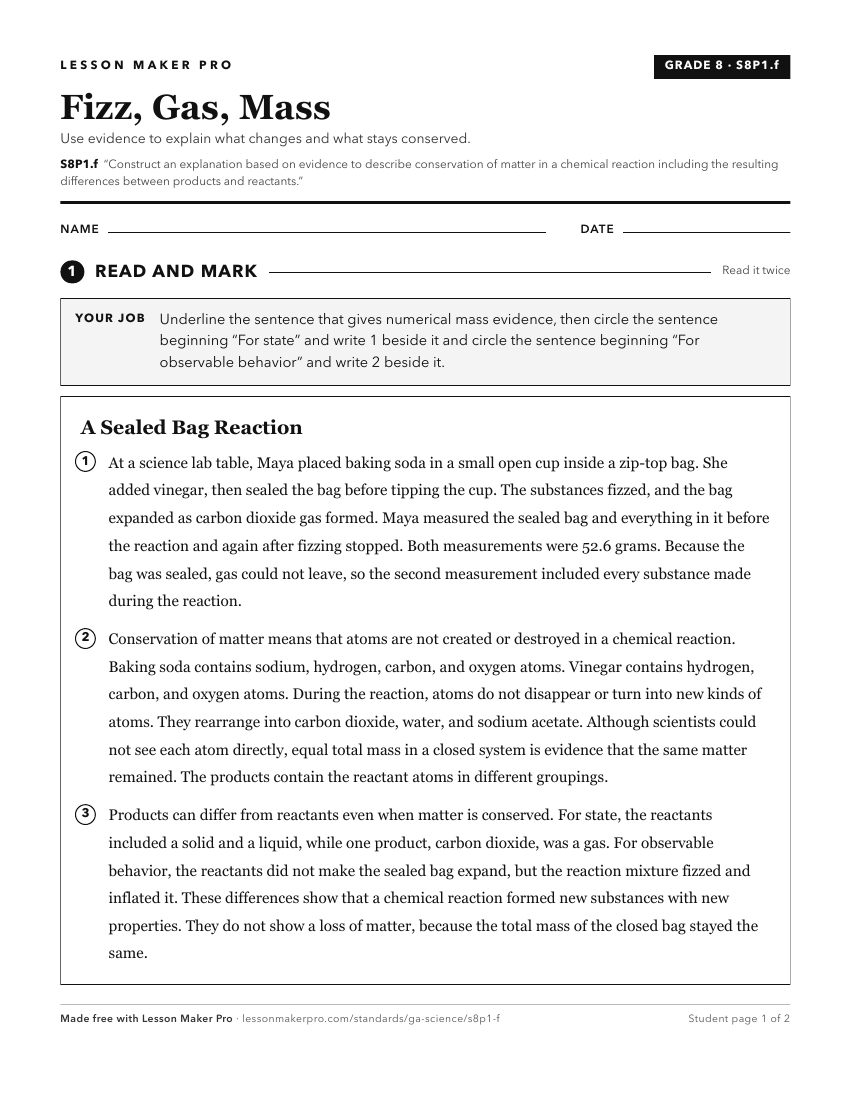
A ready-to-print activity worksheet aligned to S8P1.f, with an answer key for the teacher on its own page. No account needed.
PDF, US Letter, prints cleanly in black and white.
Download the worksheetKeep exploring
Related Standards
- S5P1.c
Plan and carry out an investigation to determine if a chemical change occurred based on observable evidence (color, gas, temperature change, odor, new substance...
- S8P1.d
Construct an argument based on observational evidence to support the claim that when a change in a substance occurs, it can be classified as either chemical or ...
- S5P1
Obtain, evaluate, and communicate information to explain the differences between a physical change and a chemical change.
- S2P1.c
Provide evidence from observations to construct an explanation that some changes in matter caused by heating or cooling can be reversed and some changes are irr...
Turn this exact standard into a lesson
Grade, subject, topic, and the complete standard are prefilled. Create one free, no account needed.
Also for this standard:Make a WorksheetMake a QuizMake a Sub Lesson