Georgia S7L3
Georgia Standard (Element Cluster)
Obtain, evaluate, and communicate information to explain how organisms reproduce either sexually or asexually and transfer genetic information to determine the traits of their offspring.
Georgia Standards of Excellence for Science
Cluster contents
Elements in This Standard
S7L3 is a Georgia science standard. These are the elements under it.
- S7L3.a
Construct an explanation supported with scientific evidence of the role of genes and chromosomes in the process of inheriting a specific trait.
- S7L3.b
Develop and use a model to describe how asexual reproduction can result in offspring with identical genetic information while sexual reproduction results in gen...
- S7L3.c
Ask questions to gather and synthesize information about the ways humans influence the inheritance of desired traits in organisms through selective breeding.
Teacher's field guide
What This Cluster Means
What Students Need to Do
- Students compare sexual and asexual reproduction and trace how genetic information passes from parent organisms to offspring. They use evidence to explain why offspring may resemble their parents yet differ from them.
What Mastery Looks Like
- Students can identify the type of reproduction shown in an example and describe how many parents contribute genetic information. They can use a simple inheritance model to predict possible offspring traits and explain variation.
Common Misconceptions
- Students may think all offspring are exact copies of their parents or that one parent controls each trait. They may also confuse inherited traits with traits gained through experience, such as scars or stronger muscles.
How to Assess It
- Give students one example of bacterial division and one allele chart for two parents. Ask them to identify each reproductive pattern and explain the expected offspring similarities or differences.
Lesson moves
Ways to Teach It
Give students colored allele cards to model genetic transfer in sexual reproduction, then compare their varied offspring with copied cards in asexual reproduction.
Ask students to write why siblings from the same parents can look different while bacteria produced by division are usually very similar.
Play an inheritance matching game where students pair parent allele cards, build possible offspring combinations, and name the traits each combination produces.
Use dog breeding or crop cuttings to compare how people use sexual and asexual reproduction to preserve or combine desired traits.
Free download
Printable S7L3 Worksheet
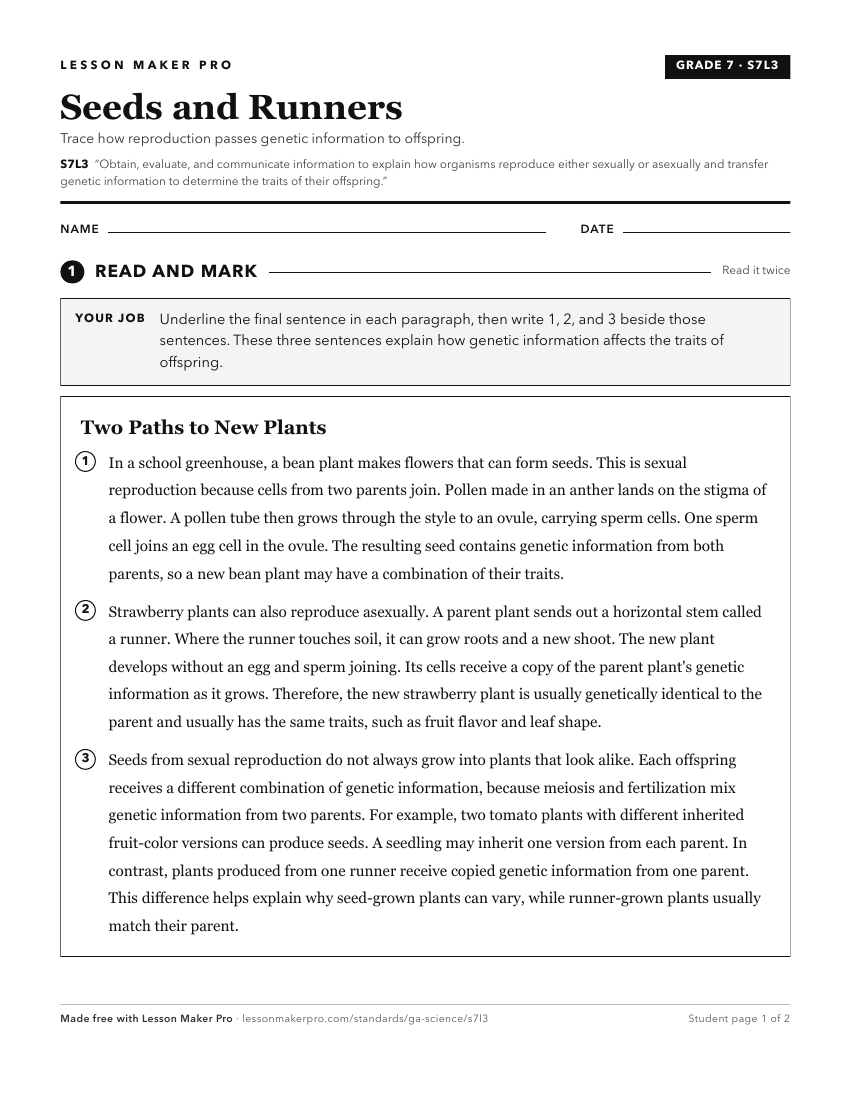
A ready-to-print activity worksheet aligned to S7L3, with an answer key for the teacher on its own page. No account needed.
PDF, US Letter, prints cleanly in black and white.
Download the worksheetKeep exploring
Related Standards
- S5L2
Obtain, evaluate, and communicate information showing that some characteristics of organisms are inherited and other characteristics are acquired.
- S7L5
Obtain, evaluate, and communicate information from multiple sources to explain the theory of evolution of living organisms through inherited characteristics.
- S7L4
Obtain, evaluate, and communicate information to examine the interdependence of organisms with one another and their environments.
- S2L1
Obtain, evaluate, and communicate information about the life cycles of different living organisms.
Turn this cluster into a lesson
Grade, subject, topic, and the complete cluster are prefilled. Create one free, no account needed.
Also for this cluster:Make a WorksheetMake a QuizMake a Sub Lesson