Georgia S7L5
Georgia Standard (Element Cluster)
Obtain, evaluate, and communicate information from multiple sources to explain the theory of evolution of living organisms through inherited characteristics.
Georgia Standards of Excellence for Science
Cluster contents
Elements in This Standard
S7L5 is a Georgia science standard. These are the elements under it.
- S7L5.a
Use mathematical representations to evaluate explanations of how natural selection leads to changes in specific traits of populations over successive generation...
- S7L5.b
Construct an explanation based on evidence that describes how genetic variation and environmental factors influence the probability of survival and reproduction...
- S7L5.c
Analyze and interpret data for patterns in the fossil record that document the existence, diversity, and extinction of organisms and their relationships to mode...
Teacher's field guide
What This Cluster Means
What Students Need to Do
- Students use several reliable sources to explain how inherited differences can become more or less common in a population over many generations. They evaluate evidence and communicate a clear, source-based explanation of evolution.
What Mastery Looks Like
- A student can connect inherited variation, survival and reproduction, and changes in trait frequency across generations. The student can compare sources, identify stronger evidence, and cite that evidence in an explanation.
Common Misconceptions
- Students often say individual organisms evolve during their lifetimes. They may think organisms develop traits because they need them, or confuse inherited traits with acquired traits. Some treat a scientific theory as a guess or accept any website as reliable evidence.
How to Assess It
- Give students two short source excerpts about pesticide-resistant insects, one evidence-based and one unsupported. Ask them to choose the stronger source and explain how inherited resistance becomes more common over generations.
Lesson moves
Ways to Teach It
Scatter colored paper moths on light and dark backgrounds, have student predators collect visible moths, then graph each color's survival across rounds.
Compare two short accounts of finch beaks and answer, "Which source gives stronger evidence for population change, and why?"
Play a sequence game where teams arrange variation, environmental pressure, survival, reproduction, and population change cards, then defend their order.
Use a simplified hospital resistance chart to explain why the same antibiotic becomes less effective against a bacterial population over time.
Free download
Printable S7L5 Worksheet
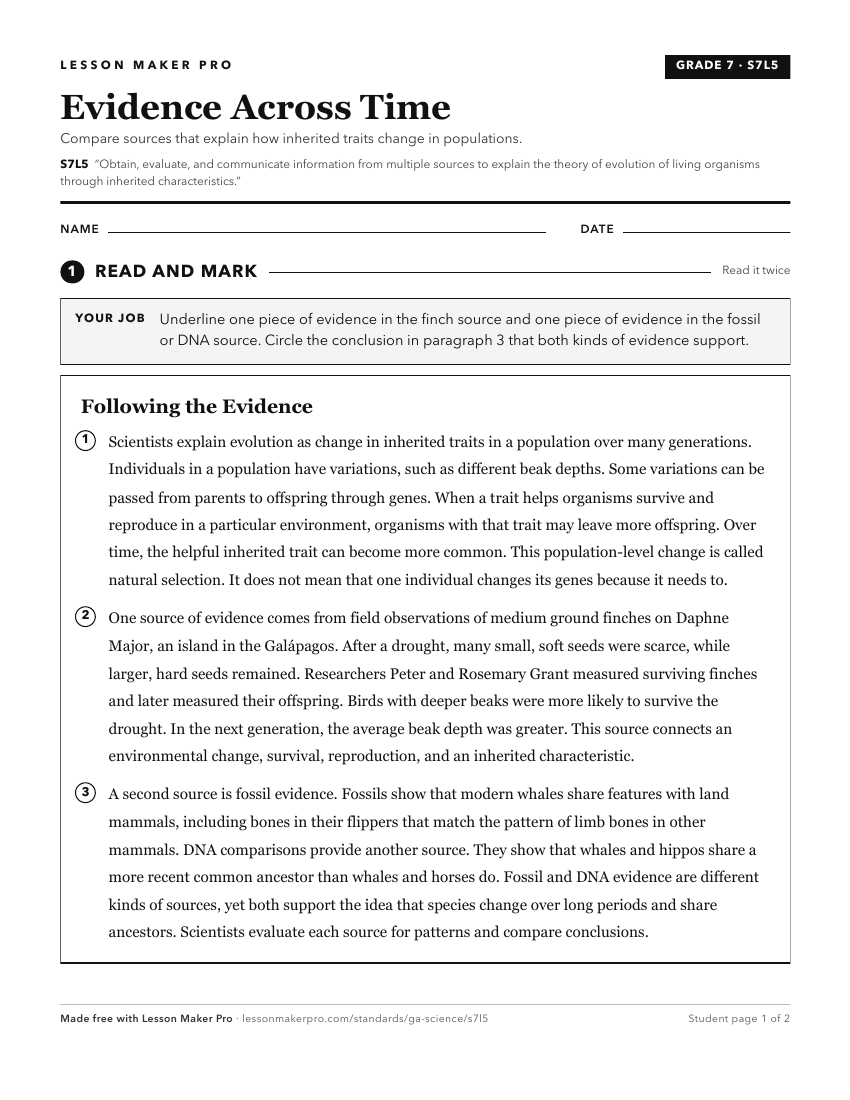
A ready-to-print activity worksheet aligned to S7L5, with an answer key for the teacher on its own page. No account needed.
PDF, US Letter, prints cleanly in black and white.
Download the worksheetKeep exploring
Related Standards
- S5L2
Obtain, evaluate, and communicate information showing that some characteristics of organisms are inherited and other characteristics are acquired.
- S7L3
Obtain, evaluate, and communicate information to explain how organisms reproduce either sexually or asexually and transfer genetic information to determine the ...
- S7L1
Obtain, evaluate, and communicate information to investigate the diversity of living organisms and how they can be compared scientifically.
- SKL2
Obtain, evaluate, and communicate information to compare the similarities and differences in groups of organisms.
Turn this cluster into a lesson
Grade, subject, topic, and the complete cluster are prefilled. Create one free, no account needed.
Also for this cluster:Make a WorksheetMake a QuizMake a Sub Lesson