Georgia S7L5.c
The Standard
- S7L5
- Obtain, evaluate, and communicate information from multiple sources to explain the theory of evolution of living organisms through inherited characteristics.
Analyze and interpret data for patterns in the fossil record that document the existence, diversity, and extinction of organisms and their relationships to modern organisms.
Georgia Standards of Excellence for Science · Obtain, evaluate, and communicate information from multiple sources to explain the theory of evolution of living organisms through inherited characteristics.
Teacher's field guide
What This Standard Means
What Students Need to Do
- Students read fossil tables, diagrams, and rock layers to find changes over time. They use those patterns to explain past diversity, likely extinctions, and similarities between fossil and modern organisms.
What Mastery Looks Like
- Students correctly identify older and younger fossils using rock-layer data. They support claims about diversity, extinction, and related traits with specific evidence from more than one source.
Common Misconceptions
- Students may think upper rock layers are always older or that every fossil organism is a direct ancestor of a modern species. They may also treat gaps in the fossil record as proof that organisms did not exist.
How to Assess It
- Give students a four-layer fossil chart showing three taxa. Ask which taxon likely became extinct, how diversity changed, and which fossil most resembles a modern organism, citing two data points.
Lesson moves
Ways to Teach It
Give groups fossil cards and labeled rock layers to arrange by age, then mark first appearances, extinctions, and trait changes.
Use two fossil images and one modern organism image to write a claim about shared traits, supported by three observations.
Run a layer-by-layer fossil reveal, with teams updating predictions about diversity and extinction after each new data card.
Examine a Georgia museum fossil database and explain how one local fossil compares with a living organism.
Free download
Printable S7L5.c Worksheet
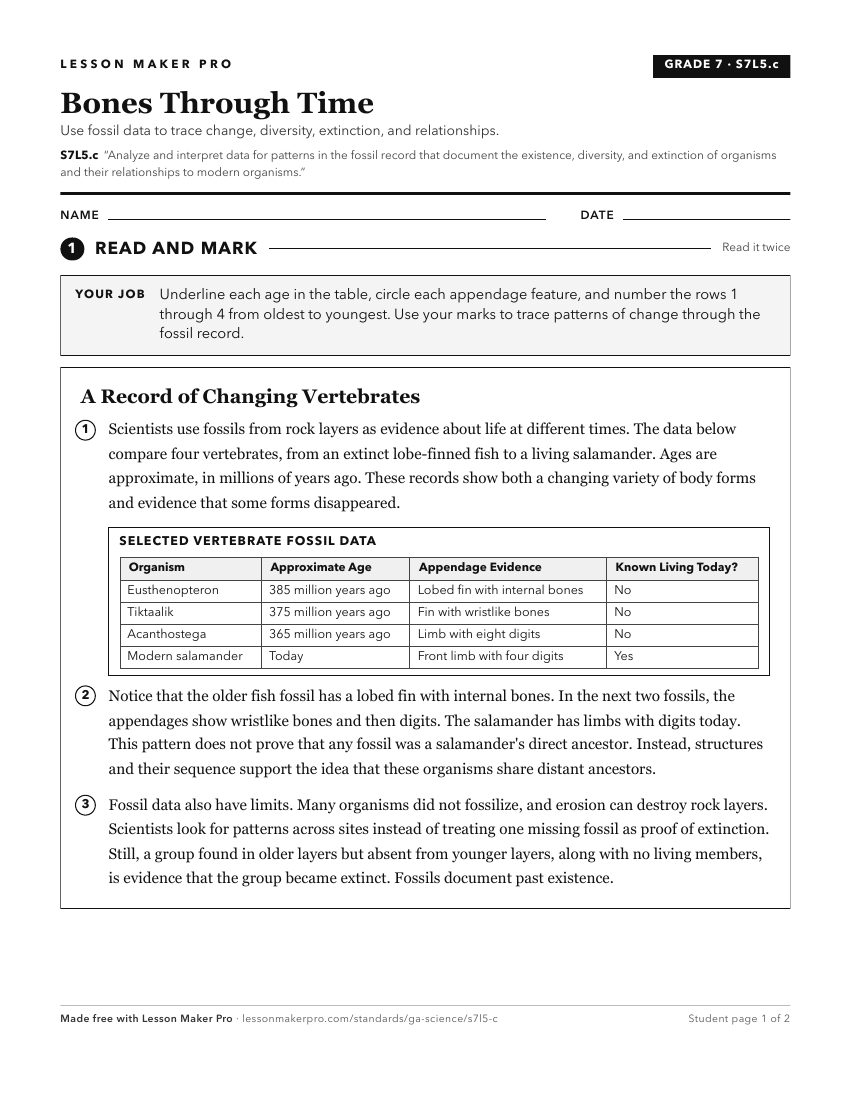
A ready-to-print activity worksheet aligned to S7L5.c, with an answer key for the teacher on its own page. No account needed.
PDF, US Letter, prints cleanly in black and white.
Download the worksheetKeep exploring
Related Standards
- S7L4.c
Analyze and interpret data to provide evidence for how resource availability, disease, climate, and human activity affect individual organisms, populations, com...
- S3E2
Obtain, evaluate, and communicate information on how fossils provide evidence of past organisms.
- S7L1
Obtain, evaluate, and communicate information to investigate the diversity of living organisms and how they can be compared scientifically.
- S3E2.a
Construct an argument from observations of fossils (authentic or reproductions) to communicate how they serve as evidence of past organisms and the environments...
Turn this exact standard into a lesson
Grade, subject, topic, and the complete standard are prefilled. Create one free, no account needed.
Also for this standard:Make a WorksheetMake a QuizMake a Sub Lesson