Georgia S6E4
Georgia Standard (Element Cluster)
Obtain, evaluate, and communicate information about how the sun, land, and water affect climate and weather.
Georgia Standards of Excellence for Science
Cluster contents
Elements in This Standard
S6E4 is a Georgia science standard. These are the elements under it.
- S6E4.a
Analyze and interpret data to compare and contrast the composition of Earth's atmospheric layers (including the ozone layer) and greenhouse gases.
- S6E4.b
Plan and carry out an investigation to demonstrate how energy from the sun transfers heat to air, land and water at different rates.
- S6E4.c
Develop a model demonstrating the interaction between unequal heating and the rotation of the Earth that causes local and global wind systems.
- S6E4.d
Construct an explanation of the relationship between air pressure, weather fronts, and air masses and meteorological events such as tornados and thunderstorms.
- S6E4.e
Analyze and interpret weather data to explain the effects of moisture evaporating from the ocean on weather patterns and weather events such as hurricanes.
Teacher's field guide
What This Cluster Means
What Students Need to Do
- Students analyze weather and climate data to explain how solar energy heats land and water at different rates. They evaluate sources and use evidence to describe effects on temperature, wind, and precipitation.
What Mastery Looks Like
- Students can use maps, graphs, or temperature data to compare coastal and inland locations. They can predict a weather pattern and support the prediction with evidence about sunlight, land, or water.
Common Misconceptions
- Students often treat weather and climate as the same thing. They may think land and water heat equally, or that the sun directly creates wind without temperature and pressure differences.
How to Assess It
- Give students this exit ticket: Sand and ocean water are both 20°C at 8 a.m.; at 2 p.m., sand is 34°C and water is 23°C. Predict the wind direction and explain why.
Lesson moves
Ways to Teach It
Place thermometers in trays of dry sand and water under a lamp, record temperatures every two minutes, then graph the results.
Compare climate graphs for Savannah and Macon, then write a claim explaining why their yearly temperature ranges differ.
Play a card match using weather scenarios, temperature data, and causes such as uneven heating, water proximity, or sunlight angle.
Compare tomorrow's forecasts for a Georgia coastal city and inland city, then explain how nearby ocean water may affect each forecast.
Free download
Printable S6E4 Worksheet
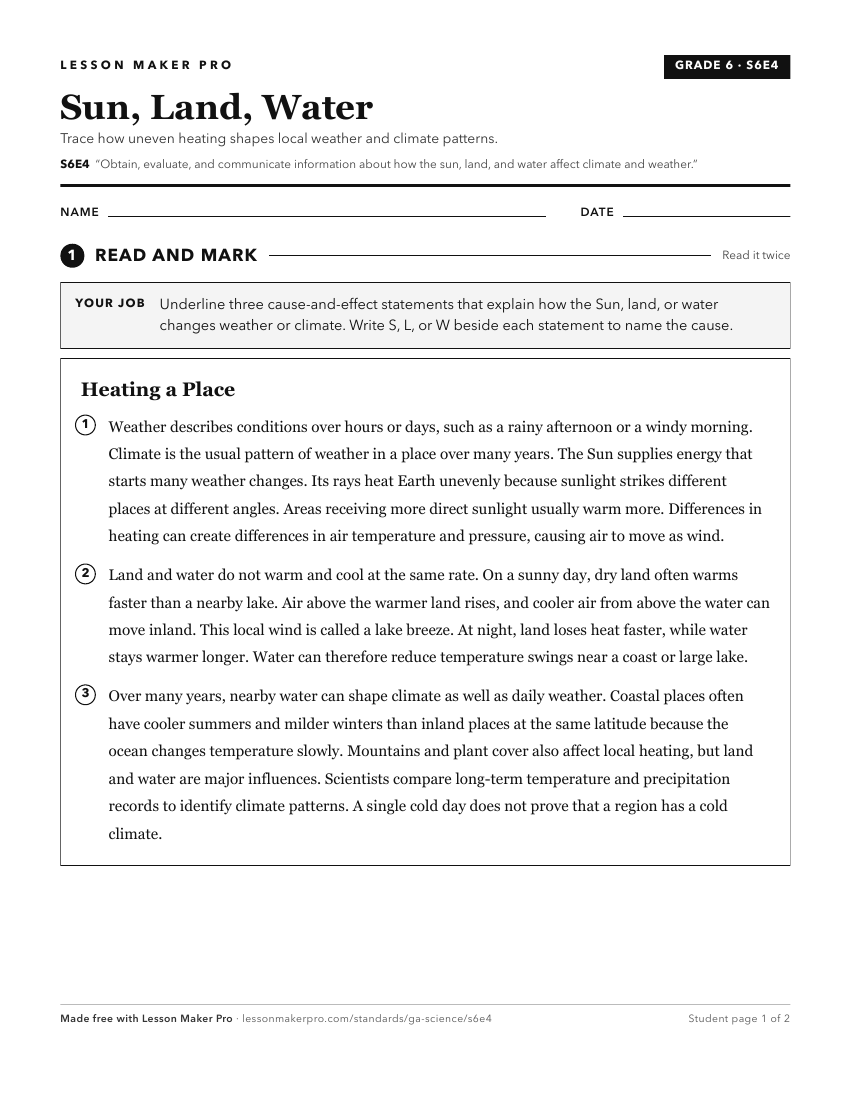
A ready-to-print activity worksheet aligned to S6E4, with an answer key for the teacher on its own page. No account needed.
PDF, US Letter, prints cleanly in black and white.
Download the worksheetKeep exploring
Related Standards
- S1E1
Obtain, evaluate, and communicate weather data to identify weather patterns.
- S4E3
Obtain, evaluate, and communicate information to demonstrate the water cycle.
- S2E3
Obtain, evaluate, and communicate information about how weather, plants, animals, and humans cause changes to the environment.
- S2E2
Obtain, evaluate, and communicate information to develop an understanding of the patterns of the sun and the moon and the sun's effect on Earth.
Turn this cluster into a lesson
Grade, subject, topic, and the complete cluster are prefilled. Create one free, no account needed.
Also for this cluster:Make a WorksheetMake a QuizMake a Sub Lesson