Georgia S2E2
Georgia Standard (Element Cluster)
Obtain, evaluate, and communicate information to develop an understanding of the patterns of the sun and the moon and the sun's effect on Earth.
Georgia Standards of Excellence for Science
Cluster contents
Elements in This Standard
S2E2 is a Georgia science standard. These are the elements under it.
- S2E2.a
Plan and carry out an investigation to determine the effect of the position of the sun in relation to a fixed object on Earth at various times of the day.
- S2E2.b
Design and build a structure that demonstrates how shadows change throughout the day.
- S2E2.c
Represent data in tables and/or graphs of the length of the day and night to recognize the change in seasons.
- S2E2.d
Use data from personal observations to describe, illustrate, and predict how the appearance of the moon changes over time in a pattern.
Teacher's field guide
What This Cluster Means
What Students Need to Do
- Students observe and record repeating changes in the Sun’s position, shadows, daylight, and the Moon’s appearance. They use observations and simple data to describe patterns and explain how sunlight affects Earth.
What Mastery Looks Like
- Students can compare observations from different times and identify a repeating pattern. They can explain that sunlight warms and lights Earth, and that changing Sun positions produce changing shadows.
Common Misconceptions
- Students may think the Sun moves around Earth each day or that shadows stay the same length and direction. They may also think the Moon makes its own light or changes shape.
How to Assess It
- Give students pictures of a pole’s shadow in the morning, noon, and afternoon. Ask them to order the pictures and write one sentence explaining the changes.
Lesson moves
Ways to Teach It
Place a craft stick in clay outdoors, then measure and sketch its shadow in the morning, at noon, and in the afternoon.
Ask students to write: What patterns would you expect after observing the Sun and Moon for several days?
Match cards showing times of day, Sun positions, and shadow lengths, then explain each match to a partner.
Compare sunny and shaded playground surfaces with thermometers, then discuss how sunlight affects choices about clothing and play areas.
Free download
Printable S2E2 Worksheet
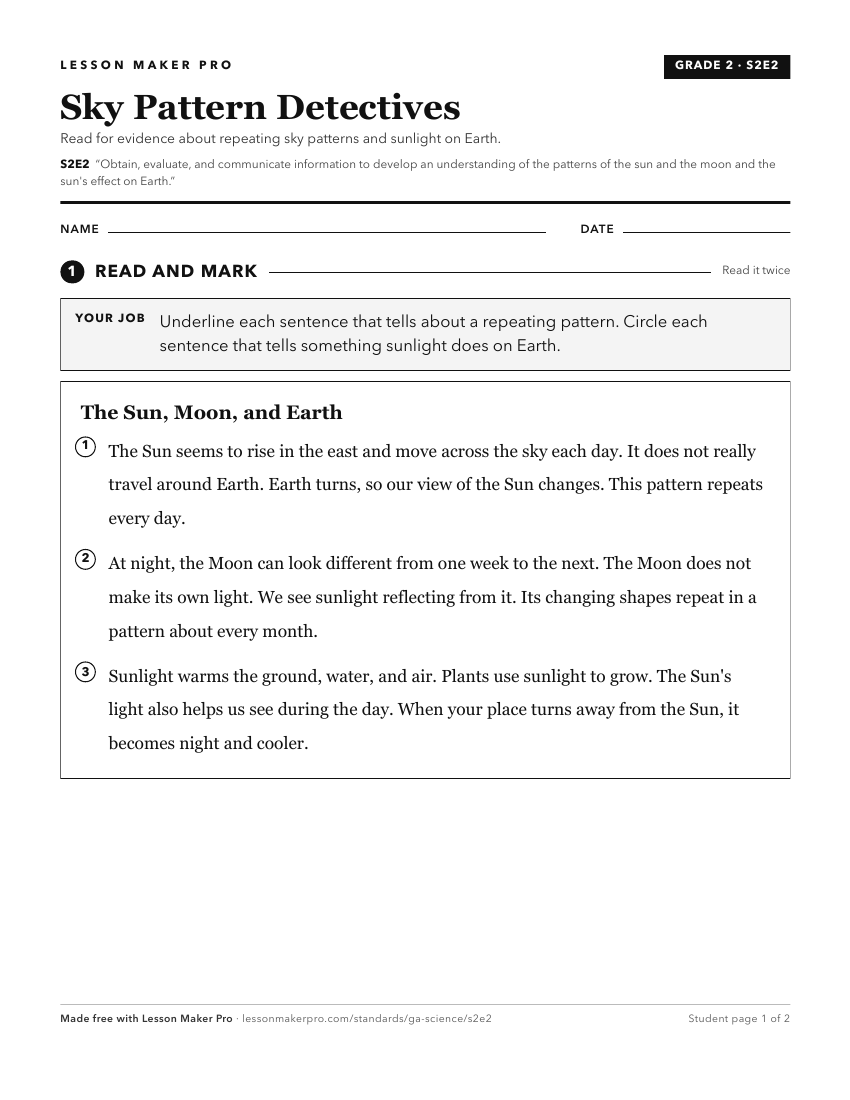
A ready-to-print activity worksheet aligned to S2E2, with an answer key for the teacher on its own page. No account needed.
PDF, US Letter, prints cleanly in black and white.
Download the worksheetKeep exploring
Related Standards
- S6E4
Obtain, evaluate, and communicate information about how the sun, land, and water affect climate and weather.
- S4E2
Obtain, evaluate, and communicate information to model the effects of the position and motion of the Earth and the moon in relation to the sun as observed from ...
- SKE1
Obtain, evaluate, and communicate observations about time patterns (day to night and night to day) and objects (sun, moon, stars) in the day and night sky.
- S6E2
Obtain, evaluate, and communicate information about the effects of the relative positions of the sun, Earth, and moon.
Turn this cluster into a lesson
Grade, subject, topic, and the complete cluster are prefilled. Create one free, no account needed.
Also for this cluster:Make a WorksheetMake a QuizMake a Sub Lesson