Georgia S2E2.c
The Standard
- S2E2
- Obtain, evaluate, and communicate information to develop an understanding of the patterns of the sun and the moon and the sun's effect on Earth.
Represent data in tables and/or graphs of the length of the day and night to recognize the change in seasons.
Georgia Standards of Excellence for Science · Obtain, evaluate, and communicate information to develop an understanding of the patterns of the sun and the moon and the sun's effect on Earth.
Teacher's field guide
What This Standard Means
What Students Need to Do
- Students organize daylight and nighttime data in a table or graph. They use the data to describe how day and night lengths change across seasons.
What Mastery Looks Like
- Students create a graph with clear labels and accurate bars or points. They explain that summer has longer days, winter has shorter days, and nighttime follows the opposite pattern.
Common Misconceptions
- Students may think day and night are always the same length. They may also reverse the pattern and claim winter has more daylight because the Sun is still visible each day.
How to Assess It
- Give students seasonal daylight data of 10, 12, 14, and 12 hours. Ask them to draw a labeled bar graph and identify the seasons with the longest day and longest night.
Lesson moves
Ways to Teach It
Give pairs monthly daylight data and linking cubes, then have them build side-by-side day and night bars for each season.
Ask, “How do day and night lengths change from winter to summer?” and require two graph details in each written response.
Play Season Match: students pair four daylight graphs with season cards and explain each match to a partner.
Use local sunrise and sunset times to plan an after-school soccer practice that ends before dark in two different seasons.
Free download
Printable S2E2.c Worksheet
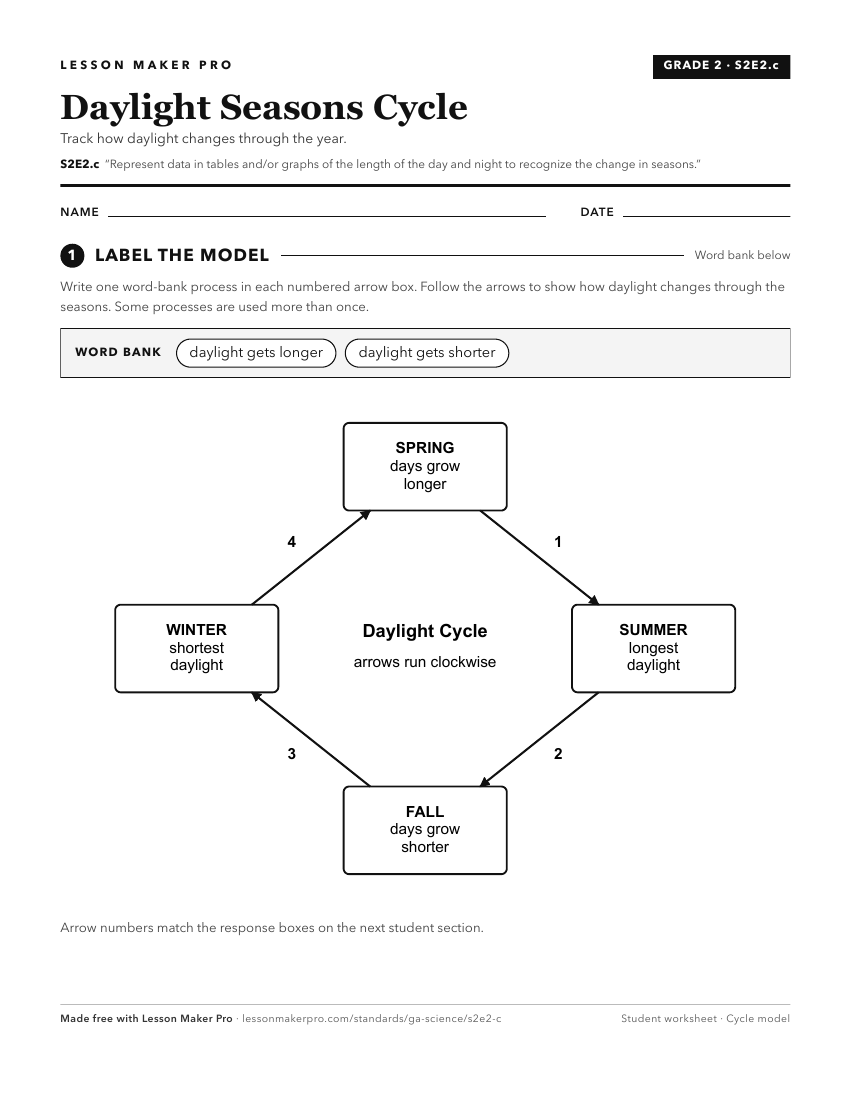
A ready-to-print activity worksheet aligned to S2E2.c, with an answer key for the teacher on its own page. No account needed.
PDF, US Letter, prints cleanly in black and white.
Download the worksheetKeep exploring
Related Standards
- S4E2.a
Develop a model to support an explanation of why the length of day and night change throughout the year.
- SKE1
Obtain, evaluate, and communicate observations about time patterns (day to night and night to day) and objects (sun, moon, stars) in the day and night sky.
- S1E1.a
Represent data in tables and/or graphs to identify and describe different types of weather and the characteristics of each type.
- S6E2.c
Analyze and interpret data to relate the tilt of the Earth to the distribution of sunlight throughout the year and its effect on seasons.
Turn this exact standard into a lesson
Grade, subject, topic, and the complete standard are prefilled. Create one free, no account needed.
Also for this standard:Make a WorksheetMake a QuizMake a Sub Lesson