Georgia S4E2.a
The Standard
- S4E2
- Obtain, evaluate, and communicate information to model the effects of the position and motion of the Earth and the moon in relation to the sun as observed from the Earth.
Develop a model to support an explanation of why the length of day and night change throughout the year.
Georgia Standards of Excellence for Science · Obtain, evaluate, and communicate information to model the effects of the position and motion of the Earth and the moon in relation to the sun as observed from the Earth.
Teacher's field guide
What This Standard Means
What Students Need to Do
- Students build and use a model showing Earth’s tilt, rotation, and path around the sun. They explain how these motions change the hours of daylight during the year.
What Mastery Looks Like
- A student can use a lamp and tilted globe to compare daylight at different points in Earth’s orbit. The student explains that Earth’s tilt causes longer summer days and shorter winter days.
Common Misconceptions
- Students may think daylight changes because Earth spins faster or moves much closer to the sun. They may also think every place on Earth has the same daylight length.
How to Assess It
- Give students diagrams of Earth at two points in its orbit. Ask which position gives Georgia more daylight and require one sentence using tilt and sunlight.
Lesson moves
Ways to Teach It
Shine a lamp on a tilted globe, rotate it, and mark how long Georgia stays in the lit half.
Ask students to explain why sunset occurs later in June than in December using Earth’s tilt and orbit.
Play a card sort matching seasonal Earth positions with longer days, shorter days, and nearly equal day and night.
Compare local sunrise and sunset times from four dates, then calculate and graph the hours of daylight.
Free download
Printable S4E2.a Worksheet
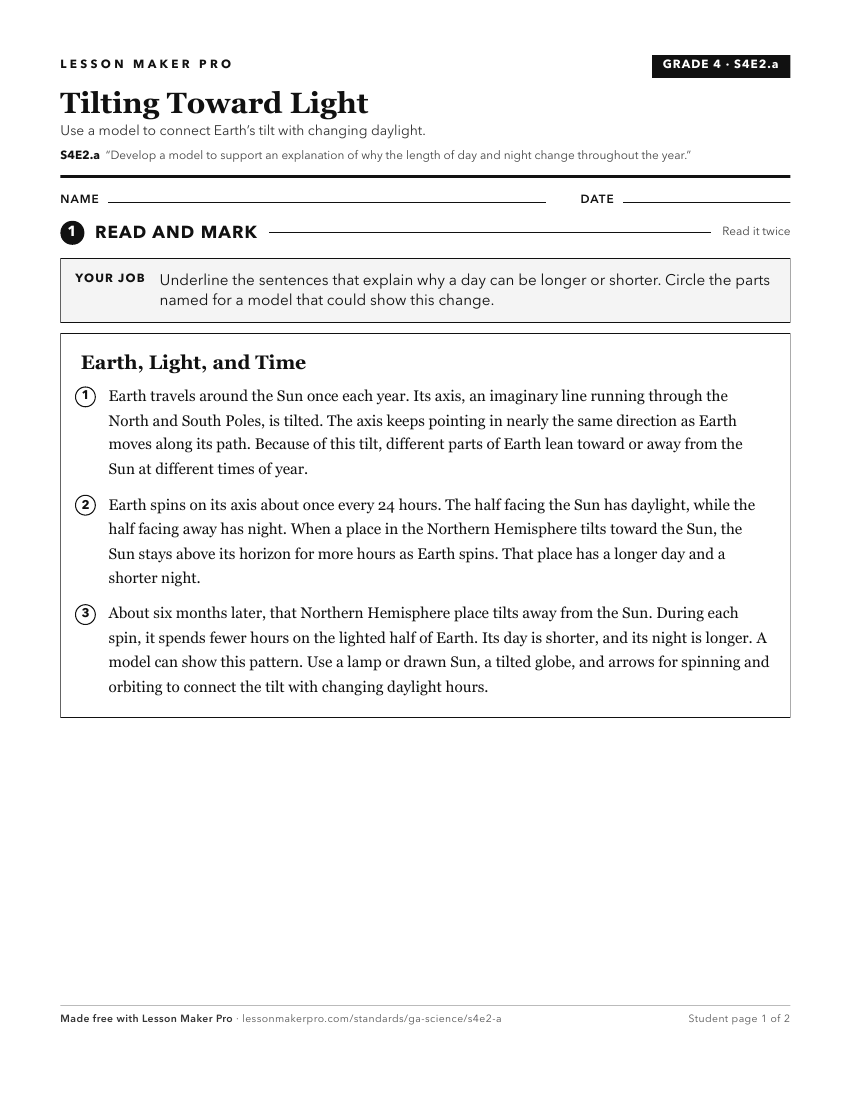
A ready-to-print activity worksheet aligned to S4E2.a, with an answer key for the teacher on its own page. No account needed.
PDF, US Letter, prints cleanly in black and white.
Download the worksheetKeep exploring
Related Standards
- S4E2.c
Construct an explanation of how the Earth's orbit, with its consistent tilt, affects seasonal changes.
- S2E2.c
Represent data in tables and/or graphs of the length of the day and night to recognize the change in seasons.
- SKE1.b
Develop a model to communicate the changes that occur in the sky during the day, as day turns into night, during the night, and as night turns into day using pi...
- S2E2.b
Design and build a structure that demonstrates how shadows change throughout the day.
Turn this exact standard into a lesson
Grade, subject, topic, and the complete standard are prefilled. Create one free, no account needed.
Also for this standard:Make a WorksheetMake a QuizMake a Sub Lesson