Georgia SKE1.b
The Standard
- SKE1
- Obtain, evaluate, and communicate observations about time patterns (day to night and night to day) and objects (sun, moon, stars) in the day and night sky.
Develop a model to communicate the changes that occur in the sky during the day, as day turns into night, during the night, and as night turns into day using pictures and words.
Georgia Standards of Excellence for Science · Obtain, evaluate, and communicate observations about time patterns (day to night and night to day) and objects (sun, moon, stars) in the day and night sky.
Teacher's field guide
What This Standard Means
What Students Need to Do
- Students create a simple sequence model showing how the sky looks across a full day and night. They use drawings, labels, and spoken words to explain each change.
What Mastery Looks Like
- Students place daytime, sunset, nighttime, and sunrise scenes in order. They include suitable sky objects and explain how light and appearance change between scenes.
Common Misconceptions
- Students may think night begins suddenly or that sunrise and sunset are the same event. They may also think the moon appears only at night or stars vanish during daylight.
How to Assess It
- Give students four boxes labeled day, sunset, night, and sunrise. Ask them to draw each sky, add one word, and explain the sequence.
Lesson moves
Ways to Teach It
Make a paper plate sky wheel with day, sunset, night, and sunrise scenes, then rotate it while describing each change.
Show sunrise and sunset photos, then ask, “What clues tell you whether night is beginning or ending?”
Give pairs sky picture cards to arrange in order, then have them explain their sequence to another pair.
Have students observe the sky one evening and the next morning, then bring two labeled drawings to compare.
Free download
Printable SKE1.b Worksheet
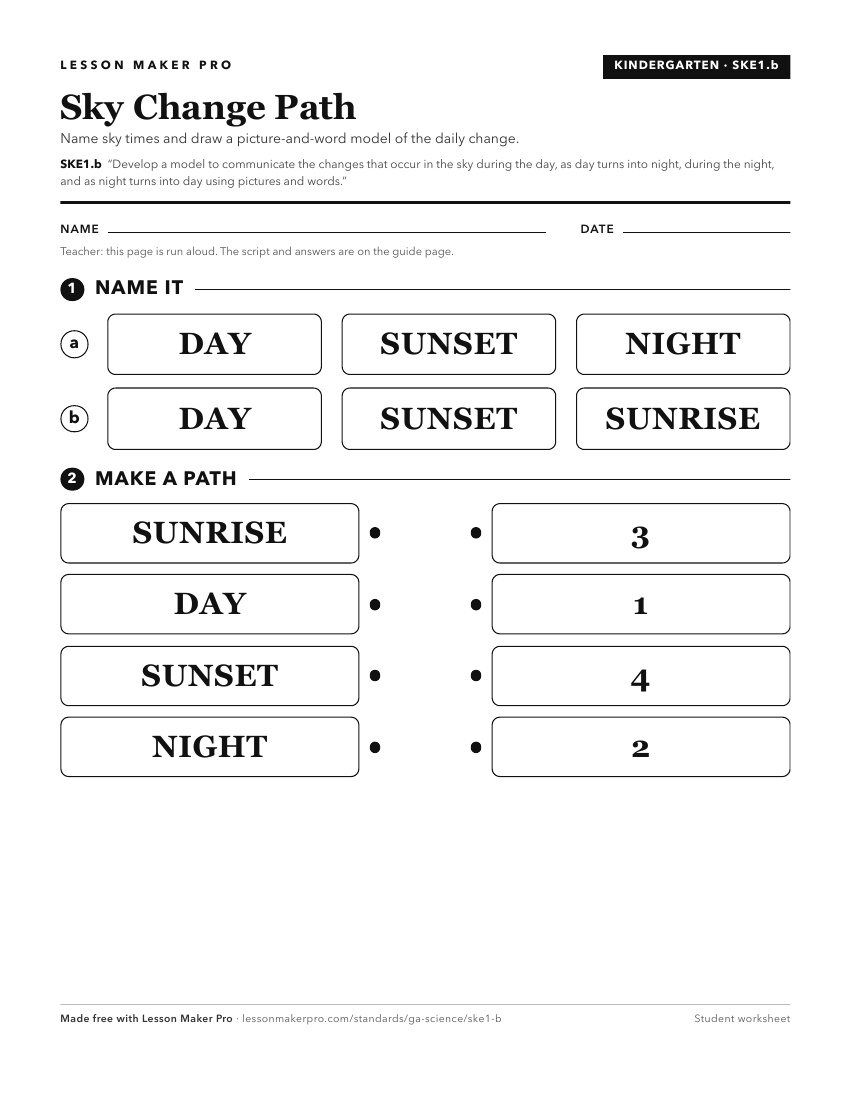
A ready-to-print activity worksheet aligned to SKE1.b, with an answer key for the teacher on its own page. No account needed.
PDF, US Letter, prints cleanly in black and white.
Download the worksheetKeep exploring
Related Standards
- S6E2.a
Develop and use a model to demonstrate the phases of the moon by showing the relative positions of the sun, Earth, and moon.
- S4E2.a
Develop a model to support an explanation of why the length of day and night change throughout the year.
- S2E2.c
Represent data in tables and/or graphs of the length of the day and night to recognize the change in seasons.
- SKE1
Obtain, evaluate, and communicate observations about time patterns (day to night and night to day) and objects (sun, moon, stars) in the day and night sky.
Turn this exact standard into a lesson
Grade, subject, topic, and the complete standard are prefilled. Create one free, no account needed.
Also for this standard:Make a WorksheetMake a QuizMake a Sub Lesson