Georgia S6E2.a
The Standard
- S6E2
- Obtain, evaluate, and communicate information about the effects of the relative positions of the sun, Earth, and moon.
Develop and use a model to demonstrate the phases of the moon by showing the relative positions of the sun, Earth, and moon.
Georgia Standards of Excellence for Science · Obtain, evaluate, and communicate information about the effects of the relative positions of the sun, Earth, and moon.
Teacher's field guide
What This Standard Means
What Students Need to Do
- Students build or interpret a model showing the sun, Earth, and moon in different positions. They predict the moon phase seen from Earth and explain why the visible lit portion changes.
What Mastery Looks Like
- A student can arrange the sun, Earth, and moon for new, quarter, and full phases, then sketch the view from Earth. They can sequence all eight phases and distinguish waxing from waning.
Common Misconceptions
- Students often think Earth’s shadow causes moon phases or that the moon makes its own light. They may think the moon changes shape, or confuse waxing with waning and reverse the phase order.
How to Assess It
- Give students a diagram with the sun, Earth, and one moon position. Ask them to name the phase, shade its Earth view, and justify their answer using relative positions.
Lesson moves
Ways to Teach It
Use a lamp, globe, and foam moon; move the moon through eight orbit positions and photograph each view from Earth’s position.
Ask students to write: Why can we see a quarter moon when half of the moon is always illuminated?
Give pairs phase cards and position diagrams, then race to match, sequence, and justify each match using sun, Earth, and moon positions.
Use a monthlong moon calendar to compare predicted phases with students’ evening observations and explain differences caused by weather or timing.
Free download
Printable S6E2.a Worksheet
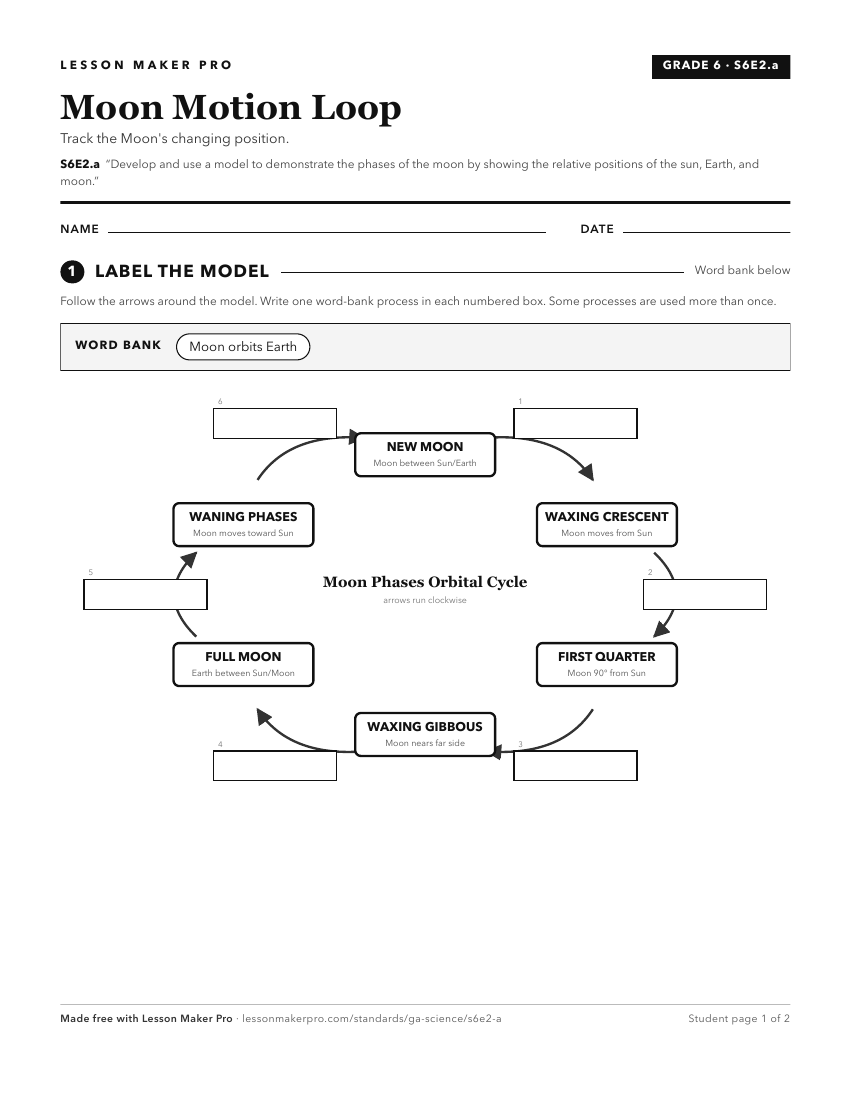
A ready-to-print activity worksheet aligned to S6E2.a, with an answer key for the teacher on its own page. No account needed.
PDF, US Letter, prints cleanly in black and white.
Download the worksheetKeep exploring
Related Standards
- S2E2.d
Use data from personal observations to describe, illustrate, and predict how the appearance of the moon changes over time in a pattern.
- S4E2
Obtain, evaluate, and communicate information to model the effects of the position and motion of the Earth and the moon in relation to the sun as observed from ...
- S4E2.b
Develop a model based on observations to describe the repeating pattern of the phases of the moon (new, crescent, quarter, gibbous, and full).
- S6E2
Obtain, evaluate, and communicate information about the effects of the relative positions of the sun, Earth, and moon.
Turn this exact standard into a lesson
Grade, subject, topic, and the complete standard are prefilled. Create one free, no account needed.
Also for this standard:Make a WorksheetMake a QuizMake a Sub Lesson