Georgia S4E2.b
The Standard
- S4E2
- Obtain, evaluate, and communicate information to model the effects of the position and motion of the Earth and the moon in relation to the sun as observed from the Earth.
Develop a model based on observations to describe the repeating pattern of the phases of the moon (new, crescent, quarter, gibbous, and full).
Georgia Standards of Excellence for Science · Obtain, evaluate, and communicate information to model the effects of the position and motion of the Earth and the moon in relation to the sun as observed from the Earth.
Teacher's field guide
What This Standard Means
What Students Need to Do
- Students record how the moon’s visible shape changes across several observations. They use those observations to create a model showing the phases increasing to full, decreasing to new, and repeating.
What Mastery Looks Like
- Students can arrange and name the phases in order, including the sequence after a full moon. They can use a labeled diagram or physical model to predict the next phase and explain that the visible portion of the moon’s lit half changes.
Common Misconceptions
- Students may think the moon makes its own light or that Earth’s shadow causes every phase. They may think a quarter moon means one quarter of the moon’s disk is visible. Some reverse or skip phases after the full moon.
How to Assess It
- On an exit ticket, show new, crescent, quarter, blank, full. Ask students to draw and name the missing phase, then predict the next two phases after full.
Lesson moves
Ways to Teach It
Darken the room, use a lamp as the sun and foam balls as moons, then sketch the visible lit shape at eight positions.
Show two moon photos and have students write which phase comes next and cite evidence from the repeating pattern.
Give pairs moon phase cards to arrange in a repeating cycle, then remove one card for partners to identify.
Use a local moon calendar to choose three observation dates, then have students predict and later record the moon’s shape.
Free download
Printable S4E2.b Worksheet
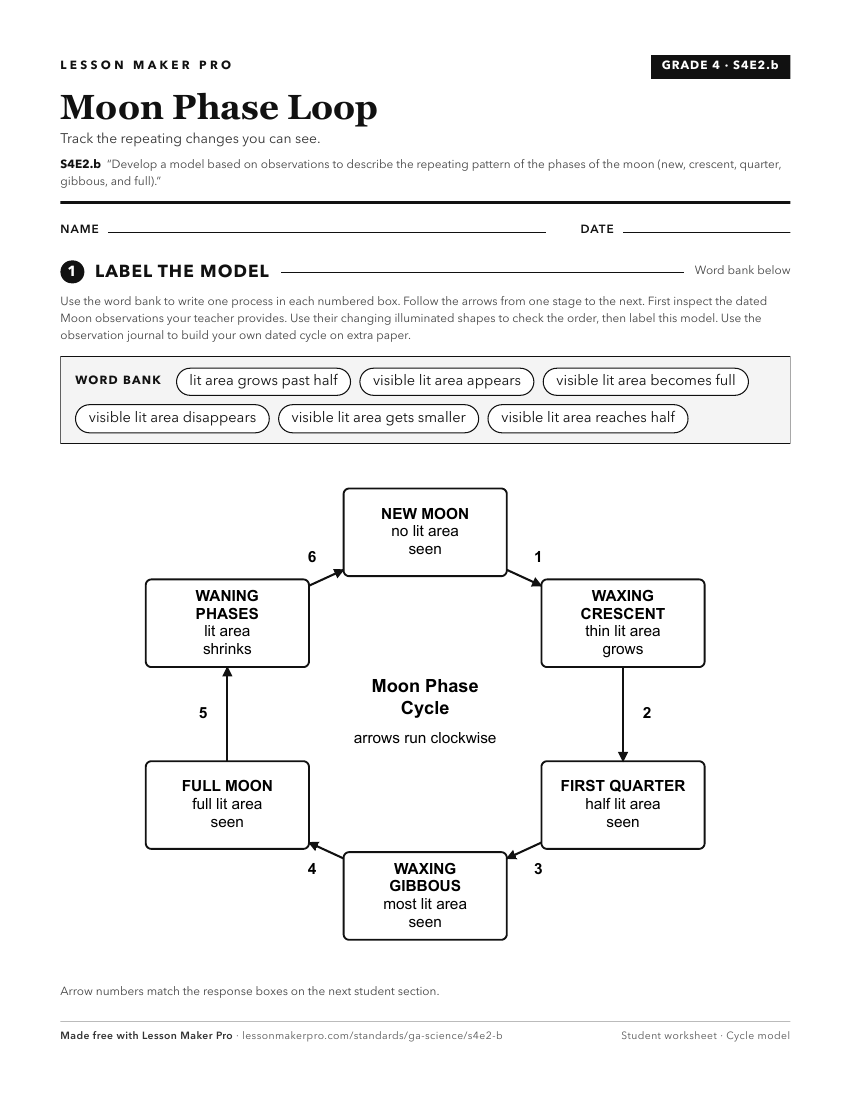
A ready-to-print activity worksheet aligned to S4E2.b, with an answer key for the teacher on its own page. No account needed.
PDF, US Letter, prints cleanly in black and white.
Download the worksheetKeep exploring
Related Standards
- S6E2.a
Develop and use a model to demonstrate the phases of the moon by showing the relative positions of the sun, Earth, and moon.
- S2E2.d
Use data from personal observations to describe, illustrate, and predict how the appearance of the moon changes over time in a pattern.
- SKE1
Obtain, evaluate, and communicate observations about time patterns (day to night and night to day) and objects (sun, moon, stars) in the day and night sky.
- SKE1.b
Develop a model to communicate the changes that occur in the sky during the day, as day turns into night, during the night, and as night turns into day using pi...
Turn this exact standard into a lesson
Grade, subject, topic, and the complete standard are prefilled. Create one free, no account needed.
Also for this standard:Make a WorksheetMake a QuizMake a Sub Lesson