Georgia S4E2
Georgia Standard (Element Cluster)
Obtain, evaluate, and communicate information to model the effects of the position and motion of the Earth and the moon in relation to the sun as observed from the Earth.
Georgia Standards of Excellence for Science
Cluster contents
Elements in This Standard
S4E2 is a Georgia science standard. These are the elements under it.
- S4E2.a
Develop a model to support an explanation of why the length of day and night change throughout the year.
- S4E2.b
Develop a model based on observations to describe the repeating pattern of the phases of the moon (new, crescent, quarter, gibbous, and full).
- S4E2.c
Construct an explanation of how the Earth's orbit, with its consistent tilt, affects seasonal changes.
Teacher's field guide
What This Cluster Means
What Students Need to Do
- Students use diagrams and physical models to explain why daylight length and seasons change as Earth orbits with a steady tilt. They use repeated observations to describe and predict the Moon’s phase pattern.
What Mastery Looks Like
- A student can model Earth orbiting the Sun and the Moon orbiting Earth while Earth’s axis keeps pointing in the same direction. The student predicts daylight length, seasons, and Moon phases, then supports each prediction with the model.
Common Misconceptions
- Students may think the Moon makes its own light or that Earth’s shadow causes every phase. They may say seasons happen because Earth moves closer to the Sun or turn Earth’s tilt as it orbits. Some confuse Earth’s daily rotation with its yearly orbit.
How to Assess It
- Ask students to draw Earth with the Northern Hemisphere tilted toward the Sun and the Moon one-quarter orbit past new moon. Have them label the season, compare daylight with nighttime, name the Moon phase, and explain each answer.
Lesson moves
Ways to Teach It
Darken the room, keep a lamp fixed, and have groups move a tilted globe and foam Moon to model seasons, daylight, and phases.
Ask pairs: Why is a half-lit Moon not always seen as a half moon, and why does Earth’s tilt cause seasons?
Give teams position cards and observation cards, then race to match each arrangement with its season, daylight length, or Moon phase.
Have students graph local sunrise and sunset times, then connect the longest and shortest days to Earth’s tilt and orbit.
Free download
Printable S4E2 Worksheet
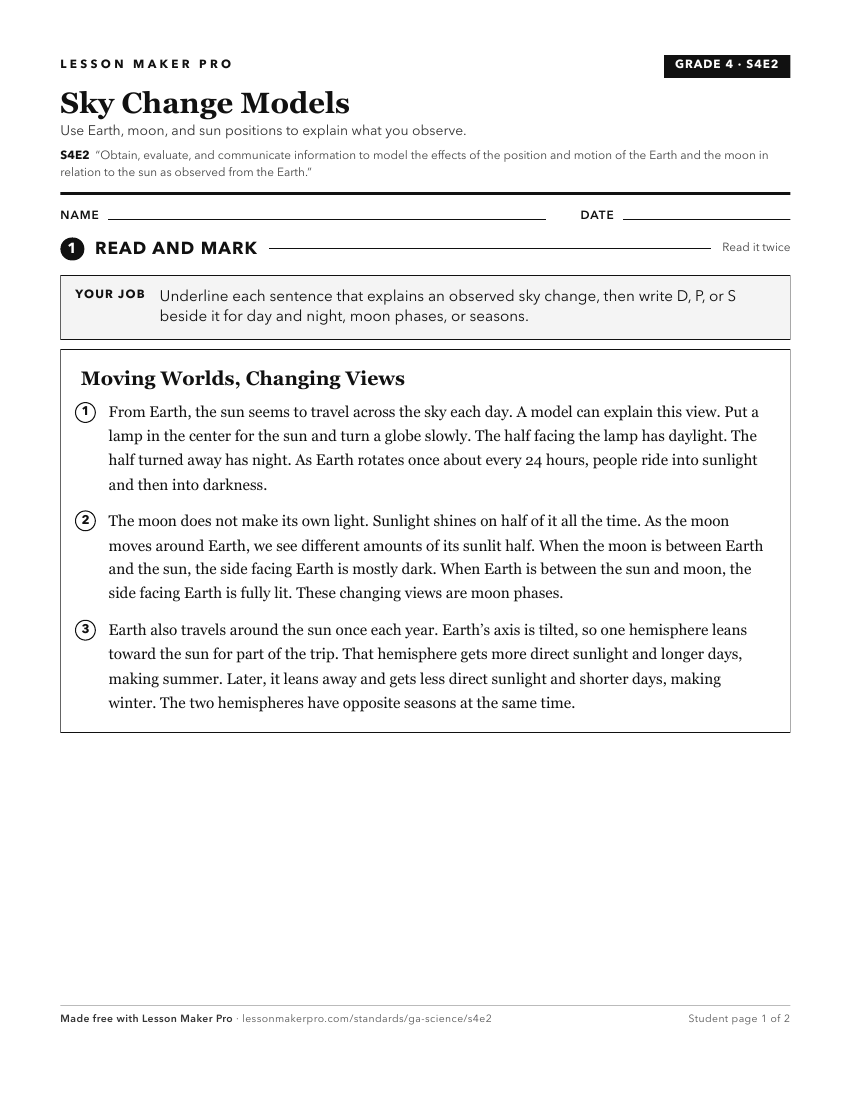
A ready-to-print activity worksheet aligned to S4E2, with an answer key for the teacher on its own page. No account needed.
PDF, US Letter, prints cleanly in black and white.
Download the worksheetKeep exploring
Related Standards
- S6E2.a
Develop and use a model to demonstrate the phases of the moon by showing the relative positions of the sun, Earth, and moon.
- S6E4
Obtain, evaluate, and communicate information about how the sun, land, and water affect climate and weather.
- S2E2
Obtain, evaluate, and communicate information to develop an understanding of the patterns of the sun and the moon and the sun's effect on Earth.
- S6E2
Obtain, evaluate, and communicate information about the effects of the relative positions of the sun, Earth, and moon.
Turn this cluster into a lesson
Grade, subject, topic, and the complete cluster are prefilled. Create one free, no account needed.
Also for this cluster:Make a WorksheetMake a QuizMake a Sub Lesson