Georgia S6E4.d
The Standard
- S6E4
- Obtain, evaluate, and communicate information about how the sun, land, and water affect climate and weather.
Construct an explanation of the relationship between air pressure, weather fronts, and air masses and meteorological events such as tornados and thunderstorms.
Georgia Standards of Excellence for Science · Obtain, evaluate, and communicate information about how the sun, land, and water affect climate and weather.
Teacher's field guide
What This Standard Means
What Students Need to Do
- Students read weather maps and data to track air masses, fronts, and pressure changes. They use evidence to explain how these conditions can produce thunderstorms and support tornado formation.
What Mastery Looks Like
- Students can identify warm and cold fronts, high and low pressure areas, and the likely movement of air masses. They explain how rising warm, moist air, instability, and changing winds can lead to severe storms.
Common Misconceptions
- Students may think low pressure always causes tornadoes or that every front produces severe weather. They may also confuse a front with an air mass or assume cold fronts only bring colder temperatures.
How to Assess It
- Give students a weather map showing a cold front moving toward warm, moist air near a low pressure center. Ask them to predict the weather and support the prediction with two map features.
Lesson moves
Ways to Teach It
Place warm red water and cold blue water at opposite ends of a clear tray, then observe movement along their boundary.
Ask students to explain why a falling barometer and an approaching cold front may signal thunderstorms but do not guarantee a tornado.
Run a weather map relay where teams match air masses, fronts, pressure patterns, and storm forecasts, then defend each match.
Compare a local severe weather report with archived pressure and front maps, then write a short evidence based explanation.
Free download
Printable S6E4.d Worksheet
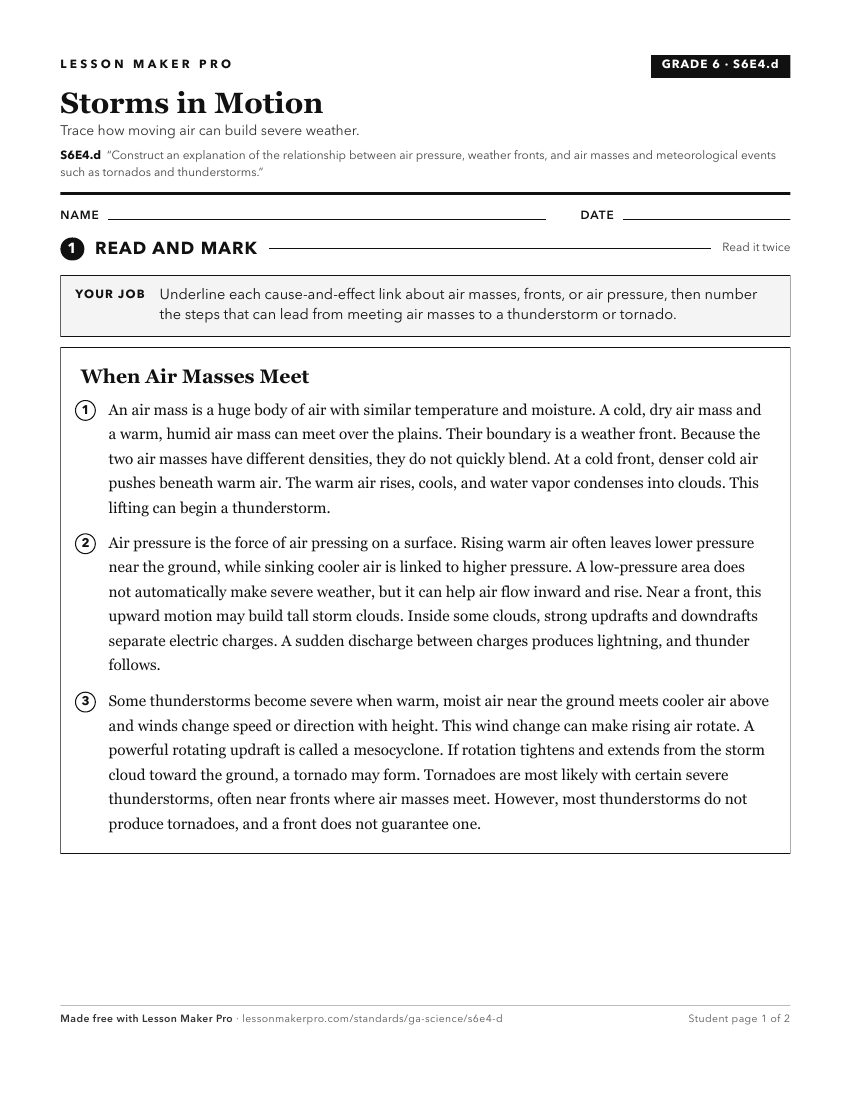
A ready-to-print activity worksheet aligned to S6E4.d, with an answer key for the teacher on its own page. No account needed.
PDF, US Letter, prints cleanly in black and white.
Download the worksheetKeep exploring
Related Standards
- S4E4.d
Construct an explanation based on research to communicate the difference between weather and climate.
- S4E4.b
Interpret data from weather maps, including fronts (warm, cold, and stationary), temperature, pressure, and precipitation to make an informed prediction about t...
- S4E4.a
Construct an explanation of how weather instruments (thermometer, rain gauge, barometer, wind vane, and anemometer) are used in gathering weather data and makin...
- S4E4.c
Ask questions and use observations of cloud types (cirrus, stratus, and cumulus) and data of weather conditions to predict weather events.
Turn this exact standard into a lesson
Grade, subject, topic, and the complete standard are prefilled. Create one free, no account needed.
Also for this standard:Make a WorksheetMake a QuizMake a Sub Lesson