Georgia S4E4.b
The Standard
- S4E4
- Obtain, evaluate, and communicate information to predict weather events and infer weather patterns using weather charts/maps and collected weather data.
Interpret data from weather maps, including fronts (warm, cold, and stationary), temperature, pressure, and precipitation to make an informed prediction about tomorrow's weather.
Georgia Standards of Excellence for Science · Obtain, evaluate, and communicate information to predict weather events and infer weather patterns using weather charts/maps and collected weather data.
Teacher's field guide
What This Standard Means
What Students Need to Do
- Students read symbols, colors, and numbers on a weather map. They connect moving fronts, temperature, air pressure, and precipitation to predict the next day’s weather.
What Mastery Looks Like
- Students give a reasonable forecast and support it with at least two map clues. They explain likely changes as a warm, cold, or stationary front approaches.
Common Misconceptions
- Students may think front symbols show where rain is falling rather than where air masses meet. They may ignore pressure or assume cold fronts always bring snow. Some think a stationary front means clear weather.
How to Assess It
- Display a local weather map and ask: What will tomorrow’s weather likely be? Write a forecast and circle two map clues that support it.
Lesson moves
Ways to Teach It
Give groups laminated weather maps and weather icon cards, then have them place tomorrow’s likely conditions on each map.
Have students write which map clue gives the strongest forecast evidence, then defend their choice to a partner.
Run a Weather Map Relay where teams identify a front, read temperature and pressure, and choose the best forecast card.
Use the local evening weather map to make class predictions, then compare them with next day’s observed temperature and precipitation.
Free download
Printable S4E4.b Worksheet
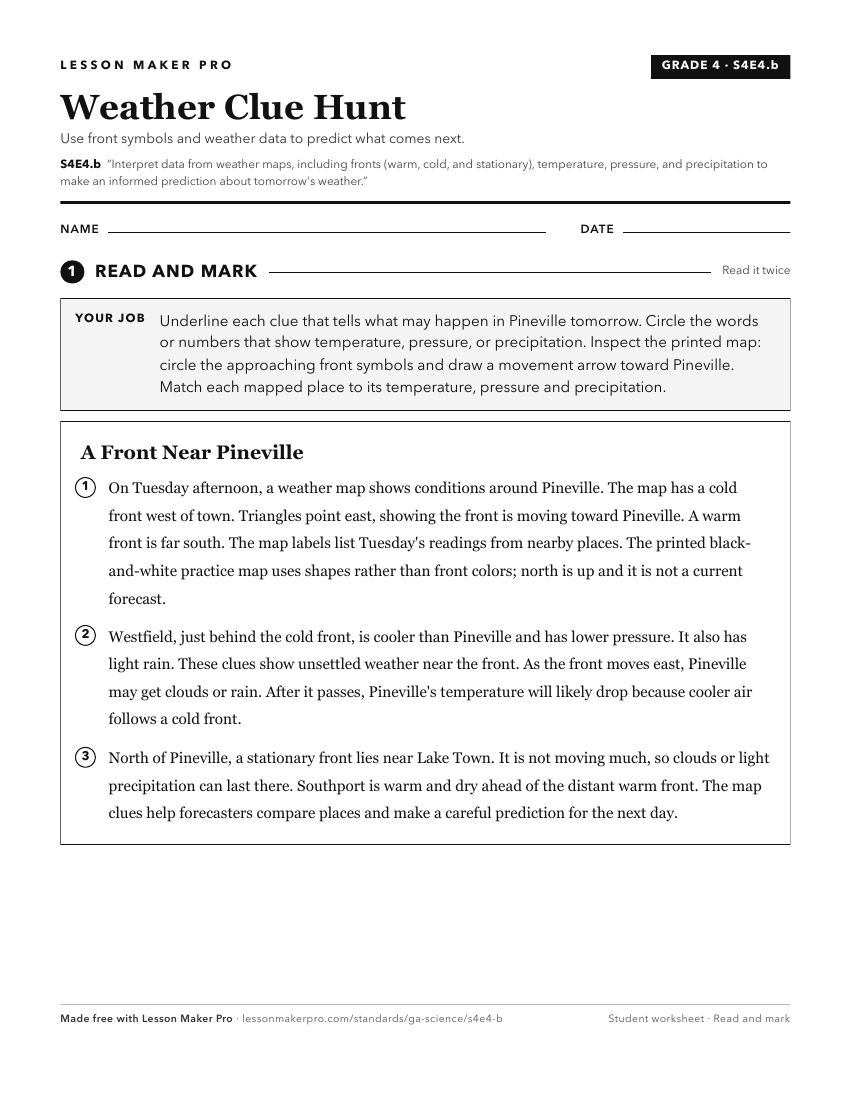
A ready-to-print activity worksheet aligned to S4E4.b, with an answer key for the teacher on its own page. No account needed.
PDF, US Letter, prints cleanly in black and white.
Download the worksheetKeep exploring
Related Standards
- S4E4
Obtain, evaluate, and communicate information to predict weather events and infer weather patterns using weather charts/maps and collected weather data.
- S1E1
Obtain, evaluate, and communicate weather data to identify weather patterns.
- S4E4.c
Ask questions and use observations of cloud types (cirrus, stratus, and cumulus) and data of weather conditions to predict weather events.
- S1E1.a
Represent data in tables and/or graphs to identify and describe different types of weather and the characteristics of each type.
Turn this exact standard into a lesson
Grade, subject, topic, and the complete standard are prefilled. Create one free, no account needed.
Also for this standard:Make a WorksheetMake a QuizMake a Sub Lesson