Georgia S4E4.a
The Standard
- S4E4
- Obtain, evaluate, and communicate information to predict weather events and infer weather patterns using weather charts/maps and collected weather data.
Construct an explanation of how weather instruments (thermometer, rain gauge, barometer, wind vane, and anemometer) are used in gathering weather data and making forecasts.
Georgia Standards of Excellence for Science · Obtain, evaluate, and communicate information to predict weather events and infer weather patterns using weather charts/maps and collected weather data.
Teacher's field guide
What This Standard Means
What Students Need to Do
- Students identify what each weather instrument measures and how its readings are recorded. They use changes in temperature, rainfall, air pressure, wind direction, and wind speed to explain a forecast.
What Mastery Looks Like
- Students correctly match each instrument to its measurement. They combine several readings, such as falling air pressure and increasing wind speed, to predict likely weather and support their prediction.
Common Misconceptions
- Students often confuse an anemometer with a wind vane or think both measure wind speed. They may treat one reading as enough for a forecast or think a rain gauge predicts future rainfall.
How to Assess It
- Give students data showing falling pressure, rising wind speed, and dropping temperature. Ask them to name the instruments used and write a one-sentence forecast with evidence.
Lesson moves
Ways to Teach It
Set up stations with a thermometer, rain gauge, barometer, wind vane, and anemometer for students to observe, measure, and record data.
Ask students to write which two weather measurements would best help predict a storm and explain their choices.
Play a matching relay where teams pair instrument cards with measurement cards, units, sample readings, and forecast clues.
Compare the class weather data with a local forecast, then identify which measurements may have supported the meteorologist's prediction.
Free download
Printable S4E4.a Worksheet
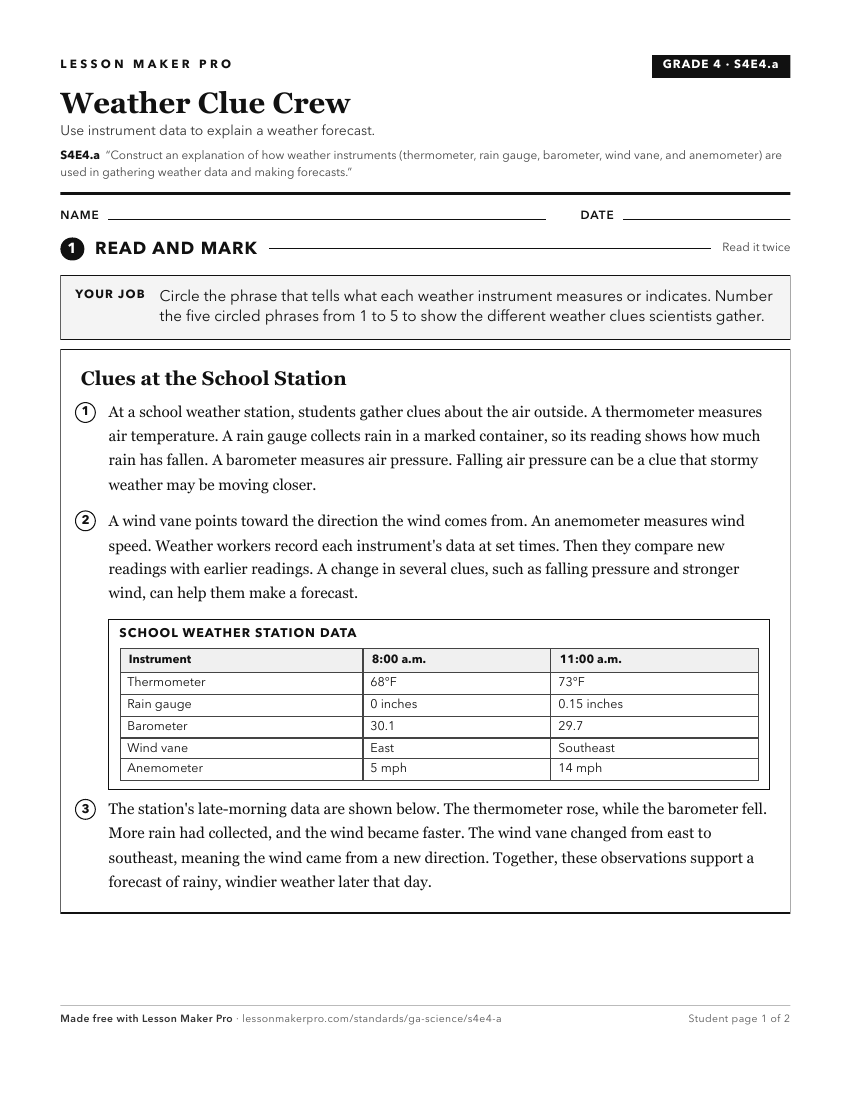
A ready-to-print activity worksheet aligned to S4E4.a, with an answer key for the teacher on its own page. No account needed.
PDF, US Letter, prints cleanly in black and white.
Download the worksheetKeep exploring
Related Standards
- S4E4.d
Construct an explanation based on research to communicate the difference between weather and climate.
- S6E4.d
Construct an explanation of the relationship between air pressure, weather fronts, and air masses and meteorological events such as tornados and thunderstorms.
- S1E1.a
Represent data in tables and/or graphs to identify and describe different types of weather and the characteristics of each type.
- S1E1.c
Plan and carry out investigations on current weather conditions by observing, measuring with simple weather instruments (thermometer, wind vane, rain gauge), an...
Turn this exact standard into a lesson
Grade, subject, topic, and the complete standard are prefilled. Create one free, no account needed.
Also for this standard:Make a WorksheetMake a QuizMake a Sub Lesson