Georgia S6E4.a
The Standard
- S6E4
- Obtain, evaluate, and communicate information about how the sun, land, and water affect climate and weather.
Analyze and interpret data to compare and contrast the composition of Earth's atmospheric layers (including the ozone layer) and greenhouse gases.
Georgia Standards of Excellence for Science · Obtain, evaluate, and communicate information about how the sun, land, and water affect climate and weather.
Teacher's field guide
What This Standard Means
What Students Need to Do
- Students use tables, graphs, and diagrams to track how gas amounts change with altitude. They compare atmospheric layers, locate the ozone-rich region, and distinguish common atmospheric gases from heat-trapping trace gases.
What Mastery Looks Like
- A student can show that nitrogen and oxygen dominate the lower atmosphere, while ozone peaks in the stratosphere and water vapor is concentrated near Earth. They compare layers using values or trends and correctly identify major greenhouse gases.
Common Misconceptions
- Students often think atmospheric layers have solid boundaries or completely different gases. They may think the ozone layer is pure ozone, greenhouse gases make up most air, or ozone loss directly causes global warming.
How to Assess It
- Give students an altitude profile showing ozone, water vapor, and carbon dioxide. Ask them to identify the ozone-rich layer, compare two gases, and cite two data points.
Lesson moves
Ways to Teach It
Build a five-layer atmosphere model with labeled cups, then place gas cards at heights supported by a provided concentration table.
Write: Why is the ozone layer not made only of ozone, and what evidence from the class graph supports your answer?
Play Layer Match: teams pair altitude, dominant gases, ozone concentration, and greenhouse gas clues with the correct atmospheric layer.
Compare printed weather balloon data with a satellite ozone profile, then explain what each instrument reveals about gases in the atmosphere.
Free download
Printable S6E4.a Worksheet
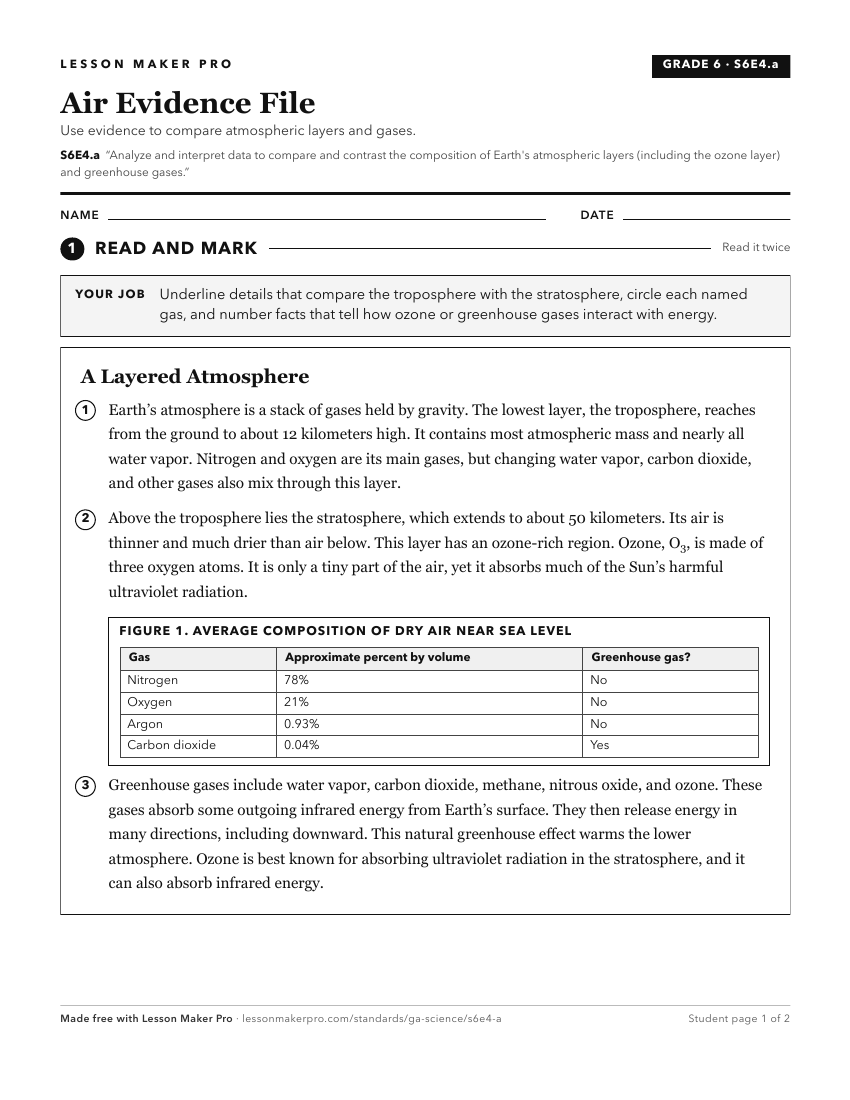
A ready-to-print activity worksheet aligned to S6E4.a, with an answer key for the teacher on its own page. No account needed.
PDF, US Letter, prints cleanly in black and white.
Download the worksheetKeep exploring
Related Standards
- S6E4
Obtain, evaluate, and communicate information about how the sun, land, and water affect climate and weather.
- SKE2
Obtain, evaluate, and communicate information to describe the physical attributes of earth materials (soil, rocks, water, and air).
- S6E2.c
Analyze and interpret data to relate the tilt of the Earth to the distribution of sunlight throughout the year and its effect on seasons.
- S6E5.a
Ask questions to compare and contrast the Earth's crust, mantle, inner and outer core, including temperature, density, thickness, and composition.
Turn this exact standard into a lesson
Grade, subject, topic, and the complete standard are prefilled. Create one free, no account needed.
Also for this standard:Make a WorksheetMake a QuizMake a Sub Lesson