Georgia S6E5.a
The Standard
- S6E5
- Obtain, evaluate, and communicate information to show how Earth's surface is formed.
Ask questions to compare and contrast the Earth's crust, mantle, inner and outer core, including temperature, density, thickness, and composition.
Georgia Standards of Excellence for Science · Obtain, evaluate, and communicate information to show how Earth's surface is formed.
Teacher's field guide
What This Standard Means
What Students Need to Do
- Students ask focused questions about how Earth’s four main layers differ. They use evidence to compare each layer’s temperature, density, thickness, physical state, and materials.
What Mastery Looks Like
- A student can organize reliable data in a table or labeled model and make accurate comparisons across layers. They can explain that temperature and density generally increase with depth, while thickness and physical state vary.
Common Misconceptions
- Students often picture the mantle as fully liquid and assume the inner core must be liquid because it is hottest. They may treat textbook diagrams as drawn to scale or confuse thickness with depth.
How to Assess It
- Give students four layer names and six data cards. Ask them to match the cards, write two accurate comparisons, and pose one question the data could answer.
Lesson moves
Ways to Teach It
Use a 64-centimeter paper strip to build a scaled cross section, then label each layer with temperature, density, state, and composition.
Write and defend a claim: Why is the hottest layer solid while the cooler layer above it is liquid?
Sort 20 layer clue cards into four labeled envelopes, then score each card only after stating an accurate comparison.
Read a short USGS seismic-wave diagram and explain how wave behavior provides evidence for a liquid outer core and solid inner core.
Free download
Printable S6E5.a Worksheet
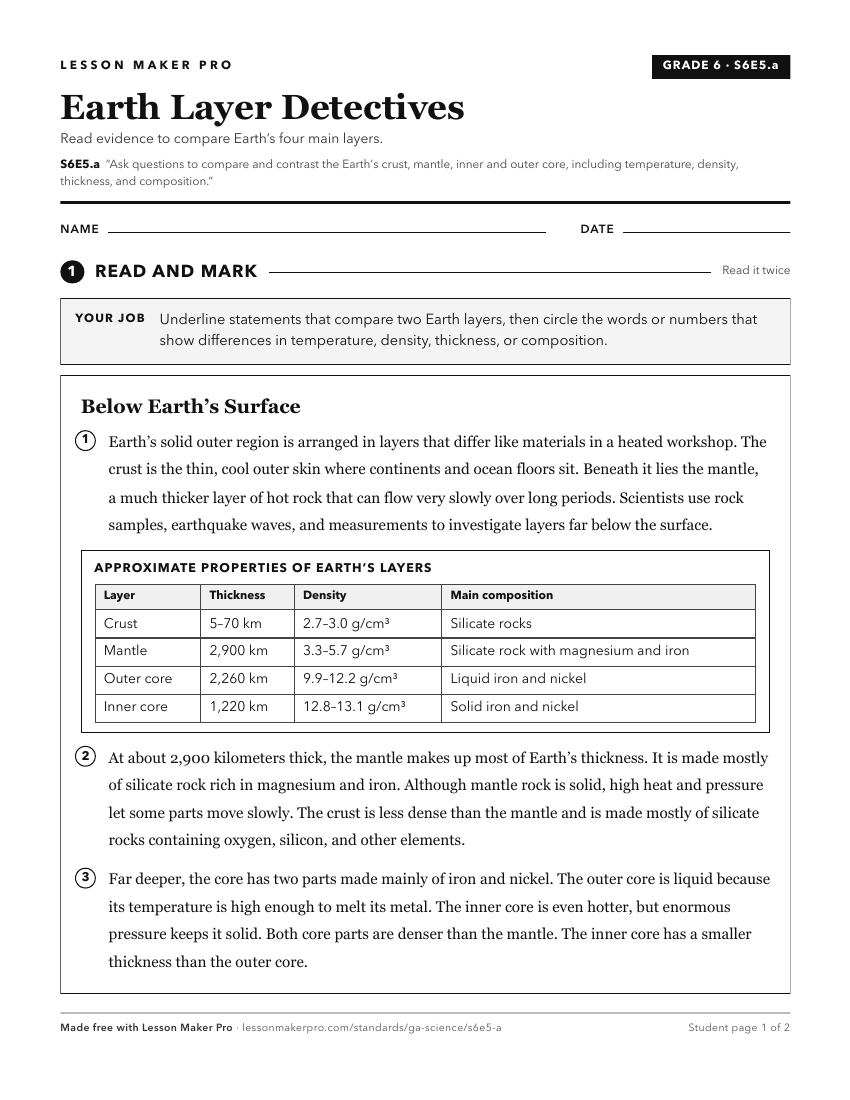
A ready-to-print activity worksheet aligned to S6E5.a, with an answer key for the teacher on its own page. No account needed.
PDF, US Letter, prints cleanly in black and white.
Download the worksheetKeep exploring
Related Standards
- S6E1.e
Ask questions to compare and contrast the characteristics, composition, and location of comets, asteroids, and meteoroids.
- SKE2.a
Ask questions to identify and describe earth materials—soil, rocks, water, and air.
- S6E4.a
Analyze and interpret data to compare and contrast the composition of Earth's atmospheric layers (including the ozone layer) and greenhouse gases.
- SKP1.a
Ask questions to compare and sort objects made of different materials. (Common materials include clay, cloth, plastic, wood, paper, and metal.)
Turn this exact standard into a lesson
Grade, subject, topic, and the complete standard are prefilled. Create one free, no account needed.
Also for this standard:Make a WorksheetMake a QuizMake a Sub Lesson