Georgia S6E1.e
The Standard
- S6E1
- Obtain, evaluate, and communicate information about current scientific views of the universe and how those views evolved.
Ask questions to compare and contrast the characteristics, composition, and location of comets, asteroids, and meteoroids.
Georgia Standards of Excellence for Science · Obtain, evaluate, and communicate information about current scientific views of the universe and how those views evolved.
Teacher's field guide
What This Standard Means
What Students Need to Do
- Students develop researchable questions that help distinguish small objects in the solar system. They compare size, shape, composition, origin, movement, and usual location using reliable evidence.
What Mastery Looks Like
- Students can identify a likely comet, asteroid, or meteoroid from a description or data table. They support the identification with at least two accurate clues about composition, size, origin, or location.
Common Misconceptions
- Students often use meteor, meteoroid, and meteorite as if they mean the same thing. They may think comets always have tails or that every asteroid stays in the asteroid belt.
How to Assess It
- Exit ticket: Complete a table for comet, asteroid, and meteoroid with one composition trait and one usual location. Then write one question that distinguishes two objects.
Lesson moves
Ways to Teach It
Give pairs 12 object cards with images, sizes, materials, and locations; students sort them and defend each placement with one clue.
Ask students to write three questions they would use to identify an unknown solar system object, then explain which question is most useful.
Play Space Object Detective by reading clue cards one at a time while teams identify the object and record evidence.
Read a one-page NASA planetary defense fact sheet, then explain why tracking asteroids differs from observing meteor showers.
Free download
Printable S6E1.e Worksheet
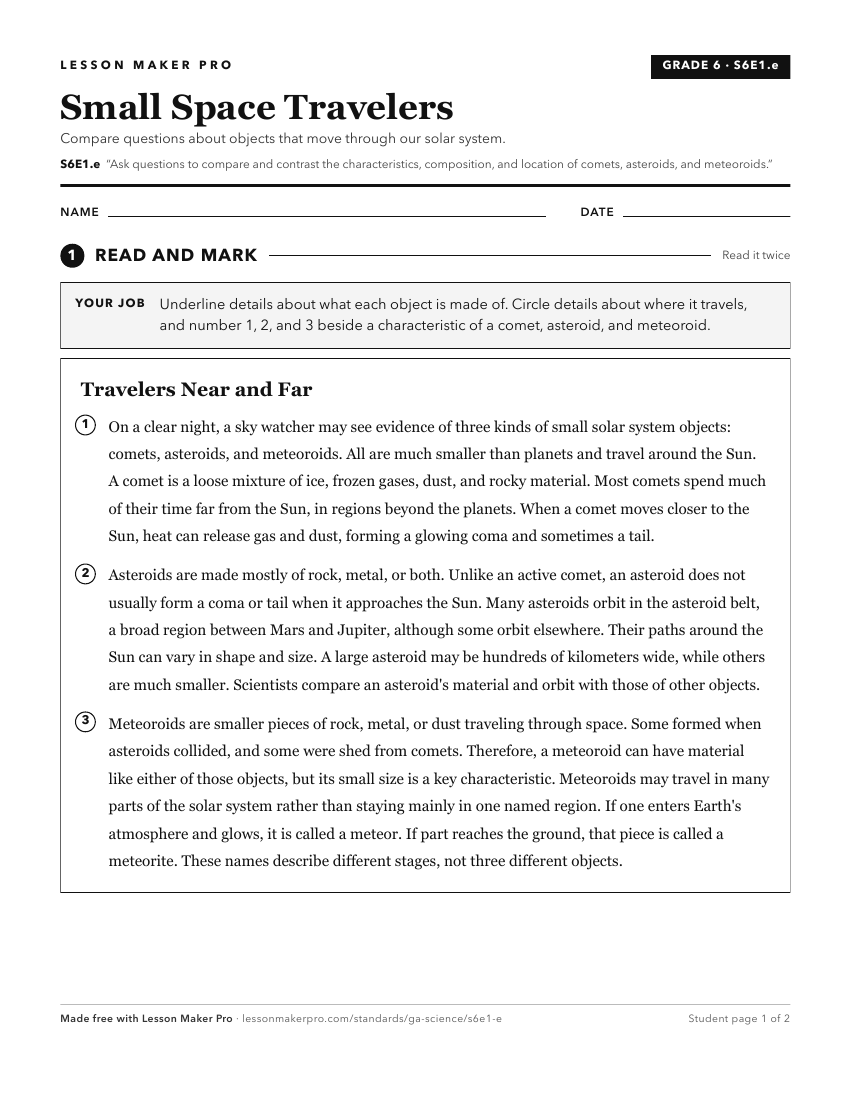
A ready-to-print activity worksheet aligned to S6E1.e, with an answer key for the teacher on its own page. No account needed.
PDF, US Letter, prints cleanly in black and white.
Download the worksheetKeep exploring
Related Standards
- SKE1.a
Ask questions to classify objects according to those seen in the day sky, the night sky, and both.
- S2P1.a
Ask questions to describe and classify different objects according to their physical properties.
- S4E1.a
Ask questions to compare and contrast technological advances that have changed the amount and type of information on distant objects in the sky.
- S6E5.a
Ask questions to compare and contrast the Earth's crust, mantle, inner and outer core, including temperature, density, thickness, and composition.
Turn this exact standard into a lesson
Grade, subject, topic, and the complete standard are prefilled. Create one free, no account needed.
Also for this standard:Make a WorksheetMake a QuizMake a Sub Lesson