Georgia S6E4.c
The Standard
- S6E4
- Obtain, evaluate, and communicate information about how the sun, land, and water affect climate and weather.
Develop a model demonstrating the interaction between unequal heating and the rotation of the Earth that causes local and global wind systems.
Georgia Standards of Excellence for Science · Obtain, evaluate, and communicate information about how the sun, land, and water affect climate and weather.
Teacher's field guide
What This Standard Means
What Students Need to Do
- Students build and explain a model showing how temperature differences create pressure differences and move air. They show how Earth’s rotation bends moving air and shapes local and global wind patterns.
What Mastery Looks Like
- Students trace a chain from uneven heating to rising and sinking air, pressure differences, and wind. Their model correctly shows opposite deflection in the Northern and Southern Hemispheres.
Common Misconceptions
- Students may think Earth’s rotation creates wind rather than changing its direction. They may also think air moves from low pressure to high pressure or that both hemispheres deflect wind the same way.
How to Assess It
- Give students a blank globe and ask them to draw, label, and explain one global wind path caused by uneven heating and Earth’s rotation.
Lesson moves
Ways to Teach It
Use a lamp, globe, temperature strips, and removable arrows to model heating differences, air movement, and wind deflection.
Ask students to explain why wind would move differently on a nonrotating Earth than on a rotating Earth.
Sort cards showing heating, rising air, sinking air, pressure, rotation, and wind direction into correct cause-and-effect sequences.
Compare a regional wind map with latitude lines, then identify where pressure differences start the wind and rotation changes its path.
Free download
Printable S6E4.c Worksheet
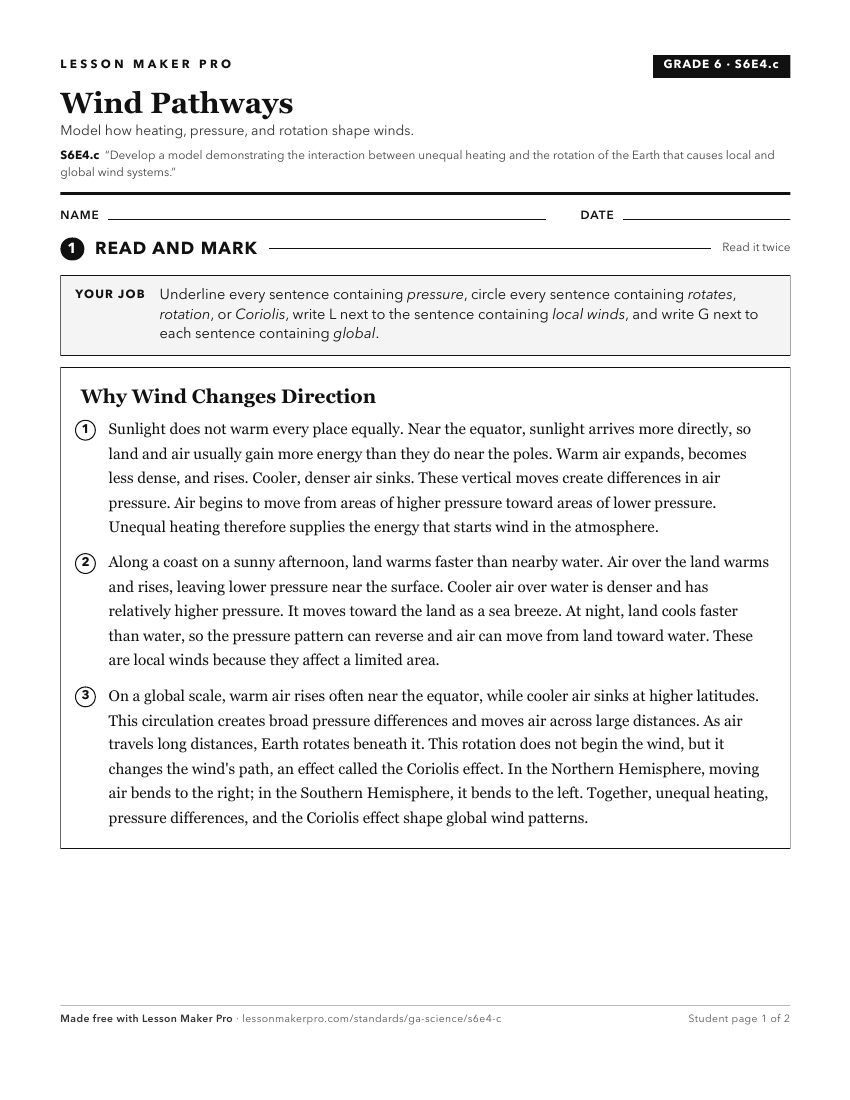
A ready-to-print activity worksheet aligned to S6E4.c, with an answer key for the teacher on its own page. No account needed.
PDF, US Letter, prints cleanly in black and white.
Download the worksheetKeep exploring
Related Standards
- S6E1.d
Develop and use a model to explain the interaction of gravity and inertia that governs the motion of objects in the solar system.
- S6E5.e
Develop a model to demonstrate how natural processes (weathering, erosion, and deposition) and human activity change rocks and the surface of the Earth.
- S4E2.a
Develop a model to support an explanation of why the length of day and night change throughout the year.
- S6E4.b
Plan and carry out an investigation to demonstrate how energy from the sun transfers heat to air, land and water at different rates.
Turn this exact standard into a lesson
Grade, subject, topic, and the complete standard are prefilled. Create one free, no account needed.
Also for this standard:Make a WorksheetMake a QuizMake a Sub Lesson