Georgia S6E1.d
The Standard
- S6E1
- Obtain, evaluate, and communicate information about current scientific views of the universe and how those views evolved.
Develop and use a model to explain the interaction of gravity and inertia that governs the motion of objects in the solar system.
Georgia Standards of Excellence for Science · Obtain, evaluate, and communicate information about current scientific views of the universe and how those views evolved.
Teacher's field guide
What This Standard Means
What Students Need to Do
- Students build diagrams or physical models showing gravity pulling objects inward while inertia carries them forward. They use the model to explain or predict orbits, paths, and changes in motion.
What Mastery Looks Like
- Students correctly draw gravity toward the larger body and motion along a tangent to the orbit. They explain that an orbit results from continuous inward falling combined with forward motion.
Common Misconceptions
- Students may think inertia pushes outward or that gravity disappears in space. They may also think orbiting objects need engines to keep moving or follow circular paths naturally without gravity.
How to Assess It
- Give students a diagram of Earth at one point in its orbit. Ask them to draw and label gravity and motion arrows, then explain why Earth stays in orbit.
Lesson moves
Ways to Teach It
Swing a foam ball on a string, then release it to observe tangential motion and label the inward pull.
Write a response to: Why does Earth not crash into the Sun or fly straight into space?
Sort orbit cards by stronger gravity, weaker gravity, faster motion, or slower motion, then predict each object's path.
Examine a weather satellite diagram and explain how gravity and forward motion keep the satellite circling Earth.
Free download
Printable S6E1.d Worksheet
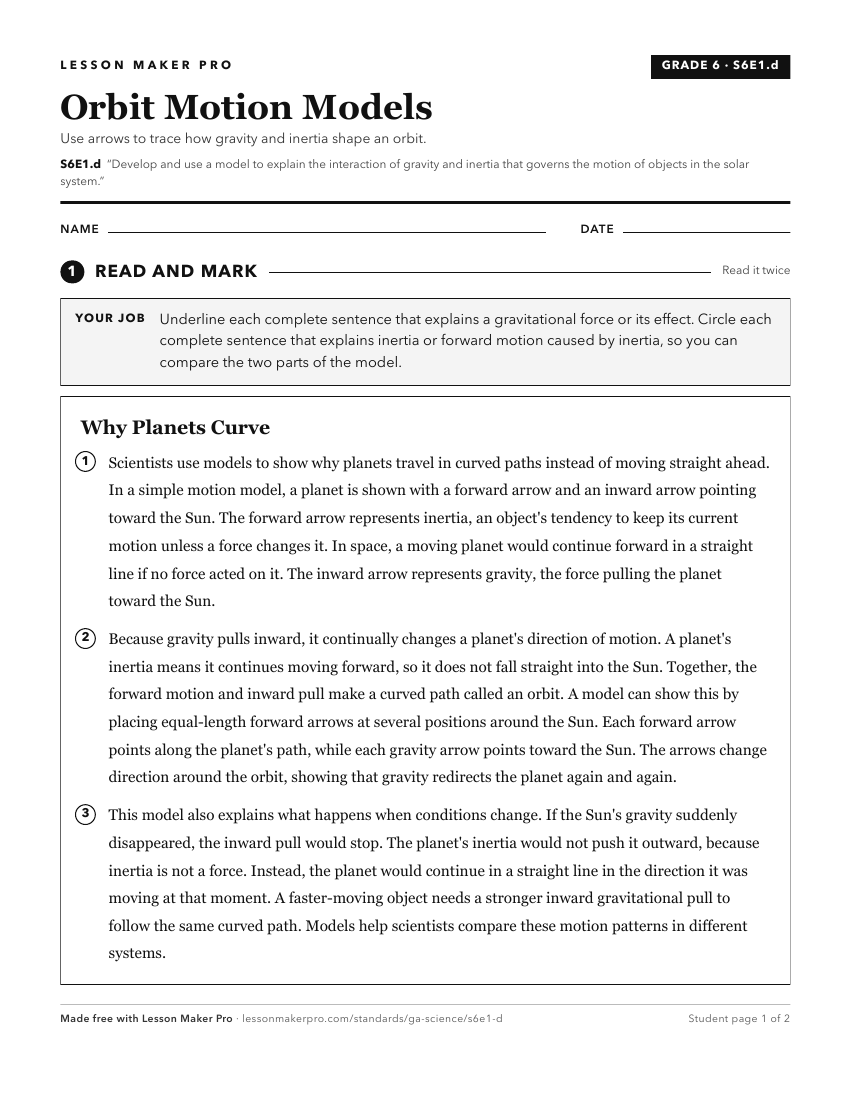
A ready-to-print activity worksheet aligned to S6E1.d, with an answer key for the teacher on its own page. No account needed.
PDF, US Letter, prints cleanly in black and white.
Download the worksheetKeep exploring
Related Standards
- S6E2.a
Develop and use a model to demonstrate the phases of the moon by showing the relative positions of the sun, Earth, and moon.
- S6E1.b
Develop a model to represent the position of the solar system in the Milky Way galaxy and in the known universe.
- S8P3.b
Construct an explanation using Newton's Laws of Motion to describe the effects of balanced and unbalanced forces on the motion of an object.
- S4E1.d
Evaluate strengths and limitations of models of our solar system in describing relative size, order, appearance and composition of planets and the sun.
Turn this exact standard into a lesson
Grade, subject, topic, and the complete standard are prefilled. Create one free, no account needed.
Also for this standard:Make a WorksheetMake a QuizMake a Sub Lesson