Georgia S6E1.b
The Standard
- S6E1
- Obtain, evaluate, and communicate information about current scientific views of the universe and how those views evolved.
Develop a model to represent the position of the solar system in the Milky Way galaxy and in the known universe.
Georgia Standards of Excellence for Science · Obtain, evaluate, and communicate information about current scientific views of the universe and how those views evolved.
Teacher's field guide
What This Standard Means
What Students Need to Do
- Students build a labeled model showing how the solar system fits within larger space structures. They place it on the Orion Spur of the Milky Way and show the galaxy within the observable universe.
What Mastery Looks Like
- Students place the solar system away from both the Milky Way’s center and outer edge. They correctly label each level and explain that sizes and distances cannot share one simple scale.
Common Misconceptions
- Students may treat the solar system and Milky Way as the same structure. They may place the Sun at the galaxy’s center or outside the galaxy. They may also assume models show true sizes and distances.
How to Assess It
- Give students a blank spiral galaxy and the prompt: “Mark and label our solar system, then sketch where the Milky Way belongs in the observable universe.” Ask them to name one model limitation.
Lesson moves
Ways to Teach It
Place a solar-system bead on the Orion Spur of a paper spiral, then set the spiral in nested Local Group and observable universe trays.
Have pairs defend which of three marked spots on a spiral galaxy best represents the solar system, using evidence from a reference diagram.
Run a card sort with planet, solar system, Orion Spur, Milky Way, Local Group, and observable universe, ordered from smallest to largest.
Use a school-address analogy, then have students write Earth’s cosmic address from planet through observable universe and mark where the analogy breaks.
Free download
Printable S6E1.b Worksheet
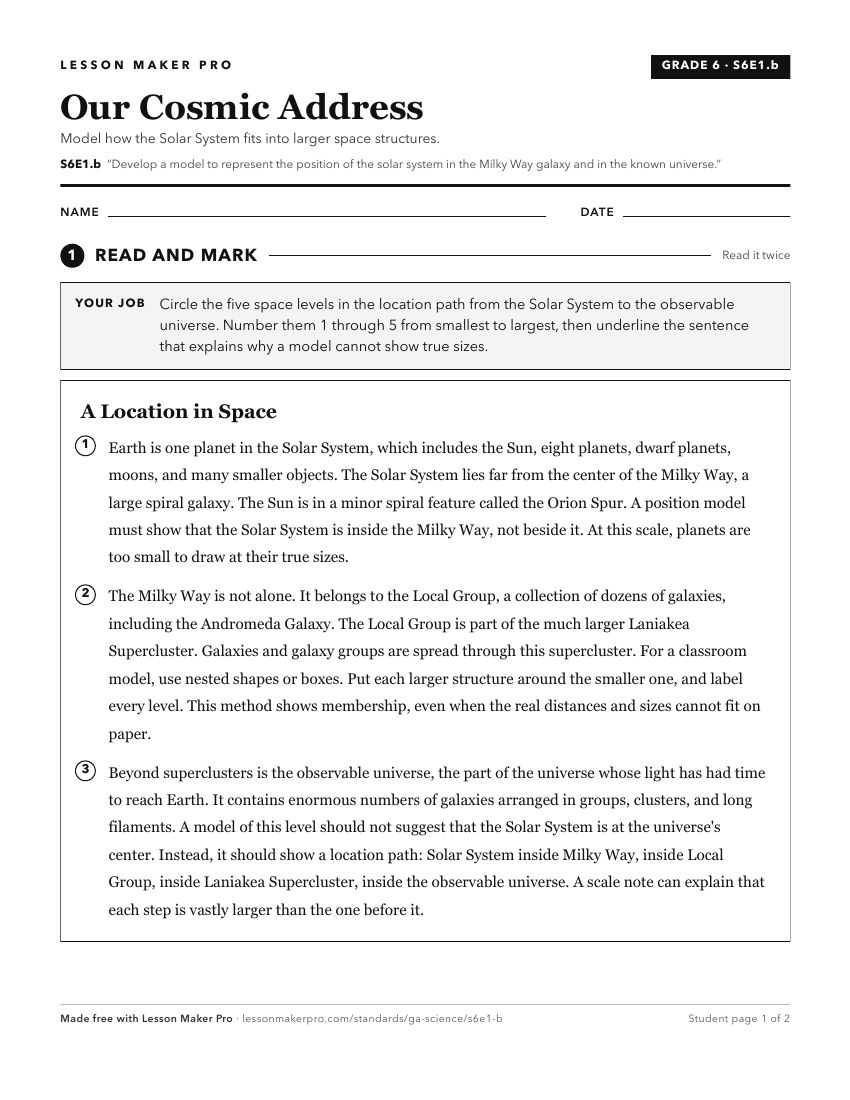
A ready-to-print activity worksheet aligned to S6E1.b, with an answer key for the teacher on its own page. No account needed.
PDF, US Letter, prints cleanly in black and white.
Download the worksheetKeep exploring
Related Standards
- S6E2.a
Develop and use a model to demonstrate the phases of the moon by showing the relative positions of the sun, Earth, and moon.
- S6E1.d
Develop and use a model to explain the interaction of gravity and inertia that governs the motion of objects in the solar system.
- S4E2.b
Develop a model based on observations to describe the repeating pattern of the phases of the moon (new, crescent, quarter, gibbous, and full).
- S4E1.d
Evaluate strengths and limitations of models of our solar system in describing relative size, order, appearance and composition of planets and the sun.
Turn this exact standard into a lesson
Grade, subject, topic, and the complete standard are prefilled. Create one free, no account needed.
Also for this standard:Make a WorksheetMake a QuizMake a Sub Lesson