Georgia S4E1.d
The Standard
- S4E1
- Obtain, evaluate, and communicate information to compare and contrast the physical attributes of stars and planets.
Evaluate strengths and limitations of models of our solar system in describing relative size, order, appearance and composition of planets and the sun.
Georgia Standards of Excellence for Science · Obtain, evaluate, and communicate information to compare and contrast the physical attributes of stars and planets.
Teacher's field guide
What This Standard Means
What Students Need to Do
- Students examine solar system models and decide what each model shows accurately or poorly. They compare how models represent planet size, order, appearance, composition, and distance.
What Mastery Looks Like
- Students can name a strength and a limitation of a diagram, physical model, or digital model. They can choose the best model for a specific question and support their choice with evidence.
Common Misconceptions
- Students may assume every model shows exact planet sizes and distances. They may confuse surface appearance with composition, or think the material used in a model matches the actual planet.
How to Assess It
- Show students a flat diagram and a scaled ball model. Ask, “Which model better shows planet size, and what is one limitation of that model?”
Lesson moves
Ways to Teach It
Build planets from measured clay amounts, then label what the model shows well and what it cannot show.
Write a claim answering, “Can one solar system model show size, distance, appearance, and composition accurately?”
Sort model cards by their best use: showing order, relative size, appearance, composition, or distance.
Compare a NASA planet image with a classroom poster, then explain which details a space scientist could learn from each.
Free download
Printable S4E1.d Worksheet
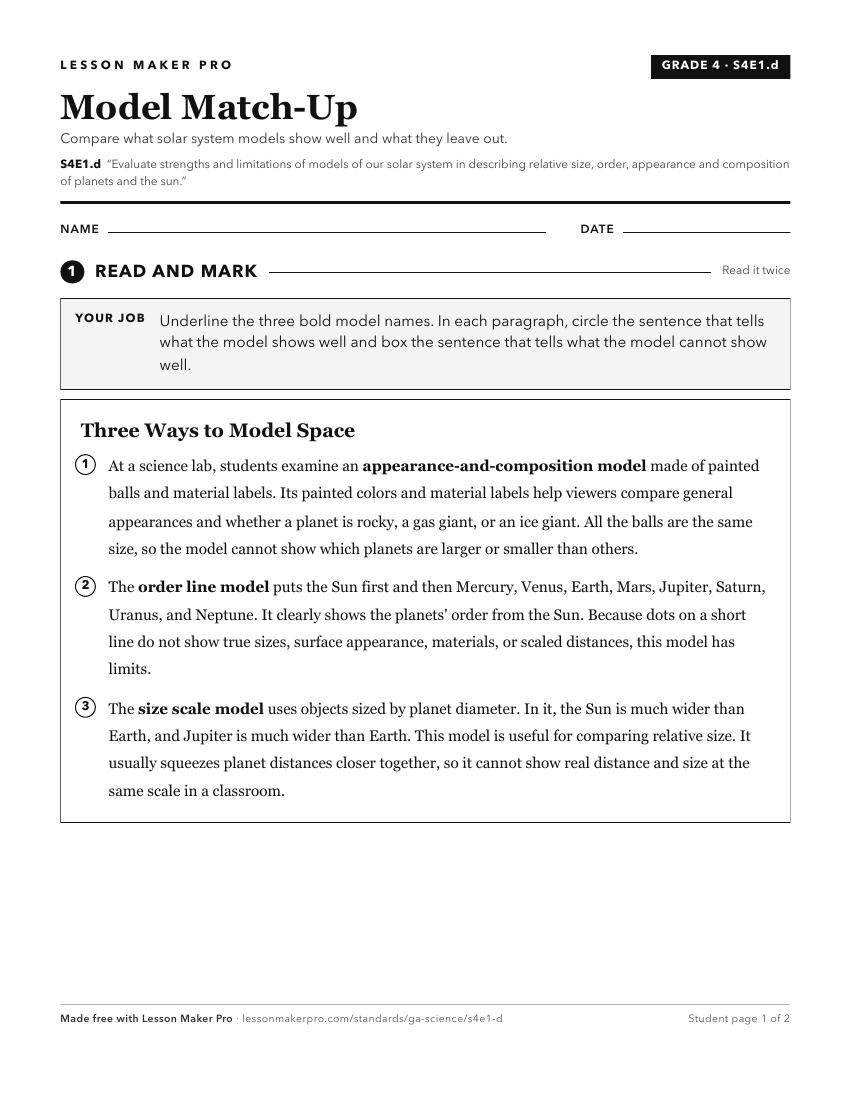
A ready-to-print activity worksheet aligned to S4E1.d, with an answer key for the teacher on its own page. No account needed.
PDF, US Letter, prints cleanly in black and white.
Download the worksheetKeep exploring
Related Standards
- S6E1.d
Develop and use a model to explain the interaction of gravity and inertia that governs the motion of objects in the solar system.
- S6E1.a
Ask questions to determine changes in models of Earth's position in the solar system, and origins of the universe as evidence that scientific theories change wi...
- S6E1.c
Analyze and interpret data to compare and contrast the planets in our solar system in terms of: * size relative to Earth, * surface and atmospheric features, * ...
- S4E1.c
Construct an explanation of the differences between stars and planets.
Turn this exact standard into a lesson
Grade, subject, topic, and the complete standard are prefilled. Create one free, no account needed.
Also for this standard:Make a WorksheetMake a QuizMake a Sub Lesson