Georgia S4E1.c
The Standard
- S4E1
- Obtain, evaluate, and communicate information to compare and contrast the physical attributes of stars and planets.
Construct an explanation of the differences between stars and planets.
Georgia Standards of Excellence for Science · Obtain, evaluate, and communicate information to compare and contrast the physical attributes of stars and planets.
Teacher's field guide
What This Standard Means
What Students Need to Do
- Students explain that stars are hot objects that produce light, while planets reflect light and orbit stars. They use facts about light, composition, size, and motion to support their explanation.
What Mastery Looks Like
- A student can compare a star and a planet using several accurate physical traits. They can classify an unfamiliar object from clues and explain the evidence behind their choice.
Common Misconceptions
- Students often think stars are smaller than planets because they look like tiny dots, or that planets produce their own light. They may not recognize the Sun as a star or may confuse rotation with orbit.
How to Assess It
- Give students this exit prompt: “A round object reflects light and travels around a star. Is it a star or planet? Explain with two facts.”
Lesson moves
Ways to Teach It
Use a flashlight as a star and foil balls as planets, then observe which object makes light and which reflects it.
Write a claim explaining why the Sun is a star and Earth is a planet, supported by three facts.
Sort clue cards into star, planet, or both, then defend one disputed card with a partner.
Use NASA fact sheets for the Sun and Earth to create a comparison chart showing light, composition, size, and motion.
Free download
Printable S4E1.c Worksheet
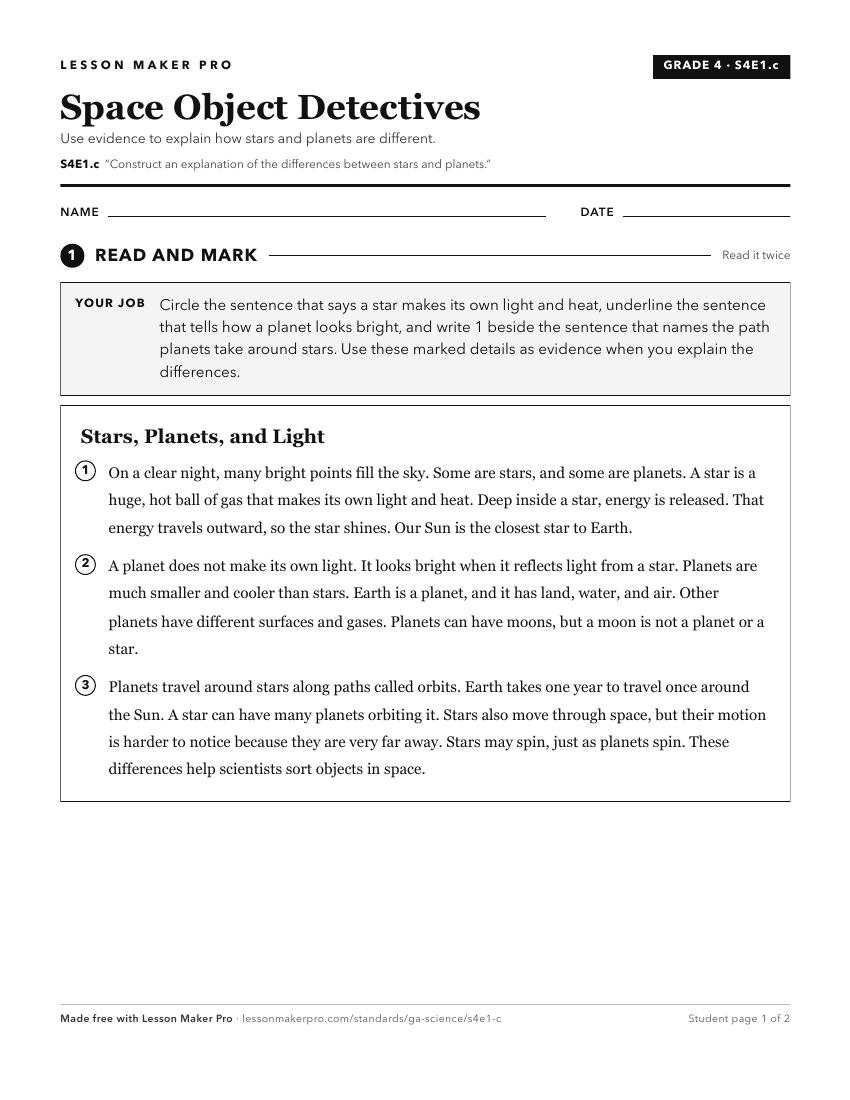
A ready-to-print activity worksheet aligned to S4E1.c, with an answer key for the teacher on its own page. No account needed.
PDF, US Letter, prints cleanly in black and white.
Download the worksheetKeep exploring
Related Standards
- S4E1.b
Construct an argument on why some stars (including the Earth's sun) appear to be larger or brighter than others.
- S6E1.c
Analyze and interpret data to compare and contrast the planets in our solar system in terms of: * size relative to Earth, * surface and atmospheric features, * ...
- S4E1.d
Evaluate strengths and limitations of models of our solar system in describing relative size, order, appearance and composition of planets and the sun.
- S4E1
Obtain, evaluate, and communicate information to compare and contrast the physical attributes of stars and planets.
Turn this exact standard into a lesson
Grade, subject, topic, and the complete standard are prefilled. Create one free, no account needed.
Also for this standard:Make a WorksheetMake a QuizMake a Sub Lesson