Georgia S4E1
Georgia Standard (Element Cluster)
Obtain, evaluate, and communicate information to compare and contrast the physical attributes of stars and planets.
Georgia Standards of Excellence for Science
Cluster contents
Elements in This Standard
S4E1 is a Georgia science standard. These are the elements under it.
- S4E1.a
Ask questions to compare and contrast technological advances that have changed the amount and type of information on distant objects in the sky.
- S4E1.b
Construct an argument on why some stars (including the Earth's sun) appear to be larger or brighter than others.
- S4E1.c
Construct an explanation of the differences between stars and planets.
- S4E1.d
Evaluate strengths and limitations of models of our solar system in describing relative size, order, appearance and composition of planets and the sun.
Teacher's field guide
What This Cluster Means
What Students Need to Do
- Students gather facts about stars and planets from books, images, videos, or data tables. They sort those facts by size, temperature, light, shape, and composition. They explain similarities and differences with evidence.
What Mastery Looks Like
- Students explain that stars produce light and heat, while planets reflect light and orbit stars. They compare attributes without relying only on how objects look from Earth.
Common Misconceptions
- Students may think stars are smaller than planets because they look like tiny dots. They may say planets make their own light or that all planets have solid surfaces.
How to Assess It
- Give students a blank Venn diagram labeled stars and planets. Ask them to add two accurate differences and one similarity.
Lesson moves
Ways to Teach It
Shine a flashlight on foam balls in a dark room to model a star producing light and planets reflecting it.
Write a claim explaining why a star can look smaller than a planet from Earth, then support it with distance evidence.
Play an attribute card sort where teams place facts under star, planet, both, or neither.
Compare telescope images of the Sun, Jupiter, and Earth, then record visible features and facts scientists use beyond photographs.
Free download
Printable S4E1 Worksheet
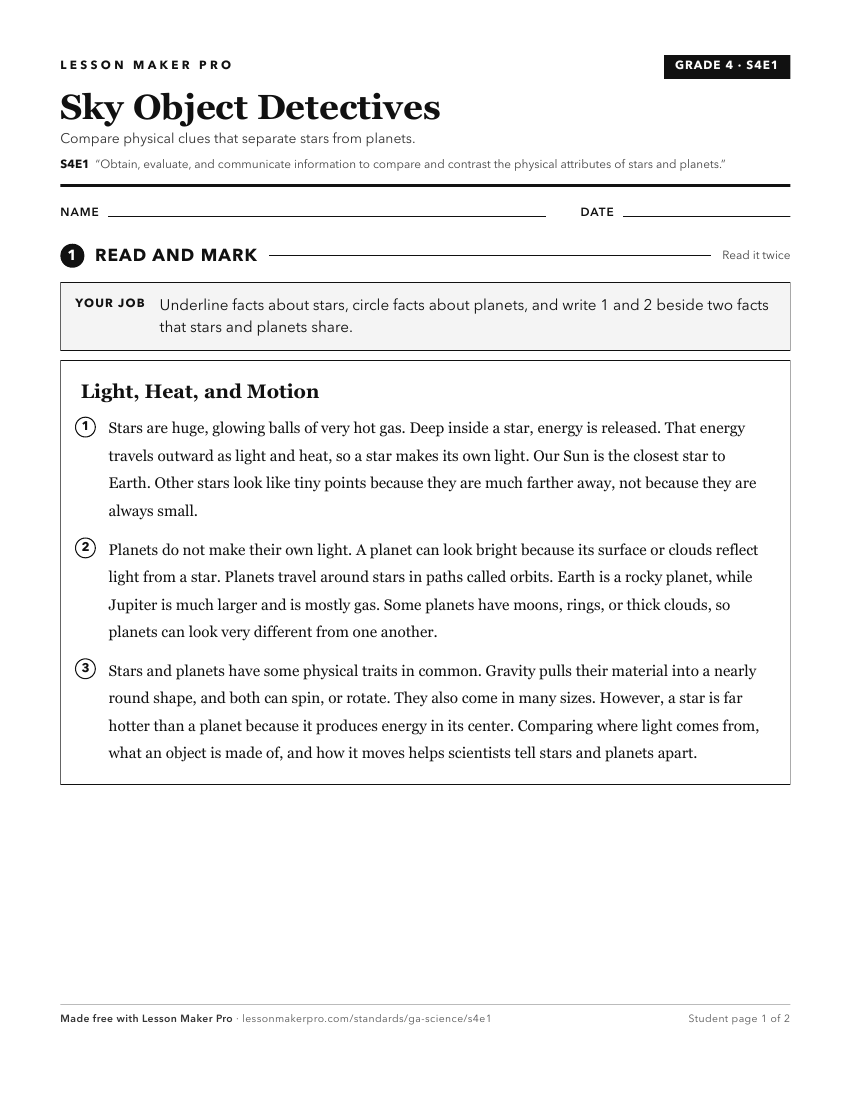
A ready-to-print activity worksheet aligned to S4E1, with an answer key for the teacher on its own page. No account needed.
PDF, US Letter, prints cleanly in black and white.
Download the worksheetKeep exploring
Related Standards
- S2E1
Obtain, evaluate, and communicate information about stars having different sizes and brightness.
- S2E1.a
Ask questions to describe the physical attributes (size and brightness) of stars.
- SKE1
Obtain, evaluate, and communicate observations about time patterns (day to night and night to day) and objects (sun, moon, stars) in the day and night sky.
- S2E2
Obtain, evaluate, and communicate information to develop an understanding of the patterns of the sun and the moon and the sun's effect on Earth.
Turn this cluster into a lesson
Grade, subject, topic, and the complete cluster are prefilled. Create one free, no account needed.
Also for this cluster:Make a WorksheetMake a QuizMake a Sub Lesson