Georgia S2E1
Georgia Standard (Element Cluster)
Obtain, evaluate, and communicate information about stars having different sizes and brightness.
Georgia Standards of Excellence for Science
Cluster contents
Elements in This Standard
S2E1 is a Georgia science standard. These are the elements under it.
Teacher's field guide
What This Cluster Means
What Students Need to Do
- Students gather facts from books, videos, images, or data cards. They compare stars by size and brightness, then explain their findings with words, drawings, or charts.
What Mastery Looks Like
- Given several star cards, students sort them accurately by relative size and brightness. They use facts from a source to explain at least two comparisons.
Common Misconceptions
- Students may think all stars are the same size because they look like tiny dots. They may assume the brightest-looking star is always the largest or that the Sun is not a star.
How to Assess It
- Give students two star cards with size and brightness facts. Ask, “How are these stars different, and which facts support your answer?”
Lesson moves
Ways to Teach It
Build three clay star models of different sizes, then compare battery tea lights with two brightness levels and record observations.
Write: Why can a bright-looking star not automatically be called the largest star? Use one fact from a class source.
Play Star Sort with fact cards, placing each star on size and brightness mats, then defend one placement to a partner.
Use a printed local night-sky chart to compare labeled stars, then record which stars would appear brighter to an observer.
Free download
Printable S2E1 Worksheet
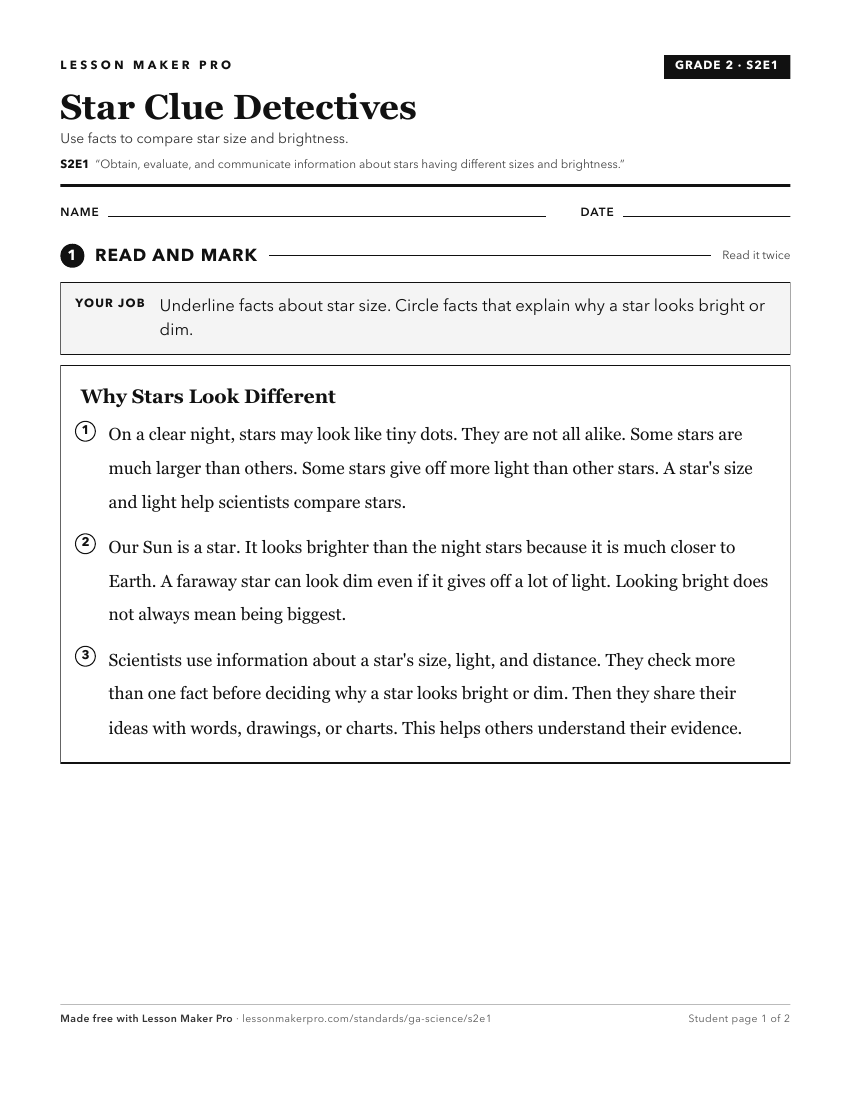
A ready-to-print activity worksheet aligned to S2E1, with an answer key for the teacher on its own page. No account needed.
PDF, US Letter, prints cleanly in black and white.
Download the worksheetKeep exploring
Related Standards
- S4P1
Obtain, evaluate, and communicate information about the nature of light and how light interacts with objects.
- SKE1
Obtain, evaluate, and communicate observations about time patterns (day to night and night to day) and objects (sun, moon, stars) in the day and night sky.
- S4E1
Obtain, evaluate, and communicate information to compare and contrast the physical attributes of stars and planets.
Turn this cluster into a lesson
Grade, subject, topic, and the complete cluster are prefilled. Create one free, no account needed.
Also for this cluster:Make a WorksheetMake a QuizMake a Sub Lesson