Georgia S8P3.b
The Standard
- S8P3
- Obtain, evaluate, and communicate information about cause and effect relationships between force, mass, and the motion of objects.
Construct an explanation using Newton's Laws of Motion to describe the effects of balanced and unbalanced forces on the motion of an object.
Georgia Standards of Excellence for Science · Obtain, evaluate, and communicate information about cause and effect relationships between force, mass, and the motion of objects.
Teacher's field guide
What This Standard Means
What Students Need to Do
- Students decide whether forces on an object are balanced, then predict whether its velocity stays constant or changes. They use Newton's laws, force diagrams, and evidence to explain how net force and mass affect acceleration.
What Mastery Looks Like
- Given a force diagram or motion scenario, students identify the net force direction and predict rest, constant velocity, or acceleration. They also identify action and reaction forces acting on different objects.
Common Misconceptions
- Students may think balanced forces always stop an object, rather than allow rest or constant velocity. They may confuse force direction with motion direction, so they miss slowing down. They may also claim action and reaction forces cancel, even though they act on different objects.
How to Assess It
- Exit ticket: A cart rolls right at constant speed with 6 N pulling each way. The right pull increases to 10 N. Describe its motion before and after, and explain why.
Lesson moves
Ways to Teach It
Use a low-friction cart, two spring scales, and added masses to compare motion during equal opposing pulls and one stronger pull.
Write how Newton's laws explain what happens when a bus starts suddenly and a standing passenger tips backward.
Sort force diagrams into balanced and unbalanced groups, then race to predict each object's next motion.
Analyze how seat belts and airbags change a passenger's motion and forces during a sudden stop.
Free download
Printable S8P3.b Worksheet
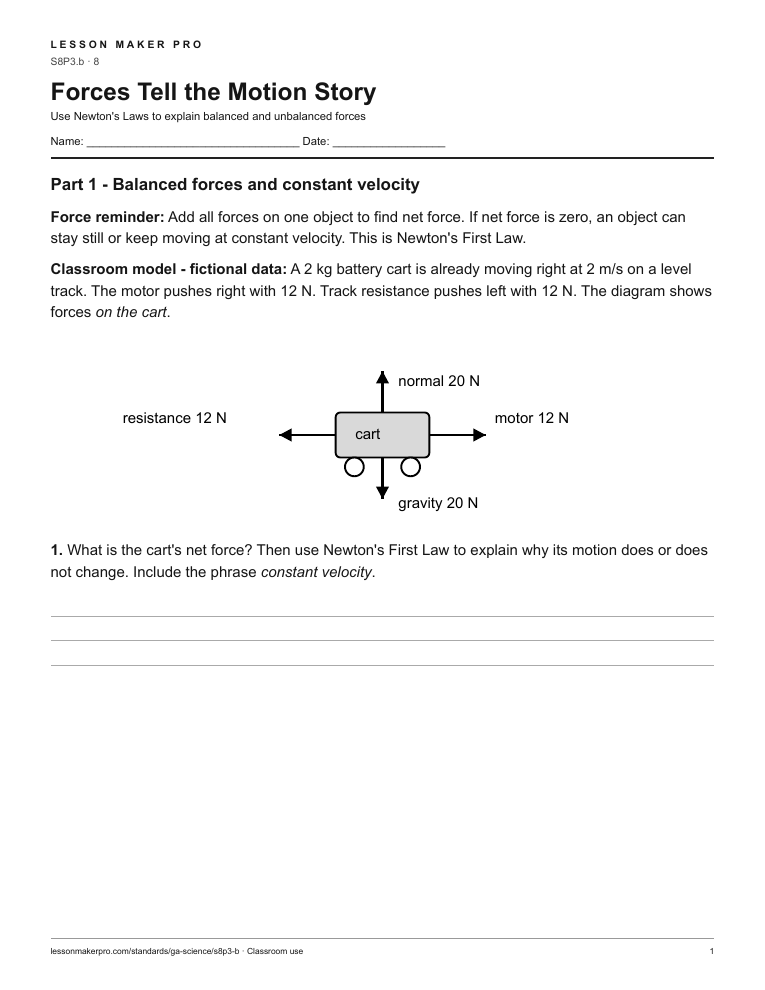
A ready-to-print activity worksheet aligned to S8P3.b, with an answer key for the teacher on its own page. No account needed.
PDF, US Letter, prints cleanly in black and white.
Download the worksheetKeep exploring
Related Standards
- S4P3
Obtain, evaluate, and communicate information about the relationship between balanced and unbalanced forces.
- S6E1.d
Develop and use a model to explain the interaction of gravity and inertia that governs the motion of objects in the solar system.
- S4P3.b
Construct an argument to support the claim that gravitational force affects the motion of an object.
- S4P3.a
Plan and carry out an investigation on the effects of balanced and unbalanced forces on an object and communicate the results.
Turn this exact standard into a lesson
Grade, subject, topic, and the complete standard are prefilled. Create one free, no account needed.
Also for this standard:Make a WorksheetMake a QuizMake a Sub Lesson