Georgia S4P3.b
The Standard
- S4P3
- Obtain, evaluate, and communicate information about the relationship between balanced and unbalanced forces.
Construct an argument to support the claim that gravitational force affects the motion of an object.
Georgia Standards of Excellence for Science · Obtain, evaluate, and communicate information about the relationship between balanced and unbalanced forces.
Teacher's field guide
What This Standard Means
What Students Need to Do
- Students use observations to explain how gravity changes an object's speed or direction. They support a clear claim with evidence and reasoning.
What Mastery Looks Like
- A student can describe what happens when an object is dropped, tossed, or rolled down a ramp. The student uses test results to connect the object's motion to Earth's pull.
Common Misconceptions
- Students may think heavier objects always fall faster or that gravity acts only on falling objects. Some think gravity stops when an object rests on a surface.
How to Assess It
- Ask: “A ball tossed upward slows, stops briefly, then falls. How does gravity explain each part of its motion?” Require a claim and evidence.
Lesson moves
Ways to Teach It
Drop two similar-size balls with different masses from the same height, then record and compare their motion.
Write a claim explaining why a tossed ball returns to the ground, using one observation as evidence.
Play an evidence-matching game by pairing motion scenario cards with observations that show gravity changing speed or direction.
Analyze a playground slide and explain how gravity affects a rider from the top to the bottom.
Free download
Printable S4P3.b Worksheet
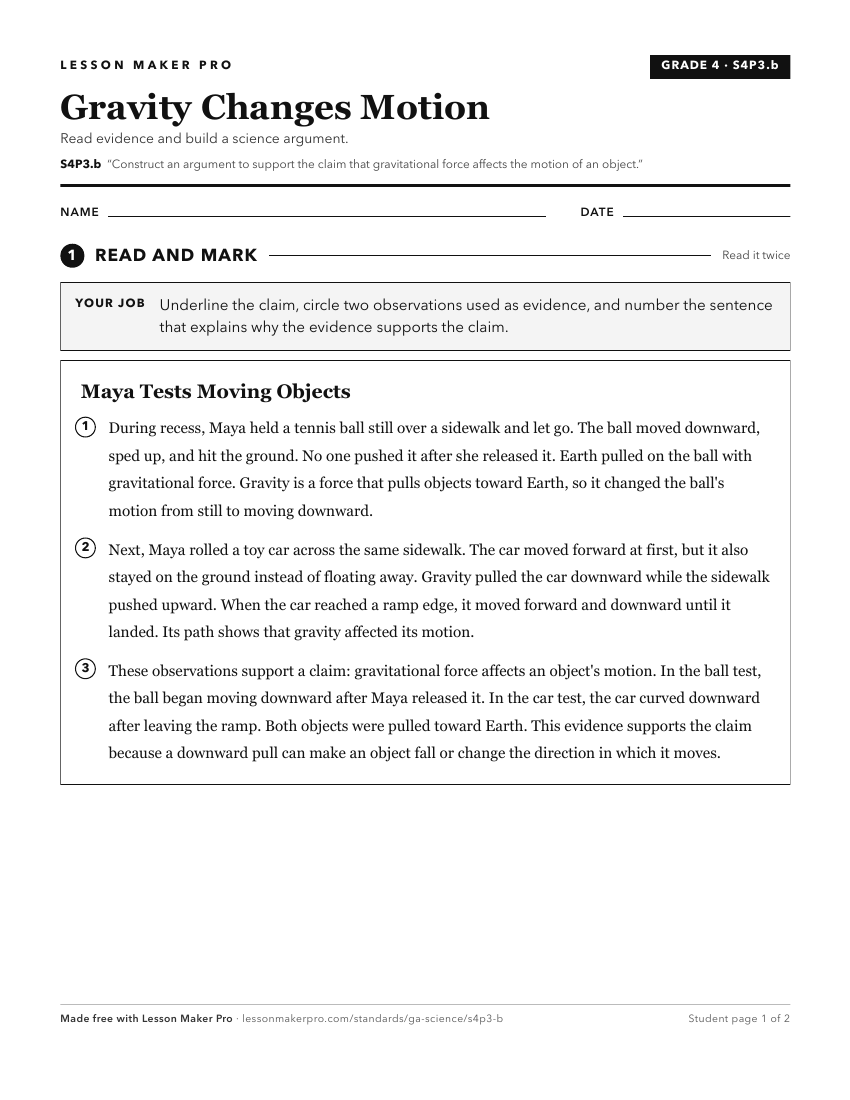
A ready-to-print activity worksheet aligned to S4P3.b, with an answer key for the teacher on its own page. No account needed.
PDF, US Letter, prints cleanly in black and white.
Download the worksheetKeep exploring
Related Standards
- S6E1.d
Develop and use a model to explain the interaction of gravity and inertia that governs the motion of objects in the solar system.
- S8P3.c
Construct an argument from evidence to support the claim that the amount of force needed to accelerate an object is proportional to its mass (inertia).
- S8P3.b
Construct an explanation using Newton's Laws of Motion to describe the effects of balanced and unbalanced forces on the motion of an object.
- S8P5.a
Construct an argument using evidence to support the claim that fields (i.e., magnetic fields, gravitational fields, and electric fields) exist between objects e...
Turn this exact standard into a lesson
Grade, subject, topic, and the complete standard are prefilled. Create one free, no account needed.
Also for this standard:Make a WorksheetMake a QuizMake a Sub Lesson