Georgia S8P5.a
The Standard
- S8P5
- Obtain, evaluate, and communicate information about gravity, electricity, and magnetism as major forces acting in nature.
Construct an argument using evidence to support the claim that fields (i.e., magnetic fields, gravitational fields, and electric fields) exist between objects exerting forces on each other even when the objects are not in contact.
Georgia Standards of Excellence for Science · Obtain, evaluate, and communicate information about gravity, electricity, and magnetism as major forces acting in nature.
Teacher's field guide
What This Standard Means
What Students Need to Do
- Students use observations to argue that objects can exert forces without touching. They connect evidence from magnetic, electric, and gravitational interactions to the presence of fields between objects.
What Mastery Looks Like
- Students make a clear claim, cite relevant observations, and explain how those observations support the existence of a field. They distinguish evidence from opinion and address all three field types.
Common Misconceptions
- Students may think a force requires contact or that empty space cannot affect motion. They may confuse fields with visible matter, or claim magnets attract every material.
How to Assess It
- Give students a picture of a magnet pulling a paper clip across a gap. Ask them to write a claim, one piece of evidence, and reasoning about the field.
Lesson moves
Ways to Teach It
Place paper over a bar magnet, sprinkle iron filings, and have students sketch the pattern as evidence of a magnetic field.
Ask students to explain how a dropped ball, charged balloon, and magnet each show force acting across a gap.
Run an evidence sort where teams match observation cards to magnetic, electric, or gravitational fields and defend each match.
Have students analyze how a compass, refrigerator magnet, static-cling sock, or falling phone provides evidence of a field.
Free download
Printable S8P5.a Worksheet
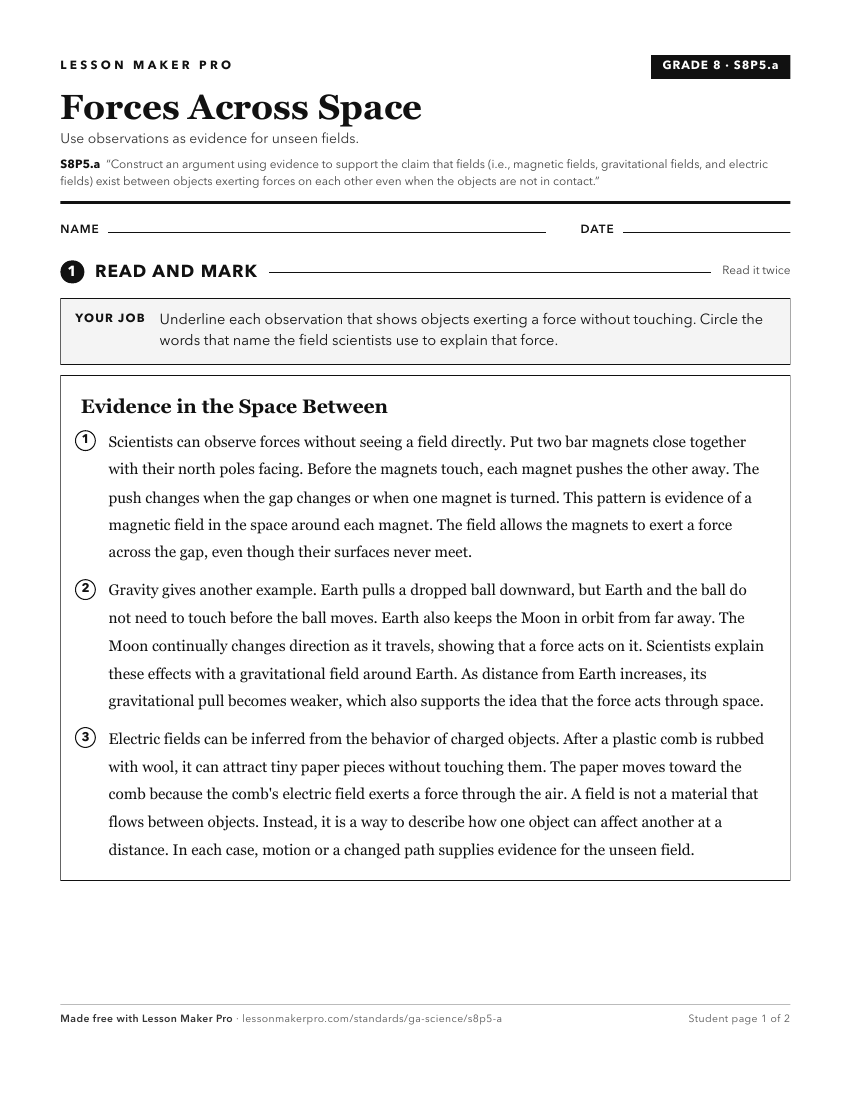
A ready-to-print activity worksheet aligned to S8P5.a, with an answer key for the teacher on its own page. No account needed.
PDF, US Letter, prints cleanly in black and white.
Download the worksheetKeep exploring
Related Standards
- S1P1.d
Construct an explanation supported by evidence that vibrating materials can make sound and that sound can make materials vibrate.
- S8P3.c
Construct an argument from evidence to support the claim that the amount of force needed to accelerate an object is proportional to its mass (inertia).
- S5P3.a
Construct an argument based on experimental evidence to communicate the differences in function and purpose of an electromagnet and a magnet.
- S4P3.b
Construct an argument to support the claim that gravitational force affects the motion of an object.
Turn this exact standard into a lesson
Grade, subject, topic, and the complete standard are prefilled. Create one free, no account needed.
Also for this standard:Make a WorksheetMake a QuizMake a Sub Lesson