Georgia S1P1.d
The Standard
- S1P1
- Obtain, evaluate, and communicate information to investigate light and sound.
Construct an explanation supported by evidence that vibrating materials can make sound and that sound can make materials vibrate.
Georgia Standards of Excellence for Science · Obtain, evaluate, and communicate information to investigate light and sound.
Teacher's field guide
What This Standard Means
What Students Need to Do
- Students observe that objects moving back and forth can produce sounds. They also use observations to explain how sound can cause another object to move.
What Mastery Looks Like
- A student can point out visible motion in a plucked rubber band or struck ruler and connect it to the sound heard. The student can cite moving rice or paper as evidence that sound caused motion.
Common Misconceptions
- Students may think sound comes only from voices or electronic devices. They may also think an object stops moving as soon as its motion becomes too small to see.
How to Assess It
- Give students this exit prompt: “A drum makes rice on a nearby tray move. Draw what happened and write one sentence explaining why.”
Lesson moves
Ways to Teach It
Stretch rubber bands around a box, pluck each band, and have students watch, feel, and describe its motion.
Ask students to explain: “How do you know the ruler moved while it made a sound?”
Play a sorting game with picture cards showing actions that do or do not produce sound through back-and-forth motion.
Place rice on plastic wrap over a bowl, make sounds nearby, and connect the rice movement to speakers, drums, and loud music.
Free download
Printable S1P1.d Worksheet
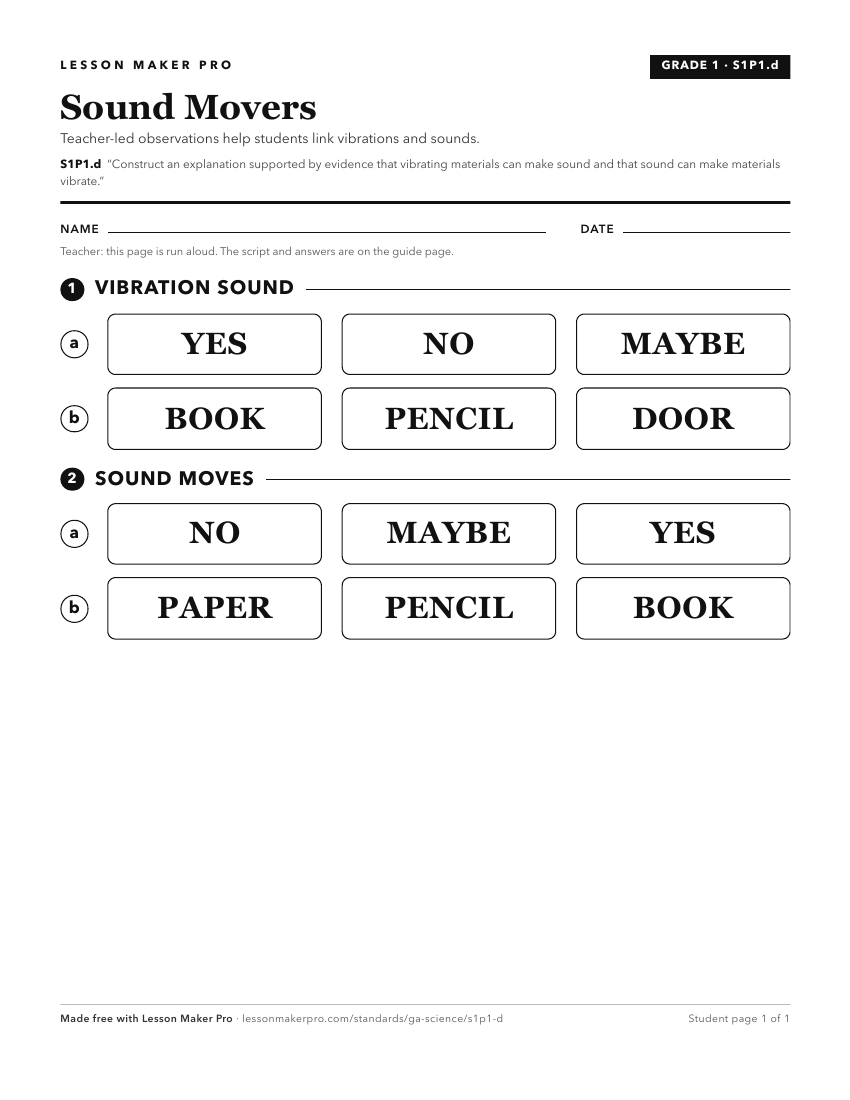
A ready-to-print activity worksheet aligned to S1P1.d, with an answer key for the teacher on its own page. No account needed.
PDF, US Letter, prints cleanly in black and white.
Download the worksheetKeep exploring
Related Standards
- S4P2.a
Plan and carry out an investigation utilizing everyday objects to produce sound and predict the effects of changing the strength or speed of vibrations.
- S8P4
Obtain, evaluate, and communicate information to support the claim that electromagnetic (light) waves behave differently than mechanical (sound) waves.
- S8P1.f
Construct an explanation based on evidence to describe conservation of matter in a chemical reaction including the resulting differences between products and re...
- S8P5.a
Construct an argument using evidence to support the claim that fields (i.e., magnetic fields, gravitational fields, and electric fields) exist between objects e...
Turn this exact standard into a lesson
Grade, subject, topic, and the complete standard are prefilled. Create one free, no account needed.
Also for this standard:Make a WorksheetMake a QuizMake a Sub Lesson