Georgia S8P3.c
The Standard
- S8P3
- Obtain, evaluate, and communicate information about cause and effect relationships between force, mass, and the motion of objects.
Construct an argument from evidence to support the claim that the amount of force needed to accelerate an object is proportional to its mass (inertia).
Georgia Standards of Excellence for Science · Obtain, evaluate, and communicate information about cause and effect relationships between force, mass, and the motion of objects.
Teacher's field guide
What This Standard Means
What Students Need to Do
- Students compare trials where acceleration stays the same while mass and applied force change. They use the data to write a claim supported by evidence and scientific reasoning.
What Mastery Looks Like
- Students recognize that doubling an object's mass requires twice the force to produce the same acceleration. They cite measurements, identify the pattern, and explain that greater mass means greater inertia.
Common Misconceptions
- Students may think heavier objects always accelerate more slowly, regardless of the applied force. They may also confuse mass with weight or claim that moving objects need a constant force to keep moving.
How to Assess It
- Give students this data: 1 kg needs 2 N, 2 kg needs 4 N, and 3 kg needs 6 N for equal acceleration. Ask them to write a claim, cite two data points, and explain the pattern.
Lesson moves
Ways to Teach It
Use carts, added masses, a force sensor, and a motion detector to measure the force needed for the same acceleration.
Ask students to explain why an empty cart and a loaded cart require different pushes to reach the same acceleration.
Have pairs match mass, force, and acceleration cards, keeping acceleration constant, then explain each match.
Compare pushing empty and loaded grocery carts, then identify how added mass changes the force needed to speed up equally.
Free download
Printable S8P3.c Worksheet
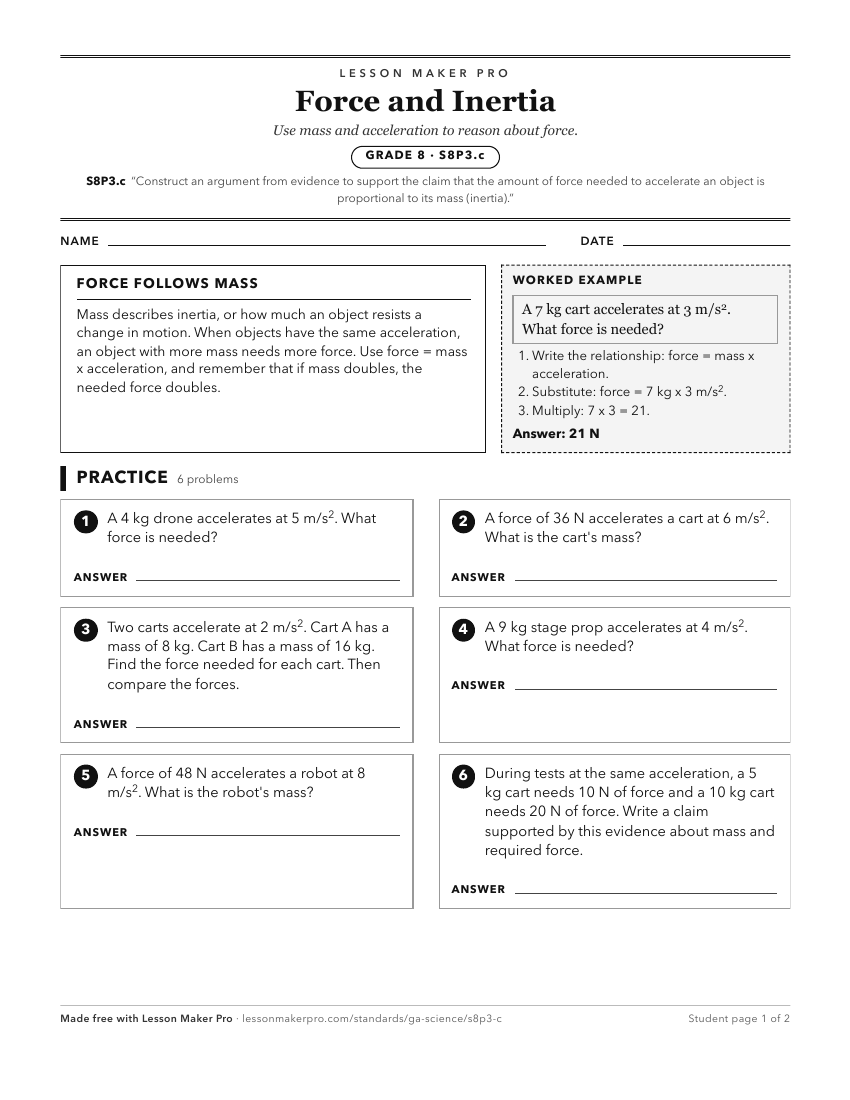
A ready-to-print activity worksheet aligned to S8P3.c, with an answer key for the teacher on its own page. No account needed.
PDF, US Letter, prints cleanly in black and white.
Download the worksheetKeep exploring
Related Standards
- S4P3.b
Construct an argument to support the claim that gravitational force affects the motion of an object.
- S8P3.b
Construct an explanation using Newton's Laws of Motion to describe the effects of balanced and unbalanced forces on the motion of an object.
- SKP2.b
Construct an argument as to the best way to move an object based on its physical attributes.
- S8P5.a
Construct an argument using evidence to support the claim that fields (i.e., magnetic fields, gravitational fields, and electric fields) exist between objects e...
Turn this exact standard into a lesson
Grade, subject, topic, and the complete standard are prefilled. Create one free, no account needed.
Also for this standard:Make a WorksheetMake a QuizMake a Sub Lesson