Florida SS.8.FL.3
Florida Standard (Benchmark Cluster)
Identify and compare the different means and risks of saving and investing money, including the impact of inflation and interest rates.
Florida Next Generation Sunshine State Standards for Social Studies
Cluster contents
Benchmarks in This Standard
SS.8.FL.3 is a Florida social studies standard. These are the benchmarks under it.
- SS.8.FL.3.1
Explain that banks and other financial institutions loan funds received from depositors to borrowers and that part of the interest received from these loans is ...
- SS.8.FL.3.2
Explain that, for the saver, an interest rate is the price a financial institution pays for using a saver's money and is normally expressed as an annual percent...
- SS.8.FL.3.3
Discuss that interest rates paid on savings and charged on loans, like all prices, are determined in a market.
- SS.8.FL.3.4
Explain that, when interest rates increase, people earn more from their savings and their savings grow more quickly.
- SS.8.FL.3.5
Identify principal as the initial amount of money upon which interest is paid.
- SS.8.FL.3.6
Identify the value of a person's savings in the future as determined by the amount saved and the interest rate. Explain why the earlier people begin to save, th...
- SS.8.FL.3.7
Discuss the different reasons that people save money, including large purchases (such as higher education, autos, and homes), retirement, and unexpected events....
- SS.8.FL.3.8
Explain that, to assure savers that their deposits are safe from bank failures, federal agencies guarantee depositors' savings in most commercial banks, savings...
Teacher's field guide
What This Cluster Means
What Students Need to Do
- Students compare savings accounts, certificates of deposit, bonds, stocks, and mutual funds by risk, return, and access to money. They explain how interest rates and inflation change purchasing power.
What Mastery Looks Like
- Students can choose a suitable option for a given goal and time frame. They support the choice with evidence about safety, expected return, liquidity, interest, and inflation.
Common Misconceptions
- Students may think higher returns are guaranteed or that all bank accounts keep pace with inflation. They may confuse easy access to money with low risk. Some overlook how time affects investment gains and losses.
How to Assess It
- Exit ticket: Maya has $1,000 and chooses between a 2 percent savings account and a higher-risk stock fund while inflation is 3 percent. Which option is safer, and what happens to the savings account's purchasing power?
Lesson moves
Ways to Teach It
Have groups sort account, bond, stock, and fund cards along scales for risk, expected return, and access to cash.
Ask students to write which option fits an emergency fund and which fits retirement, then defend each choice.
Run a four-round investing game using event cards for rate changes, inflation, market gains, and market losses.
Compare current savings rates from two banks with a recent inflation rate, then calculate whether purchasing power would rise or fall.
Free download
Printable SS.8.FL.3 Worksheet
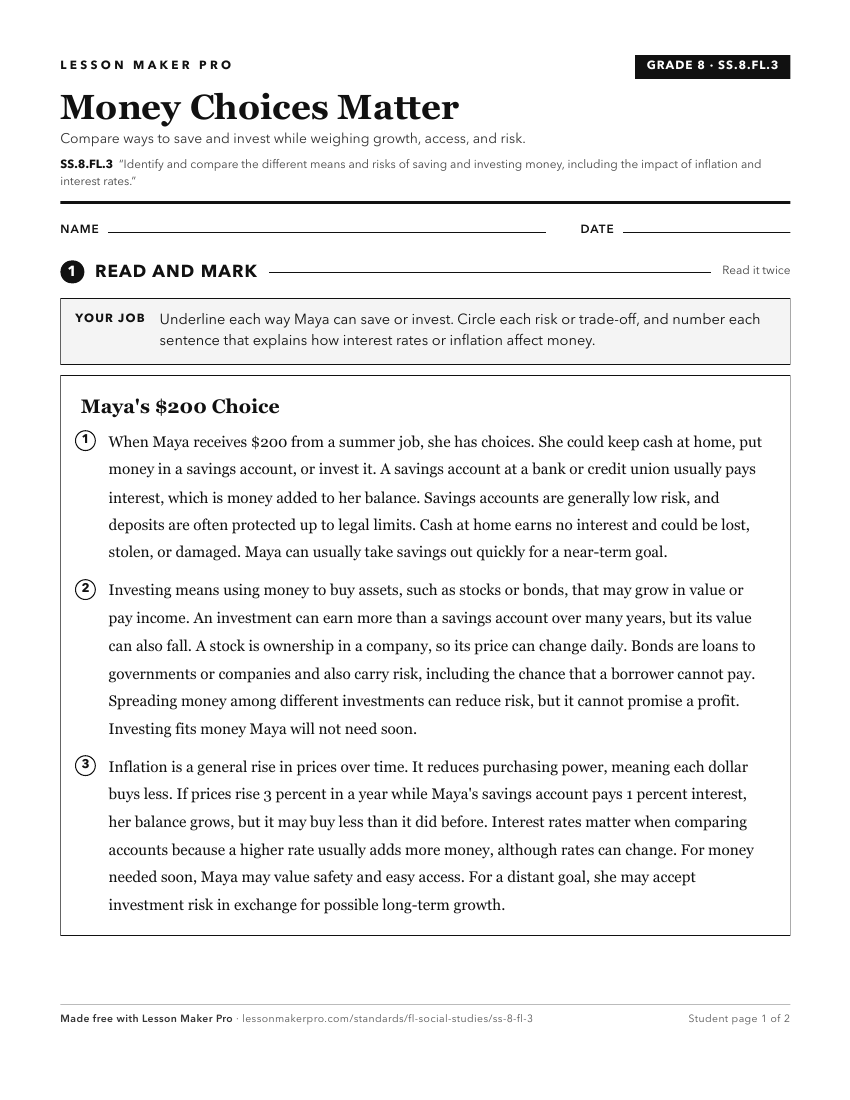
A ready-to-print activity worksheet aligned to SS.8.FL.3, with an answer key for the teacher on its own page. No account needed.
PDF, US Letter, prints cleanly in black and white.
Download the worksheetKeep exploring
Related Standards
- SS.2.E.1.4
Explain the personal benefits and costs involved in saving and spending.
- SS.8.FL.5
Identify and analyze the means, types and risks of financial investing including personal and societal influences and the government’s role in regulating invest...
- SS.4.FL.5.1
Explain that after people have saved some of their income, they must decide how to invest their savings so that it can grow over time.
Turn this cluster into a lesson
Grade, subject, topic, and the complete cluster are prefilled. Create one free, no account needed.
Also for this cluster:Make a WorksheetMake a QuizMake a Sub Lesson