Florida SS.8.FL.3.3
The Standard
- SS.8.FL.3
- Identify and compare the different means and risks of saving and investing money, including the impact of inflation and interest rates.
Discuss that interest rates paid on savings and charged on loans, like all prices, are determined in a market.
Florida Next Generation Sunshine State Standards for Social Studies
Teacher's field guide
What This Standard Means
What Students Need to Do
- Students explain how competition between savers, borrowers, banks, and other lenders affects interest rates. They predict how changes in available savings or demand for loans can push rates up or down.
What Mastery Looks Like
- Students correctly describe interest as the price paid for using money. Given a market change, they predict the likely rate change and explain its effect on savers and borrowers.
Common Misconceptions
- Students may think banks choose rates without competition or that the government sets every rate. They may also confuse savings returns with borrowing costs or assume both rates are always equal.
How to Assess It
- Use this exit ticket: More families want car loans, but available savings stay the same. Predict what happens to loan rates and explain why.
Lesson moves
Ways to Teach It
Give students lender tokens and borrower cards, then run three lending rounds while changing the number of available lenders.
Ask students to explain who benefits and who pays more when interest rates rise, using one saver and one borrower.
Play a rate prediction game where teams identify whether each market scenario will push interest rates up, down, or leave them unchanged.
Compare current savings APYs and car loan APRs from three banks, then discuss how competition affects each offer.
Free download
Printable SS.8.FL.3.3 Worksheet
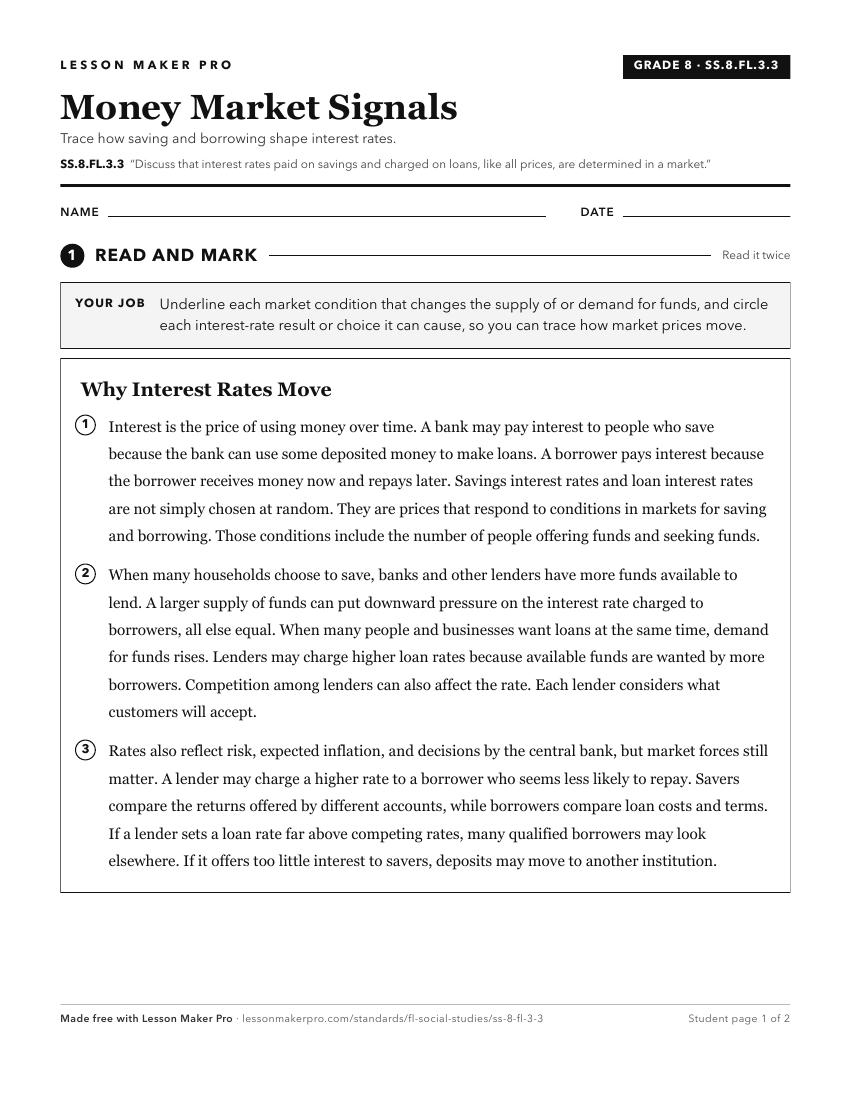
A ready-to-print activity worksheet aligned to SS.8.FL.3.3, with an answer key for the teacher on its own page. No account needed.
PDF, US Letter, prints cleanly in black and white.
Download the worksheetKeep exploring
Related Standards
- SS.8.FL.4.4
Explain that lenders charge different interest rates based on the risk of nonpayment by borrowers. Describe why the higher the risk of nonpayment, the higher th...
- SS.8.FL.4.1
Explain that people who apply for loans are told what the interest rate on the loan will be. An interest rate is the price of using someone else's money express...
- SS.4.FL.4.1
Discuss that interest is the price the borrower pays for using someone else's money.
- SS.8.FL.3.2
Explain that, for the saver, an interest rate is the price a financial institution pays for using a saver's money and is normally expressed as an annual percent...
Turn this exact standard into a lesson
Grade, subject, topic, and the complete standard are prefilled. Create one free, no account needed.
Also for this standard:Make a WorksheetMake a QuizMake a Sub Lesson