Florida SS.8.FL.4.4
The Standard
- SS.8.FL.4
- Identify and analyze the benefits, risks, associated fees, and laws that consumers should consider when choosing to buy on credit.
Explain that lenders charge different interest rates based on the risk of nonpayment by borrowers. Describe why the higher the risk of nonpayment, the higher the interest rate charged by financial institutions, and the lower the risk of nonpayment, the lower the interest rate charged.
Florida Next Generation Sunshine State Standards for Social Studies
Teacher's field guide
What This Standard Means
What Students Need to Do
- Students compare borrower profiles and judge which applicants are more likely to repay a loan. They explain how that judgment affects the interest rate offered.
What Mastery Looks Like
- Students use evidence such as payment history, debt, and income stability to compare lending risk. They correctly connect greater risk with a higher rate and greater borrowing cost.
Common Misconceptions
- Students may think every borrower receives the advertised rate or that a higher rate means a better loan. They may also assume income alone determines risk and ignore payment history or existing debt.
How to Assess It
- Give students two borrower profiles applying for the same loan. Ask which borrower should receive the lower rate and require one sentence citing evidence.
Lesson moves
Ways to Teach It
Sort borrower cards by likely repayment risk, then match each card to a low, medium, or high interest rate.
Write a lender memo explaining why two applicants for the same loan receive different rates.
Play Rate Match, teams pair fictional credit profiles with loan offers and defend each match using evidence.
Compare fictional auto loan offers for buyers with different credit histories, then identify how lender risk changes borrowing cost.
Free download
Printable SS.8.FL.4.4 Worksheet
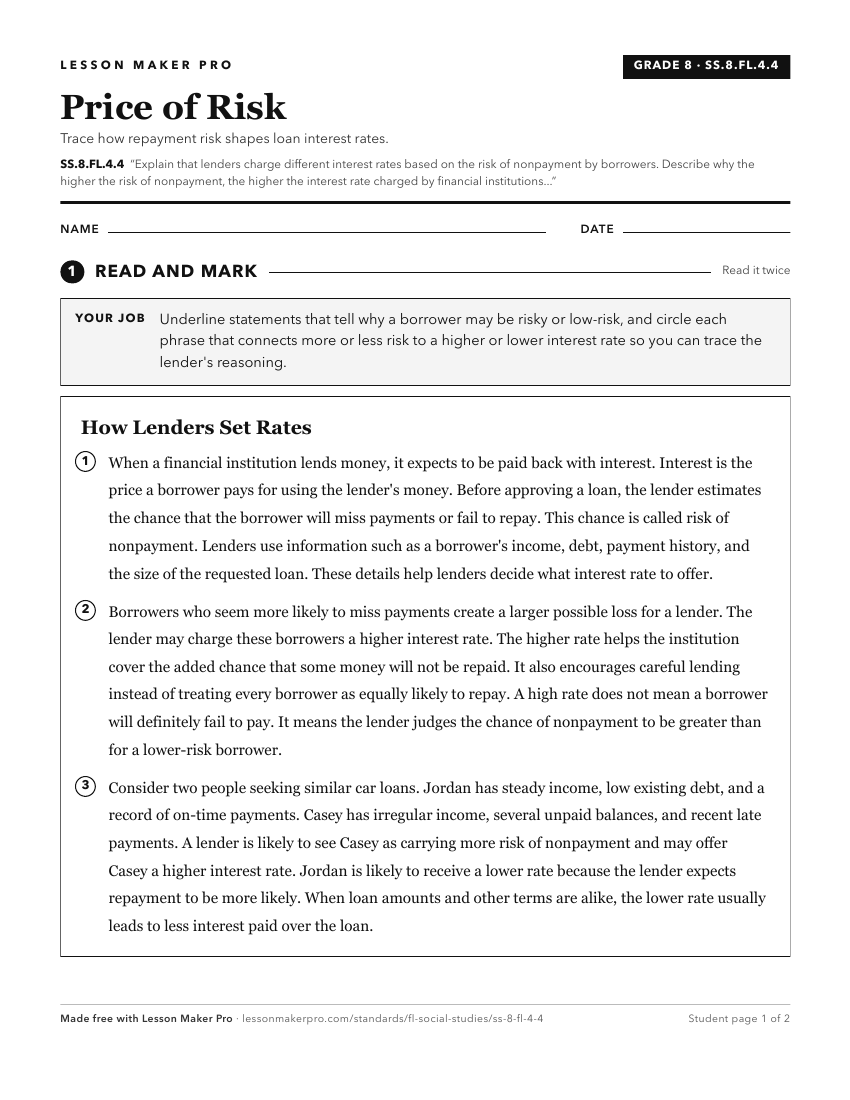
A ready-to-print activity worksheet aligned to SS.8.FL.4.4, with an answer key for the teacher on its own page. No account needed.
PDF, US Letter, prints cleanly in black and white.
Download the worksheetKeep exploring
Related Standards
- SS.8.FL.4.2
Identify a credit card purchase as a loan from the financial institution that issued the card. Explain that credit card interest rates tend to be higher than ra...
- SS.8.FL.4.1
Explain that people who apply for loans are told what the interest rate on the loan will be. An interest rate is the price of using someone else's money express...
- SS.8.FL.3.3
Discuss that interest rates paid on savings and charged on loans, like all prices, are determined in a market.
- SS.4.FL.4.1
Discuss that interest is the price the borrower pays for using someone else's money.
Turn this exact standard into a lesson
Grade, subject, topic, and the complete standard are prefilled. Create one free, no account needed.
Also for this standard:Make a WorksheetMake a QuizMake a Sub Lesson