Florida SS.8.FL.5
Florida Standard (Benchmark Cluster)
Identify and analyze the means, types and risks of financial investing including personal and societal influences and the government’s role in regulating investments.
Florida Next Generation Sunshine State Standards for Social Studies
Cluster contents
Benchmarks in This Standard
SS.8.FL.5 is a Florida social studies standard. These are the benchmarks under it.
- SS.8.FL.5.1
Describe the differences among the different types of financial assets, including a wide variety of financial instruments such as bank deposits, stocks, bonds, ...
- SS.8.FL.5.2
Calculate the amount of interest income received from depositing a certain amount of money in a bank account paying 1 percent per year and from owning a bond pa...
- SS.8.FL.5.3
Discuss that when people buy corporate stock, they are purchasing ownership shares in a business that if the business is profitable, they will expect to receive...
- SS.8.FL.5.4
Explain that the price of a financial asset is determined by the interaction of buyers and sellers in a financial market.
- SS.8.FL.5.5
Explain that the rate of return earned from investments will vary according to the amount of risk and, in general, a trade-off exists between the security of an...
Teacher's field guide
What This Cluster Means
What Students Need to Do
- Students compare stocks, bonds, and mutual funds by possible return, risk, fees, liquidity, and time horizon. They explain how personal goals, family, advertising, social media, and economic events shape choices. They also describe how the SEC requires disclosures, oversees markets, and investigates fraud.
What Mastery Looks Like
- Given an investor profile, a student can recommend an investment and defend the choice using risk, return, fees, and access to money. The student can spot a warning sign, explain an outside influence, and name an investor protection without claiming the government prevents losses.
Common Misconceptions
- Students often treat investing like guaranteed saving or assume high advertised returns mean a better choice. They may confuse a brokerage account with an investment or think a popular stock is safe. They may also believe SEC oversight guarantees returns or that FDIC insurance covers stocks and mutual funds.
How to Assess It
- Exit ticket: Jordan needs $600 in six months and sees an influencer promise a guaranteed 20 percent stock return. Recommend an action, name two risks or influences, and explain what the SEC can and cannot do.
Lesson moves
Ways to Teach It
Give groups cards for stocks, bonds, mutual funds, and savings accounts, then have them rank each by risk, return, and liquidity.
Ask students to write: How could family advice, social media, and a recession push two people toward different investments?
Run a risk-return sorting relay using scenario cards, with teams placing each investor and investment match on a class grid.
Have students inspect a real mutual fund fact sheet, finding its fees, past returns, risk statement, and SEC-required disclosures.
Free download
Printable SS.8.FL.5 Worksheet
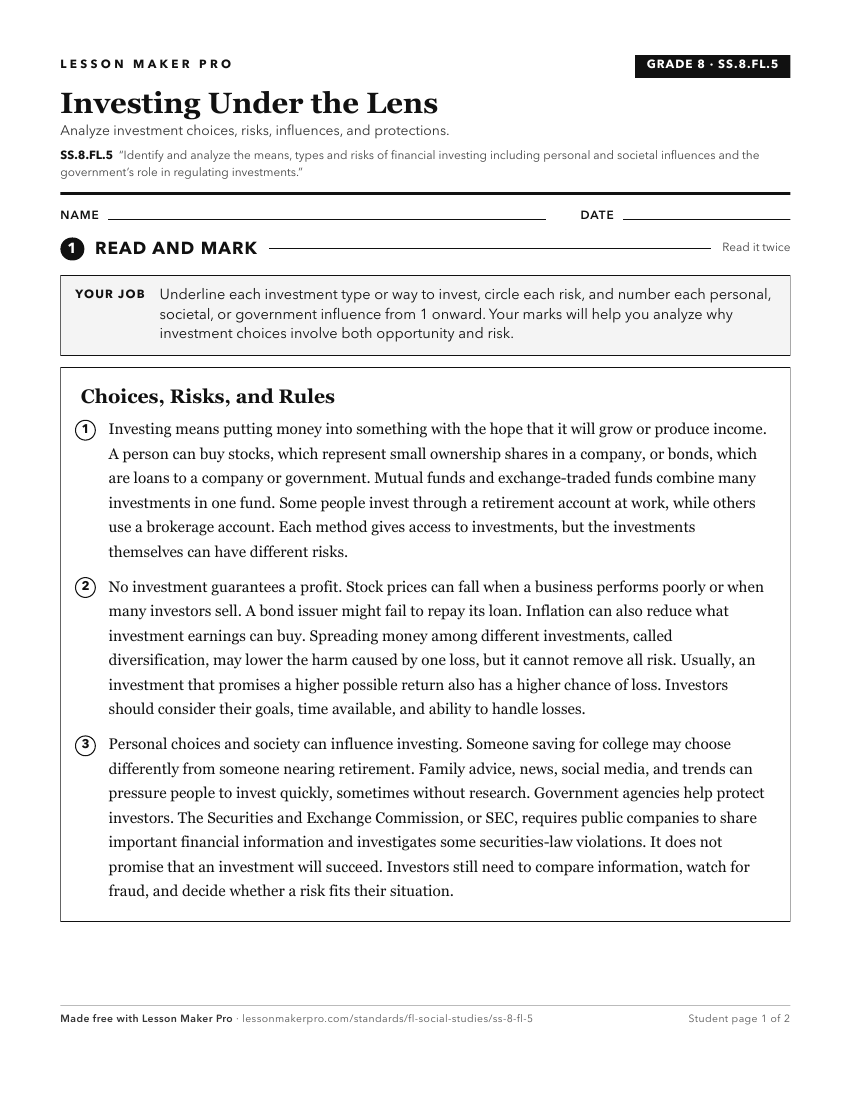
A ready-to-print activity worksheet aligned to SS.8.FL.5, with an answer key for the teacher on its own page. No account needed.
PDF, US Letter, prints cleanly in black and white.
Download the worksheetKeep exploring
Related Standards
- SS.8.FL.3
Identify and compare the different means and risks of saving and investing money, including the impact of inflation and interest rates.
- SS.4.FL.5
Financial Investing
- SS.8.FL.6.1
Analyze the fact that personal financial risk exists when unexpected events can damage health, income, property, wealth, or future opportunities.
- SS.8.FL.6
Identify and analyze methods of protecting financial investments and personal information.
Turn this cluster into a lesson
Grade, subject, topic, and the complete cluster are prefilled. Create one free, no account needed.
Also for this cluster:Make a WorksheetMake a QuizMake a Sub Lesson