Florida SS.8.FL.5.5
The Standard
- SS.8.FL.5
- Identify and analyze the means, types and risks of financial investing including personal and societal influences and the government’s role in regulating investments.
Explain that the rate of return earned from investments will vary according to the amount of risk and, in general, a trade-off exists between the security of an investment and its expected rate of return.
Florida Next Generation Sunshine State Standards for Social Studies
Teacher's field guide
What This Standard Means
What Students Need to Do
- Students compare investments by chance of loss, predictability, and possible gain. They explain why choices with higher possible returns usually carry more uncertainty.
What Mastery Looks Like
- Given several investment options, students can rank them by risk and expected return. They can justify each ranking and explain that an expected return is not guaranteed.
Common Misconceptions
- Students may think a higher expected return means a guaranteed larger profit. They may also think all risk leads to loss, or that safer choices can never lose value.
How to Assess It
- Give students three options: a savings account, a diversified stock fund, and one company’s stock. Ask them to rank each by risk and expected return, then justify their rankings.
Lesson moves
Ways to Teach It
Have groups place savings, bond, stock fund, and single-stock cards on a risk-return continuum, then defend each placement.
Ask students to write which matters more for a college fund, steady value or higher possible growth, and explain why.
Teams draw investor profiles and investment cards, then earn points by making matches and supporting each choice with risk and return evidence.
Students compare a bank savings APY with historical stock market returns, then identify the risks and explain why neither figure guarantees future results.
Free download
Printable SS.8.FL.5.5 Worksheet
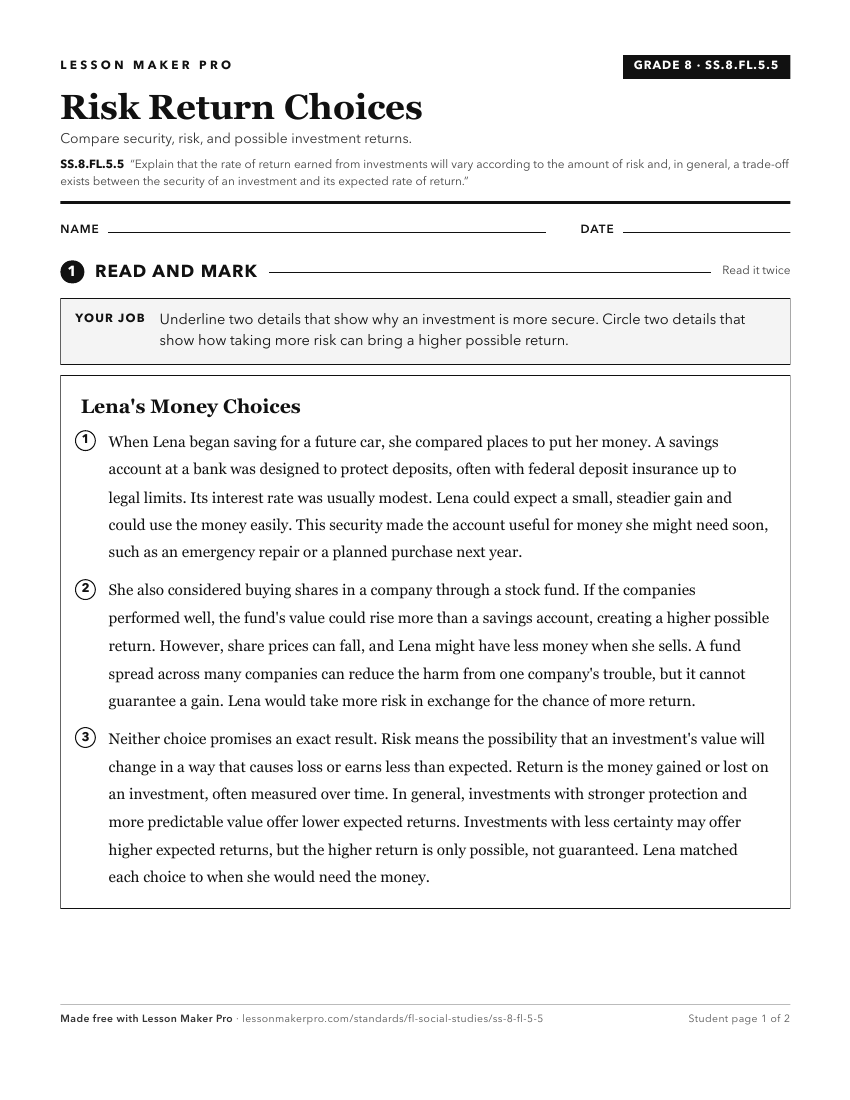
A ready-to-print activity worksheet aligned to SS.8.FL.5.5, with an answer key for the teacher on its own page. No account needed.
PDF, US Letter, prints cleanly in black and white.
Download the worksheetKeep exploring
Related Standards
- SS.8.FL.6.6
Explain that individuals can choose to accept some risk, to take steps to avoid or reduce risk, or to transfer risk to others through the purchase of insurance ...
- SS.4.FL.6.1
Explain that risk is the chance of loss or harm.
- SS.4.FL.5.1
Explain that after people have saved some of their income, they must decide how to invest their savings so that it can grow over time.
- SS.8.FL.3
Identify and compare the different means and risks of saving and investing money, including the impact of inflation and interest rates.
Turn this exact standard into a lesson
Grade, subject, topic, and the complete standard are prefilled. Create one free, no account needed.
Also for this standard:Make a WorksheetMake a QuizMake a Sub Lesson