Florida SS.8.FL.5.2
The Standard
- SS.8.FL.5
- Identify and analyze the means, types and risks of financial investing including personal and societal influences and the government’s role in regulating investments.
Calculate the amount of interest income received from depositing a certain amount of money in a bank account paying 1 percent per year and from owning a bond paying 5 percent per year in order to analyze that interest is received from money deposited in bank accounts as well as by owning a corporate or government bond or making a loan.
Florida Next Generation Sunshine State Standards for Social Studies
Teacher's field guide
What This Standard Means
What Students Need to Do
- Students calculate one year of interest by multiplying the principal by the annual rate written as a decimal. They compare earnings from deposits, bonds, and loans at different rates.
What Mastery Looks Like
- Students correctly identify the principal, rate, and interest income in a problem. They explain why the same principal earns more interest at 5 percent than at 1 percent.
Common Misconceptions
- Students may multiply by 1 or 5 instead of 0.01 or 0.05. They may confuse interest income with the total balance or assume 5 percent always means $5.
How to Assess It
- Exit ticket: Calculate one year of interest on $800 at 1 percent and 5 percent, then state how much more the higher rate earns.
Lesson moves
Ways to Teach It
Give pairs $1,000 in play money and two rate cards, then have them calculate and label one-year earnings for each investment.
Ask students to write three sentences explaining why a $600 bond at 5 percent earns more interest in one year than a $600 savings account at 1 percent.
Use matching cards with principals, rates, and interest amounts, and have teams build correct sets before checking with a calculator.
Show a bank savings offer and a government bond rate, then have students calculate expected annual interest on $2,000.
Free download
Printable SS.8.FL.5.2 Worksheet
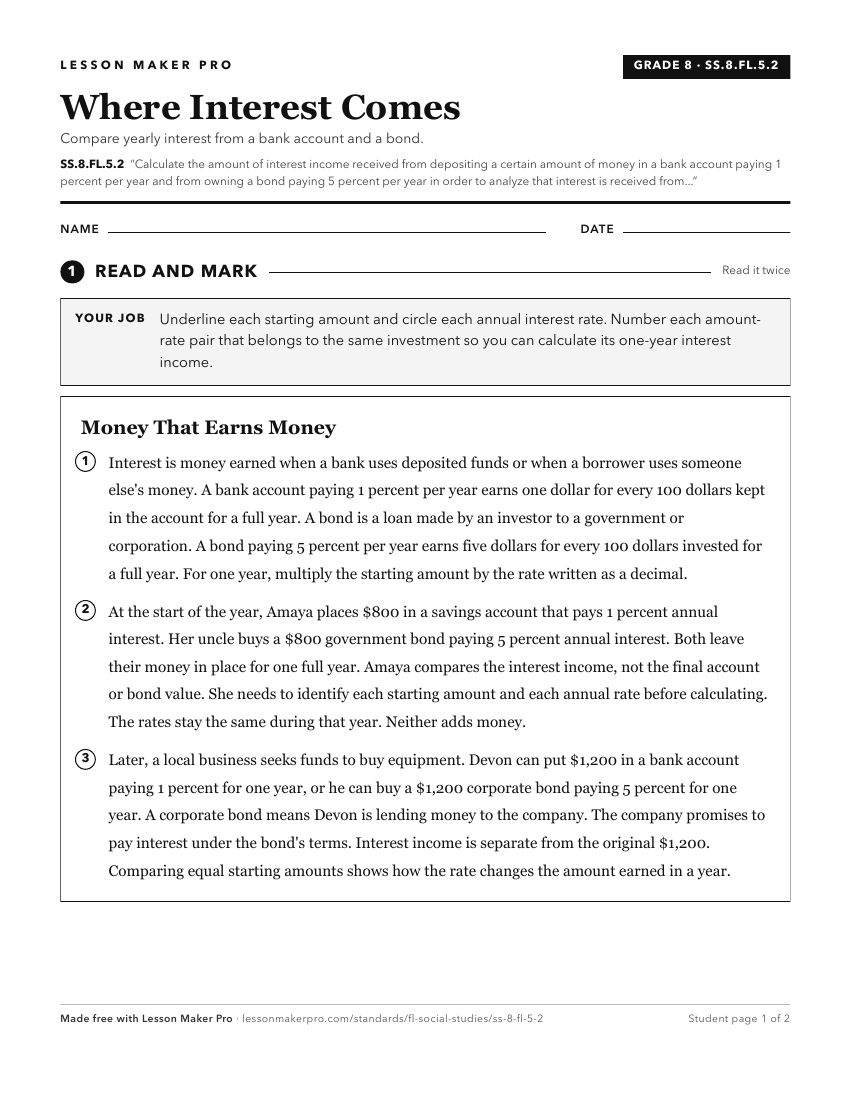
A ready-to-print activity worksheet aligned to SS.8.FL.5.2, with an answer key for the teacher on its own page. No account needed.
PDF, US Letter, prints cleanly in black and white.
Download the worksheetKeep exploring
Related Standards
- SS.8.FL.1.7
Identify that interest, dividends, and capital appreciation (gains) are forms of income earned from financial investments.
- SS.4.FL.1.4
People can earn interest income from letting other people borrow their money. Explain why banks and financial institutions pay people interest when they deposit...
- SS.8.FL.3.2
Explain that, for the saver, an interest rate is the price a financial institution pays for using a saver's money and is normally expressed as an annual percent...
- SS.4.FL.3.5
Explain that when people deposit money into a bank (or other financial institution), the bank may pay them interest. Banks attract savings by paying interest. P...
Turn this exact standard into a lesson
Grade, subject, topic, and the complete standard are prefilled. Create one free, no account needed.
Also for this standard:Make a WorksheetMake a QuizMake a Sub Lesson