Florida SS.8.FL.3.6
The Standard
- SS.8.FL.3
- Identify and compare the different means and risks of saving and investing money, including the impact of inflation and interest rates.
Identify the value of a person’s savings in the future as determined by the amount saved and the interest rate. Explain why the earlier people begin to save, the more savings they will be able to accumulate, all other things equal, as a result of the power of compound interest.
Florida Next Generation Sunshine State Standards for Social Studies
Teacher's field guide
What This Standard Means
What Students Need to Do
- Students calculate how a starting amount grows at a given interest rate over time. They explain how earning interest on earlier interest makes an early deposit grow more.
What Mastery Looks Like
- Students can compare savings plans with different deposits, rates, or time periods. They calculate future balances and use compound interest to explain why starting earlier produces more money.
Common Misconceptions
- Students may add the same dollar amount each year instead of calculating interest on the new balance. They may think the interest rate matters, but the starting amount and number of years do not.
How to Assess It
- Give this exit ticket: Ana and Ben each save $500 at 5 percent annual interest. Ana saves for 10 years and Ben for 5 years. Calculate both balances and explain the difference.
Lesson moves
Ways to Teach It
Use 100 counters as dollars, add 10 percent interest each round, and record five yearly balances to model compounding.
Write a response: Why does saving $500 now produce more than saving $500 five years later at the same rate?
Match cards showing principal, rate, and years to balance cards, then justify each match with a calculation.
Compare two local bank savings rates and calculate what $1,000 would become after five years in each account.
Free download
Printable SS.8.FL.3.6 Worksheet
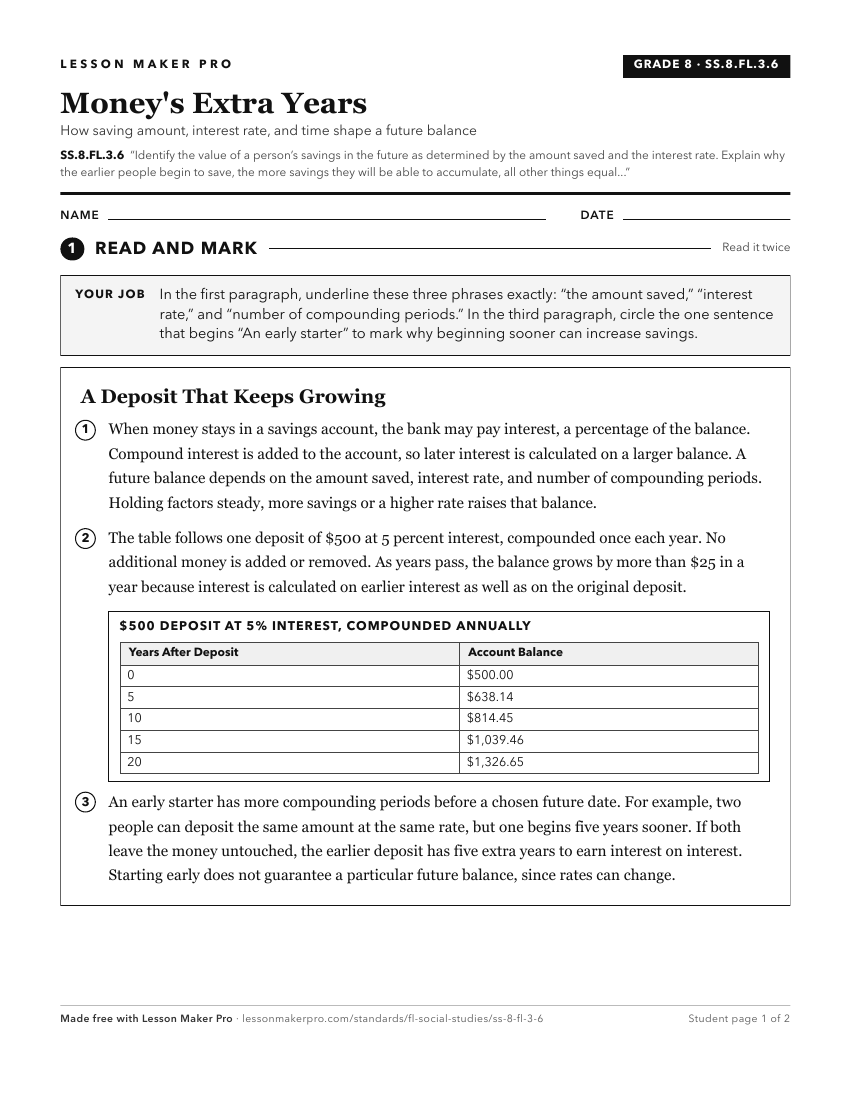
A ready-to-print activity worksheet aligned to SS.8.FL.3.6, with an answer key for the teacher on its own page. No account needed.
PDF, US Letter, prints cleanly in black and white.
Download the worksheetKeep exploring
Related Standards
- SS.8.FL.3.4
Explain that, when interest rates increase, people earn more from their savings and their savings grow more quickly.
- SS.4.FL.5.1
Explain that after people have saved some of their income, they must decide how to invest their savings so that it can grow over time.
- SS.8.FL.3.7
Discuss the different reasons that people save money, including large purchases (such as higher education, autos, and homes), retirement, and unexpected events....
- SS.4.FL.3.4
Identify savings goals that people set as incentives to save. One savings goal might be to buy goods and services in the future.
Turn this exact standard into a lesson
Grade, subject, topic, and the complete standard are prefilled. Create one free, no account needed.
Also for this standard:Make a WorksheetMake a QuizMake a Sub Lesson