Florida SS.68.AA.2
Florida Standard (Benchmark Cluster)
Analyze events that involved or affected Africans from the founding of the nation through Reconstruction.
Florida Next Generation Sunshine State Standards for Social Studies
Cluster contents
Benchmarks in This Standard
SS.68.AA.2 is a Florida social studies standard. These are the benchmarks under it.
- SS.68.AA.2.1
Explain early congressional actions regarding the institution of slavery (i.e., Northwest Ordinance of 1787, Three-Fifths Compromise, Act Prohibiting Importatio...
- SS.68.AA.2.2
Explain the effect of the cotton industry on the expansion of slavery due to Eli Whitney's Cotton Gin.
- SS.68.AA.2.3
Examine the various duties and trades performed by slaves (e.g., agricultural work, painting, carpentry, tailoring, domestic service, blacksmithing, transportat...
- SS.68.AA.2.4
Examine the Underground Railroad and its importance to those seeking freedom.
- SS.68.AA.2.5
Identify political figures who strove to abolish the institution of slavery (e.g., Thaddeus Stevens, Abraham Lincoln, Zachariah Chandler).
- SS.68.AA.2.6
Evaluate various abolitionist movements that continuously pushed to end slavery.
- SS.68.AA.2.7
Examine how the status of slaves, those who had escaped slavery and free blacks, affected their contributions to the Civil War effort.
- SS.68.AA.2.8
Describe significant contributions made by key figures during Reconstruction (e.g., President Ulysses S. Grant, Secretary of War Edwin Stanton, Frederick Dougla...
Teacher's field guide
What This Cluster Means
What Students Need to Do
- Students trace how laws, wars, economic shifts, and resistance shaped enslaved and free Africans and African Americans from independence through Reconstruction. They use sources to explain causes, effects, differing experiences, and change over time.
What Mastery Looks Like
- A student can connect a named event, such as the Fugitive Slave Act, Emancipation Proclamation, or Black Codes, to a specific effect on people. The student supports the claim with source evidence and explains what changed and what remained limited.
Common Misconceptions
- Students may assume all Black people were enslaved or had the same experience in every state. They often treat emancipation as immediate equality and overlook Black Codes, violence, and limits on voting or land ownership. Some list events without explaining cause, effect, resistance, or continuity.
How to Assess It
- Give students excerpts from the Emancipation Proclamation and a Black Code. Ask them to identify one change, one remaining limit, and a phrase supporting each answer.
Lesson moves
Ways to Teach It
Have pairs arrange cards for the Constitution, cotton gin, abolition, Civil War, and Reconstruction, then add impact cards for enslaved and free people.
Discuss: Which changed Black Americans' daily lives more, a law, a war, or resistance? Require two named examples.
Play a cause-and-effect match game using event cards and outcome cards, with teams defending each match in one sentence.
Map one Florida site tied to slavery, the Civil War, or Reconstruction, then write a caption linking it to a national event.
Free download
Printable SS.68.AA.2 Worksheet
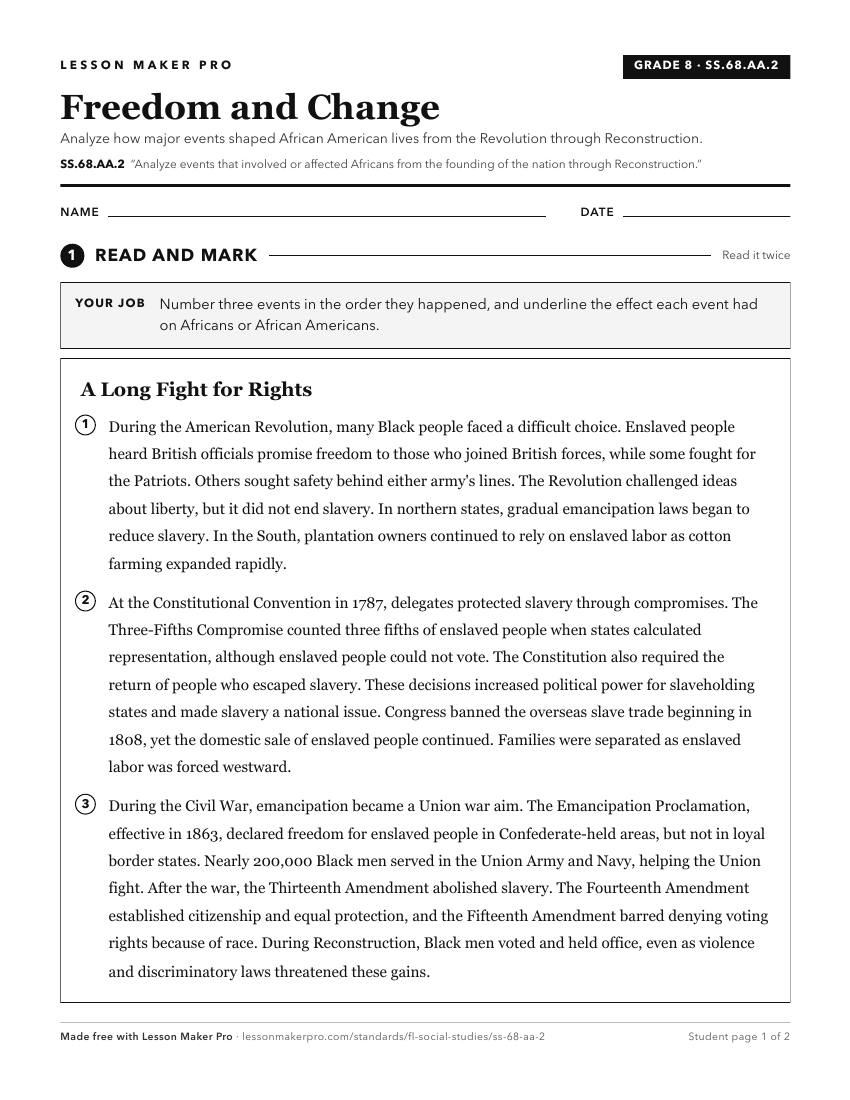
A ready-to-print activity worksheet aligned to SS.68.AA.2, with an answer key for the teacher on its own page. No account needed.
PDF, US Letter, prints cleanly in black and white.
Download the worksheetKeep exploring
Related Standards
- SS.5.AA.1.1
Examine the life of African Americans in the colonial era.
- SS.8.A.5.8
Explain and evaluate the policies, practices, and consequences of Reconstruction (i.e., presidential and congressional reconstruction, Johnson’s impeachment, Ci...
- SS.8.CG.2.6
Evaluate how amendments to the U.S. Constitution expanded opportunities for civic participation through Reconstruction.
- SS.8.A.5
Examine the causes, course, and consequences of the Civil War and Reconstruction including its effects on American peoples.
Turn this cluster into a lesson
Grade, subject, topic, and the complete cluster are prefilled. Create one free, no account needed.
Also for this cluster:Make a WorksheetMake a QuizMake a Sub Lesson