Florida SS.5.AA.1.1
The Standard
- SS.5.AA.1
- Resiliency, contributions, and influence of African Americans on the United States beginning in the colonial era through westward expansion.
Examine the life of African Americans in the colonial era.
Florida Next Generation Sunshine State Standards for Social Studies
Teacher's field guide
What This Standard Means
What Students Need to Do
- Students use maps, images, laws, and short accounts to describe how free and enslaved African Americans lived in different colonies. They compare work, family life, legal limits, resistance, and cultural contributions across regions.
What Mastery Looks Like
- A student can make a clear claim about colonial African American life and support it with details from two sources. They explain how experiences differed by region and legal status.
Common Misconceptions
- Students may assume all African Americans were enslaved or had the same experiences in every colony. They may overlook families, communities, resistance, skilled work, and cultural influence. They may confuse colonial slavery with later plantation slavery.
How to Assess It
- Exit ticket: Using one image and one law excerpt, explain two facts about African American life and one way legal status shaped daily life.
Lesson moves
Ways to Teach It
Give pairs replica source cards from New England, middle, and southern colonies to sort by work, law, family, resistance, and culture.
Write a claim answering, "How did region and legal status shape daily life?" Support it with two source details.
Play a matching game that pairs each source snippet with a region and free or enslaved status, then require one evidence-based explanation.
Examine a Fort Mose map and visitor page, then write a museum label explaining why the settlement mattered to freedom seekers.
Free download
Printable SS.5.AA.1.1 Worksheet
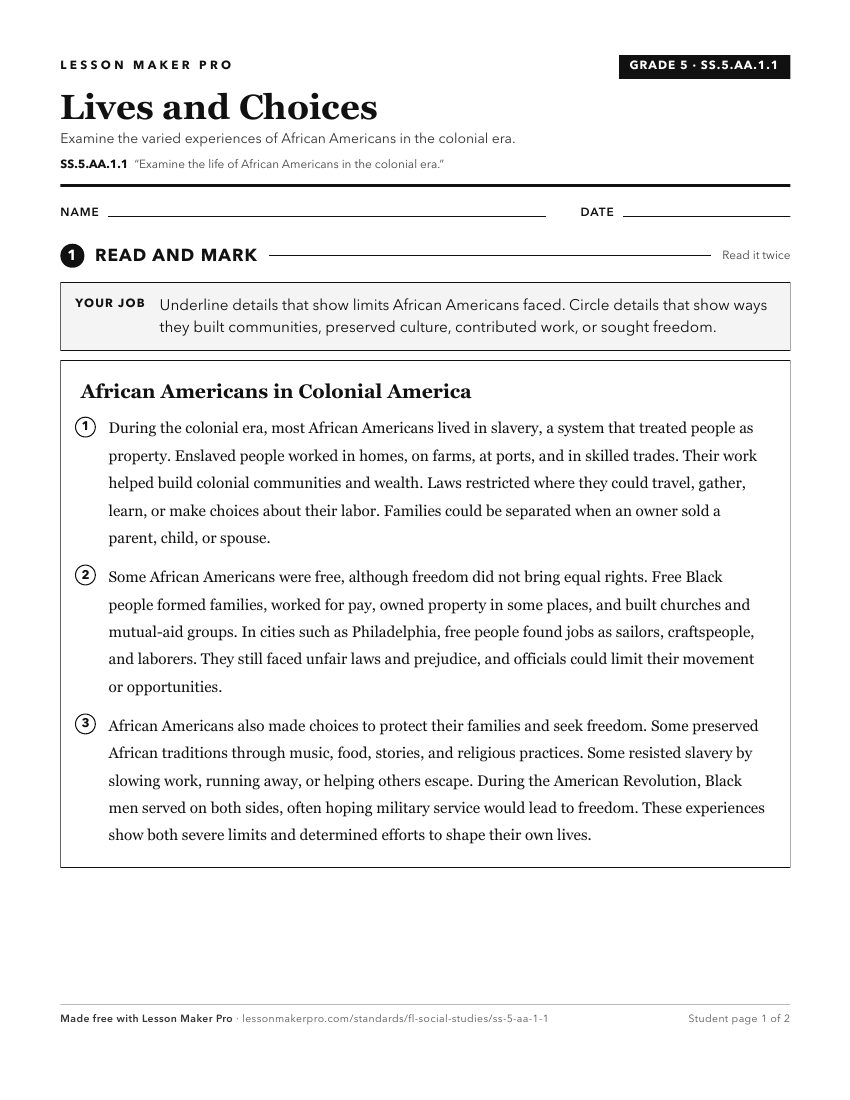
A ready-to-print activity worksheet aligned to SS.5.AA.1.1, with an answer key for the teacher on its own page. No account needed.
PDF, US Letter, prints cleanly in black and white.
Download the worksheetKeep exploring
Related Standards
- SS.2.A.2.4
Explore ways the daily life of people living in Colonial America changed over time.
- SS.5.AA.1.6
Examine the experiences and contributions of African Americans in early Florida.
- SS.68.AA.1.6
Examine the service and sacrifice of African patriots during the Revolutionary Era (e.g., Crispus Attucks, Peter Salem, James Armistead Lafayette, 1st Rhode Isl...
- SS.8.A.3.15
Examine this time period (1763-1815) from the perspective of historically under-represented groups (e.g., children, indentured servants, Native Americans, slave...
Turn this exact standard into a lesson
Grade, subject, topic, and the complete standard are prefilled. Create one free, no account needed.
Also for this standard:Make a WorksheetMake a QuizMake a Sub Lesson