Florida SS.4.FL.6
Florida Standard (Benchmark Cluster)
Protecting and Insuring
Florida Next Generation Sunshine State Standards for Social Studies
Cluster contents
Benchmarks in This Standard
SS.4.FL.6 is a Florida social studies standard. These are the benchmarks under it.
- SS.4.FL.6.1
Explain that risk is the chance of loss or harm.
- SS.4.FL.6.2
Explain that risk from accidents and unexpected events is an unavoidable part of daily life.
- SS.4.FL.6.3
Describe ways that individuals can either choose to accept risk or take steps to protect themselves by avoiding or reducing risk.
- SS.4.FL.6.4
Discuss that one method to cope with unexpected losses is to save for emergencies.
Teacher's field guide
What This Cluster Means
What Students Need to Do
- Students explain how insurance can reduce the financial cost of accidents, damage, illness, or loss. They identify what common types of insurance protect and why people pay for coverage.
What Mastery Looks Like
- Students match a risk, such as a car crash or house fire, with an appropriate type of insurance. They explain that insurance limits financial loss but does not prevent the event.
Common Misconceptions
- Students may think insurance prevents accidents or replaces every lost item at no cost. They may also confuse an insurance payment with money saved in a bank account.
How to Assess It
- Give students this prompt: “A storm damages a family’s roof. How could insurance help, and what would it not do?”
Lesson moves
Ways to Teach It
Give groups event cards and insurance cards, then have them match each risk with the coverage that could reduce the financial loss.
Ask students to write: “Why might a family pay for insurance even if they never make a claim?”
Play Risk Match, where teams earn points by pairing events such as theft, illness, or crashes with suitable insurance types.
Show a sample phone protection plan and compare its cost with the price of replacing a damaged phone.
Free download
Printable SS.4.FL.6 Worksheet
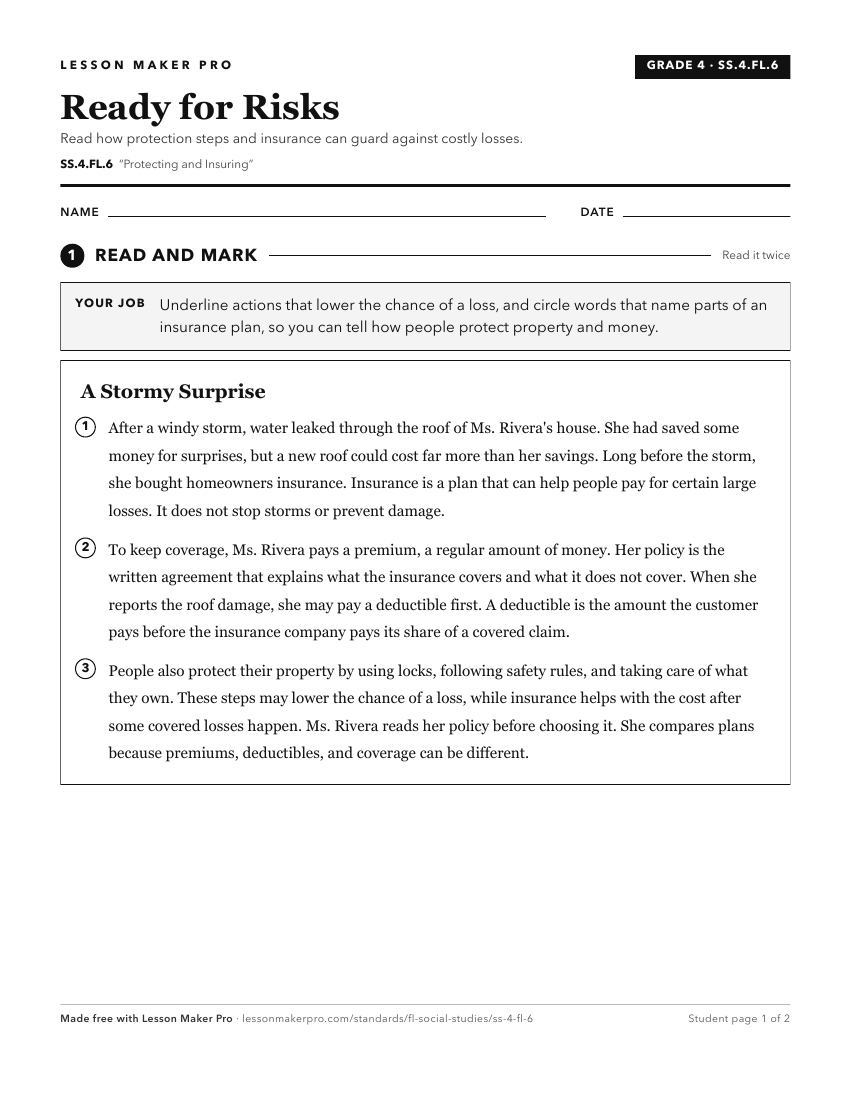
A ready-to-print activity worksheet aligned to SS.4.FL.6, with an answer key for the teacher on its own page. No account needed.
PDF, US Letter, prints cleanly in black and white.
Download the worksheetKeep exploring
Related Standards
- SS.8.FL.6.2
Identify insurance as a product that allows people to pay a fee (called a premium) now to transfer the costs of a potential loss to a third party.
- SS.8.FL.6.3
Describe how a person may self-insure by accepting a risk and saving money on a regular basis to cover a potential loss.
- SS.8.FL.6
Identify and analyze methods of protecting financial investments and personal information.
- SS.8.FL.6.4
Discuss why insurance policies that guarantee higher levels of payment in the event of a loss (coverage) have higher prices.
Turn this cluster into a lesson
Grade, subject, and topic are prefilled; the lesson picks the standards under this heading. Create one free, no account needed.
Also for this cluster:Make a WorksheetMake a QuizMake a Sub Lesson